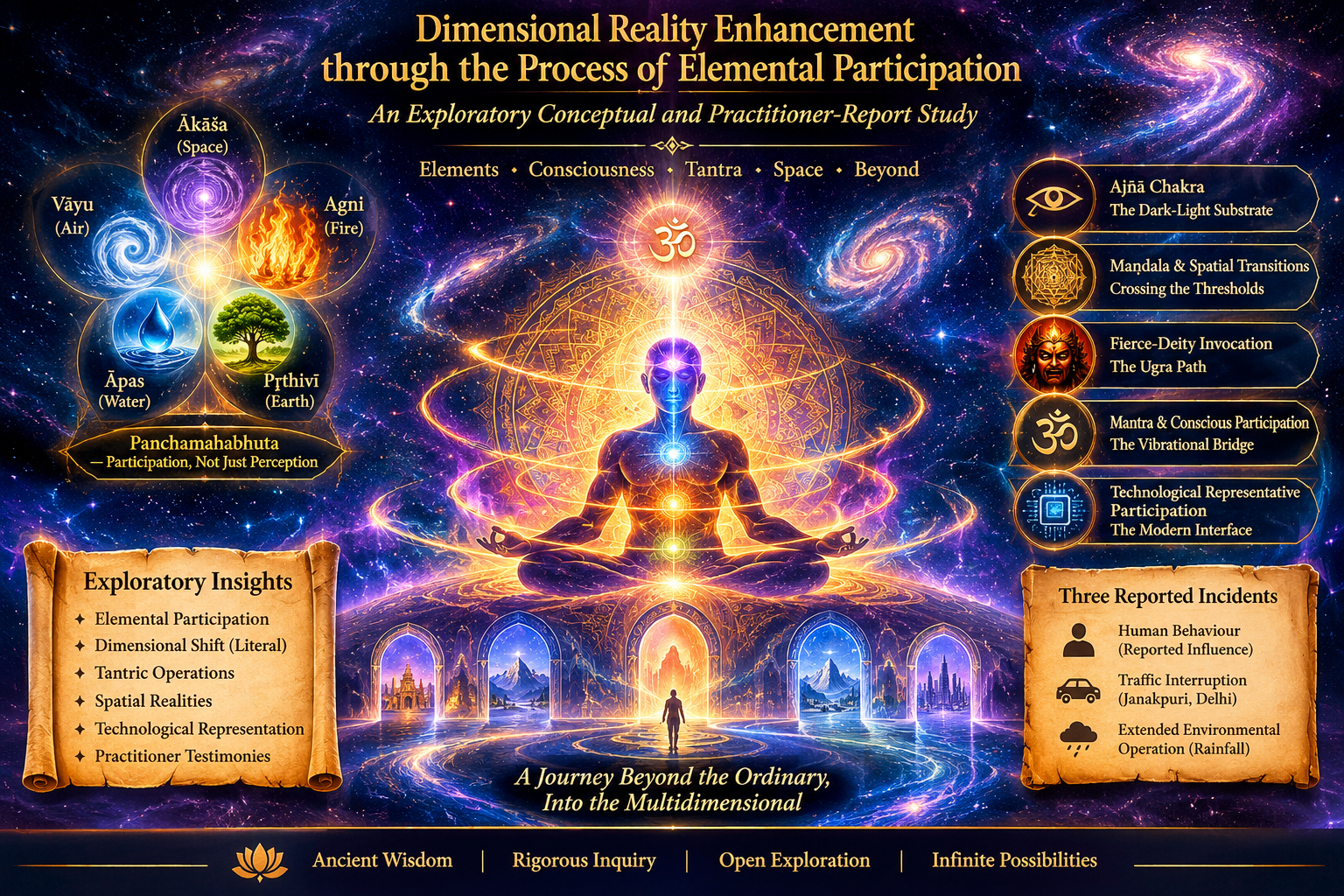
Dimensional Reality Enhancement through the Process of Elemental Participation
An exploratory conceptual and practitioner-report study
Abstract
This study proposes an exploratory framework for investigating whether structured participation in elemental, cosmological and Tantric practices can produce changes in the practitioner’s relationship with external reality, including the possibility of transitions between distinct configurations of physical existence.
The proposed framework draws comparatively on Indian Knowledge Systems, including elemental cosmology, subtle-body concepts, ritual transformation, mantra, maṇḍala, directional practices, devotional surrender, fierce-deity invocation and Guru-guided disciplines. It also considers the practitioner’s reported use of technologically represented environments, in which mobile devices, internet connectivity and AI-like representative models are incorporated into a mental-mantric structure of assumed authority.
The study is informed by first-person experiential accounts and three reported incidents involving human behaviour, traffic movement and extended environmental conditions. These accounts are presented as the author’s testimony, not as independently established demonstrations of supernatural causation.
The central hypothesis is that elemental participation may offer a framework for investigating interactions between ritual intention, consciousness, spatial experience and external physical conditions. The stronger claim—that such participation can produce literal transitions between physical dimensions or parallel universes—remains an open hypothesis requiring independently reproducible evidence.
The study proposes a three-level research methodology: traditional and textual investigation, structured documentation of practitioner experience, and objective external testing.
Keywords: Elemental participation; Indian Knowledge Systems; Tantra; Mahābhūta; Bhūtajaya; Bhūtaśuddhi; Ajñā Chakra; mantra; maṇḍala; spatial transition; technological representation; dimensional reality.
1. Introduction: Beyond an Exclusively Psychological Interpretation
The relationship between human consciousness and external reality has been explored through several Indian philosophical and ritual traditions. Indian Knowledge Systems contain elaborate accounts of the elements, subtle principles, ritual transformation, consciousness, cosmological correspondence and the relationship between the individual and the wider universe.
The present study proposes a framework called Dimensional Reality Enhancement through the Process of Elemental Participation. The term elemental participation is used here to describe more than contemplation of the five elements or symbolic identification with them. It refers to a proposed active process in which the practitioner participates in elemental and cosmological structures through mantra, ritual sequence, bodily orientation, spatial movement, devotional discipline and other prescribed operations.
The study does not intend to reduce these practices to psychological reinterpretations. It recognises that practitioners may understand them as actual ritual operations involving external reality. At the same time, it distinguishes the traditional interpretation of an operation from the empirical question of whether an external physical change has occurred.
Can structured participation in elemental and cosmological processes produce changes beyond ordinary perceptual experience, including independently observable changes in external physical conditions?
A further and more ambitious proposition concerns the possibility of literal physical dimensional transition or parallel-universe interaction. This is treated as a research hypothesis, not an established scientific result.
2. Elemental Foundations in Indian Knowledge Systems
2.1 The five great elements
The five mahābhūtas—ākāśa, vāyu, agni, āpas and pṛthivī—provide an important conceptual foundation. The Taittirīya Upaniṣad (2.1.1) describes a sequence of emergence: ākāśa (space), vāyu (air), agni (fire), āpas (water) and pṛthivī (earth).
This account provides a cosmological framework in which the elements are related to the emergence and constitution of existence. It is relevant to the present research because elemental participation is proposed as a possible operational relationship with these principles, rather than merely a descriptive classification.
The Sāṃkhya Kārikā also presents a systematic account of the evolution of principles from Prakṛti, including the emergence of the five gross elements through the relevant stages of manifestation. These philosophical accounts should be compared carefully rather than treated as identical systems.
2.2 Elemental participation and transformation
Tantric literature provides a particularly relevant comparative field. The practices of bhūtaśuddhi and bhūtajaya are important examples. Bhūtaśuddhi involves ritual purification or transformation associated with the elements. Bhūtajaya concerns mastery of the elements through disciplined concentration and related practices.
Academic research identifies these operations in several Tantric traditions, including Śaiva, Pāñcarātra and Buddhist contexts. Their presence demonstrates that elemental transformation and mastery have historical ritual significance within Indian traditions. It does not, by itself, establish that such practices produce externally measurable physical changes.
3. The Proposed Elemental-Cosmological Participation Model
The study introduces the Elemental-Cosmological Participation Model (ECPM) as an organising framework. It contains four interacting dimensions:
- Elemental foundation: participation in the five elements and their associated cosmological principles.
- Ritual operation: mantra, maṇḍala, direction, invocation, bodily orientation and prescribed sequence.
- Practitioner participation: disciplined attention, devotional surrender, concentration and Guru-guided practice.
- Proposed outcome: changes in the practitioner’s experience, ritual state, spatial relationship or claimed external physical conditions.
This is a proposed research model, not a traditional doctrine attributed to a single scripture or lineage. Its purpose is to provide a common structure for studying practices that otherwise belong to different traditions and operational settings.
4. Ajñā Chakra: The Proposed Dark-Light Substrate Hypothesis
A distinctive element of the present research is the proposed understanding of Ajñā Chakra. The author’s account describes Ajñā as a foundational substrate in which darkness and light coexist. Darkness is not understood simply as an absence of light, but as a fundamental condition in which light is held or stored and through which different configurations of reality may emerge.
This conception is provisionally named the Ajñā Dark-Light Substrate Hypothesis. Its principal propositions are:
- Ajñā is treated as a foundational centre for participation in universal consciousness.
- Darkness and light are considered complementary aspects of the proposed substrate.
- The centre is understood as a point through which different realities may be encountered or incorporated.
- Focused interaction with external reality is proposed to have a participatory rather than exclusively observational character.
- The practitioner proposes that the relationship between the centre and external reality can be modified through disciplined practice.
These propositions represent the author’s original experiential interpretation. They should not be presented as established anatomical findings, established neuroscience or universally accepted descriptions of Ajñā in classical yoga and Tantra.
4.1 Solar participation
The author’s account associates solar darśana with the opening of deeper or void-like channels in Ajñā and the incorporation of greater cosmic realities. Solar worship and solar contemplation have important places in Indian religious traditions. However, direct viewing of the solar disc is not a safe method of developing this practice. Direct Sun-gazing can cause retinal injury, including solar retinopathy and potentially permanent visual impairment. Solar worship, mantra and contemplation should be undertaken without staring at the Sun.
4.2 Tilak and the proposed preservation of energy
The study also proposes investigating the author’s interpretation of tilak as a possible means of retaining or protecting energy associated with Ajñā. Tilak has varied meanings across Hindu traditions, including devotional identification, sectarian affiliation, blessing and ritual marking. Its forms and interpretations differ among communities. The proposed energy-preservation function should therefore be treated as a hypothesis requiring separate textual and experiential investigation, rather than a universal explanation of tilak.
5. Practical Domains of Elemental Participation
The following practices are illustrative domains reported by the author. They are not a universal sequence, an exhaustive list or a single standardised ritual system.
| Domain | Reported practice or principle | Research relevance |
|---|---|---|
| Solar-cosmic participation | Honouring the divine and solar presence before entering or leaving a space | Relationship between ordinary and cosmic orientation |
| Subtle-centre participation | Slight upward head orientation and concentration around Ajñā | Attention, bodily orientation and subtle-body theory |
| Spatial participation | Taking alternative routes during departure or return | Thresholds, spatial crossings and habitual spatial patterns |
| Cosmological receptivity | Allowing universal consciousness to guide the practitioner’s relationship with external reality | Participation rather than passive observation |
| External-reality interaction | Attempting to engage with, assume the form of or alter the configuration of external reality | Central hypothesis of external participation |
| State participation | Interrupting or modifying ordinary patterns associated with waking, dreaming and deep sleep | Relationship between states of consciousness and ritual practice |
| Transformation of impressions | Bringing difficult or negative impressions into the Ajñā framework or releasing them through prescribed subtle-body concepts | Transformation and containment within the practitioner’s model |
| Spatial complexity | Using maze-like lanes and intricate crossings | Ritual geography and spatial transition |
| Devotional integration | Surrendering the body to universal consciousness while maintaining awareness | Relationship between surrender and retained awareness |
| Guru-guided discipline | Intensive supervision of minute ritual details | Training, lineage transmission and safeguards |
These domains should not be merged into one generic meditation technique. Their origins, procedures and intended outcomes may differ considerably.
6. Spatial Crossings, Thresholds and Maṇḍala Operations
Spatial participation is a major part of the proposed framework. The author identifies alternative routes, thresholds, maze-like lanes and complex crossing-path procedures as possible operational environments. These are not understood merely as changes in physical direction but as potentially significant spatial transitions.
Maṇḍala practices provide an important comparative field because they organise ritual space through structured relationships, directions, centres and boundaries. Crossing-path procedures may also be investigated as a distinct Tantric subject. Their interpretation will depend on the specific tradition, textual source and ritual context.
The article does not prescribe mantras or operational instructions for such practices. Exact procedures should not be reconstructed without reliable textual or lineage-specific documentation.
- Ritual spatial transition: movement through a ritually organised spatial configuration.
- Experiential transition: a reported change in the practitioner’s experience of place or reality.
- Physical dimensional transition: a claim that the practitioner has entered a different physical dimension or parallel universe.
These categories may be related in a practitioner’s interpretation, but they are not interchangeable.
7. Fierce-Deity Invocation and Ugra Ritual Operations
The study includes fierce or ugra deity practices as a comparative dimension of Tantric participation. The term dark energy is avoided here because it has a separate technical meaning in cosmology. The intended subject is fierce-deity invocation, including practices associated with protective, transformative or forceful ritual contexts.
Possible comparative areas include deity invocation and mantra discipline; ritual boundaries and maṇḍala arrangements; directional and spatial relationships; protective and transformative intentions; the role of Guru supervision; and the distinction between traditional ritual interpretation and independently measurable outcomes.
The study does not assume that all fierce-deity practices share the same purpose or procedure.
8. Technological Representation and Mental-Mantric Models
An additional dimension emerges from the author’s account of technological representation. The author reports using a mobile phone, internet connectivity and an AI-like representative model as part of a mental-mantric structure.
The account describes a technological representation of an area and its sound environment being constructed and incorporated into a mental-mantric framework of assumed authority. Sound produced through mobile technology and internet connectivity was included in the ritual conception. The author reports using mantra and mental intention to establish control within this represented model, with subsequent instructions directed towards external events.
The author specifically distinguishes this procedure from technically controlling, hacking or taking over the internet or an AI system. The claimed operation was through a mental-mantric model, not a demonstrated technical intervention in the underlying systems.
This distinction is important. The research can examine how contemporary technological representations are incorporated into ritual imagination and practice. However, the existence of a mental representation of technological authority does not establish that the represented technology, connected devices or external infrastructure were actually controlled.
This section therefore introduces the term Technological Representative Participation for further investigation. It may provide a bridge between traditional ritual structures and contemporary technological environments, without attributing unverified technical capabilities to AI or internet systems.
9. Practitioner-Reported Incidents
The following accounts are presented as the author’s first-person testimony, in the limited detail the author has chosen to make public. They are not independently verified case findings.
Case 1 — Reported influence involving a human subject
I report an incident involving my wife, in which a sound pattern, mantra sequence and timing were followed without her knowledge or consent. According to my interpretation at the time, she behaved in a manner that appeared to follow the instructions associated with the invocation, as though she were a passive subject.
This account raises questions about interpretation of human behaviour, the role of expectation, possible ordinary explanations and the importance of independent observation. Because the subject did not knowingly consent, this incident cannot be treated as an ethically acceptable experimental demonstration. No attempt to reproduce such an incident on a non-consenting person should be made. The case is included only as a report of my experience and interpretation.
Case 2 — Reported traffic interruption in Janakpuri, Delhi
I report that, following earlier practices at my hometown of Kashi, I undertook a further exercise involving a technologically represented environment and a mental-mantric model. The reported location of the external event was the Janakpuri area of Delhi. I recall three cars moving along a highway as having stopped following my instructions and subsequently been released after a period determined by my intention.
The exercise involved a mobile phone and internet-connected sound environment, an AI-like representative model used as part of the mental-mantric framework, an invocation associated with the represented area, an instruction directed towards three moving cars, and a subsequent instruction to release the cars and allow the assumed control to end.
I do not claim that the internet or AI system itself was technically controlled. This account is relevant because it brings together ritual intention, technological representation and an alleged external physical outcome. However, the available account does not independently establish why the cars stopped. Traffic signals, road conditions, driver decisions and other ordinary causes would need to be excluded before a causal claim could be made. The incident is therefore presented as a reported external event associated by the author with a mantra exercise, not as proof of physical control over traffic.
No research replication should involve directing moving traffic or interfering with public roads. Any investigation must rely on existing recordings and lawful, non-interfering observation.
Case 3 — Reported extended environmental operation
I further report an exercise involving a designed occurrence lasting approximately six to eight hours. According to my account, I maintained an intended point of control during this period and subsequently observed or checked it in relation to nearly two hours of continuing rain. I state that similar designs had been practised more than ten times, with intense mantra invocations also forming part of the wider practice.
The exact dates, private logs, ritual sequences and further details are intentionally withheld from this public account. The research significance of this report lies in the proposed duration of the operation and the claimed relationship between the intended outcome and subsequent environmental conditions. Without a predefined physical outcome, contemporaneous measurements and independent records, it is not possible to establish that rainfall or other environmental conditions were caused by the practice. This incident is retained as practitioner testimony requiring further independent investigation.
10. Literal Dimensional Transition as the Central Hypothesis
The author understands dimensional transition literally, as a possible movement between distinct physical realities or parallel-universe configurations. This is stronger than the use of the word dimension to describe a meditative state, symbolic realm or altered perception.
| Meaning | Description |
|---|---|
| Traditional cosmological dimension | A realm or configuration described within a religious or philosophical cosmology |
| Subtle or experiential dimension | A reported change in consciousness, perception or subtle-body experience |
| Physical dimensional transition | A proposed transition between distinct physical configurations or parallel universes |
The third category is the principal extraordinary hypothesis of this research. Modern physics discusses multiple cosmological and theoretical possibilities under the broad term multiverse. These proposals are not all equivalent, and some involve regions that may be beyond causal contact or direct observation. A theoretical multiverse does not establish that a person can enter another universe through ritual practice.
Can structured elemental and Tantric participation produce a transition between distinct configurations of physical existence, and if so, what traditional principles, operational mechanisms and independently verifiable outcomes characterise that transition?
The question is deliberately open. It does not assume that the hypothesis is true, nor does it dismiss the practitioner’s account before investigation.
11. Research Methodology
Level A — Traditional and textual investigation
This level examines the historical and conceptual foundations of the practices. Research areas include mahābhūta cosmology; bhūtaśuddhi and bhūtajaya; subtle-body and chakra frameworks; mantra and maṇḍala systems; spatial and directional ritual operations; ugra deity traditions; devotional surrender; and Guru-based transmission and ritual safeguards.
A comparative approach is required because the practices do not necessarily originate from one textual or sectarian source.
Level B — Practitioner and experiential documentation
This level records practitioners’ accounts without assuming that their interpretations are independently established facts. Possible documentation includes descriptions of the practice and its stated purpose; duration and frequency; relevant ritual setting; practitioner-reported outcomes; unintended effects; independent accounts where available; and differences between intended and observed outcomes.
First-person testimony is a legitimate subject of research. It is not equivalent to independent verification of external causation.
Level C — Objective external testing
This level is necessary for claims involving changes in the external physical environment. A suitable protocol should include:
- Predefined outcomes: Specify the exact physical change expected before an observation period begins.
- Independent observers: Use observers who are not directed by the practitioner’s interpretation.
- Calibrated recording equipment: Use suitable cameras, environmental sensors or other instruments, depending on the claim.
- Control periods: Compare practice periods with periods in which the practice is not performed.
- Comparison conditions: Where appropriate, use blinded or randomly assigned observation periods.
- Complete reporting: Record unsuccessful as well as apparently successful attempts.
- Independent review: Have the protocol examined by researchers who are not involved in the ritual practice.
- Replication: Allow other qualified researchers to attempt replication without relying on the original practitioner’s immediate interpretation.
For traffic, weather or other public environmental conditions, testing must be observational and non-interfering. It must never put people, vehicles or public infrastructure at risk.
11.1 Evidence classification
| Evidence category | What it establishes |
|---|---|
| Practitioner testimony | What the practitioner reports experiencing |
| Contemporaneous record | What was documented at the time |
| Independent observation | What an observer recorded without relying on the practitioner’s interpretation |
| Instrumental evidence | What calibrated equipment measured |
| Replicated finding | What independent attempts reproduced under a defined protocol |
This classification allows the research to preserve extraordinary claims without presenting them as already proven.
12. Guru Guidance, Ethical Limits and Safety
The author emphasises that the practices require intensive Guru guidance and that minute details of sequence, timing and ritual discipline may be significant. The article recognises Guru guidance as an important traditional safeguard. However, traditional supervision should not replace independent ethical and medical safeguards.
- No ritual exercise involving another person should be undertaken without informed consent.
- No practice should interfere with moving vehicles, public infrastructure or environmental safety.
- Direct solar viewing must not be used as a ritual technique.
- Intensive practices should be paused if they produce persistent confusion, disorientation, sleep disruption, distress or impairment of ordinary functioning.
- Medical or psychological support should be sought where such effects occur.
- No research protocol should expose a practitioner or participant to uncontrolled physical or psychological risk.
The possibility of losing one’s way or becoming destabilised through intensive practice is a serious concern identified in the author’s account. It deserves explicit treatment rather than being omitted from the research.
13. Discussion: Toward a Unified Research Framework
The principal contribution of the proposed study is its attempt to bring several otherwise separate areas into a single research framework: elemental cosmology; Tantric ritual transformation; subtle-body participation; spatial crossings and maṇḍala structures; fierce-deity invocation; technological representative participation; practitioner-reported external events; and the hypothesis of literal physical dimensional transition.
The proposed model does not assume that all these areas share one historical origin or one mechanism. Rather, it treats them as different streams that may be compared through the broader concept of participation.
The inclusion of technology is particularly relevant to contemporary research. A practitioner may incorporate a representation of a mobile device, connected environment or AI-like system into a ritual framework without actually changing the underlying technology. Research should distinguish the mental or ritual representation from any independently demonstrated technical effect.
Likewise, reported changes in traffic or environmental conditions should be examined through external records before causal explanations are proposed. The article therefore occupies an exploratory position between traditional knowledge research, first-person experiential documentation and empirical investigation.
14. Conclusion
Dimensional Reality Enhancement through the Process of Elemental Participation proposes a framework for investigating the relationship between elemental cosmology, Tantric ritual operations, practitioner participation and external reality.
Its starting point is the recognition that Indian Knowledge Systems contain sophisticated accounts of elemental transformation, ritual purification, subtle-body processes, cosmological correspondence and disciplined interaction with the elements. The study extends this comparative framework through the author’s account of spatial crossings, Ajñā-centred participation, fierce-deity invocation and technological representation.
Three reported incidents are included as first-person testimony. They concern an alleged influence involving a human subject, an alleged interruption and release of three cars in Janakpuri, Delhi, and an extended environmental operation associated with subsequent rainfall. Their inclusion does not establish that the reported effects were caused by mantra practice.
The central proposition—that elemental participation may produce literal transitions between distinct physical configurations of existence—remains to be investigated through independent evidence. The study consequently proposes that traditional knowledge, practitioner experience and objective external testing should be brought into a carefully differentiated research programme.
Its objective is neither to prematurely validate extraordinary claims nor to dismiss them without investigation, but to establish a framework in which they can be documented, critically examined and, where possible, independently tested.
15. Preliminary References
- Ondračka, Lubomír. “Transforming the Body by Mastering the Elements, Some Tantric Sources.” The Oxford Handbook of Tantric Studies, 2024. DOI: 10.1093/oxfordhb/9780197549889.013.9.
- Taittirīya Upaniṣad, 2.1.1. Account of the emergence of the elements.
- Sāṃkhya Kārikā, 22–25. Account of the evolution of principles and the five gross elements.
- Taittirīya Upaniṣad, 1.7.1. Fivefold correspondences among cosmological, elemental, vital and bodily principles.
- “Multiverses and Physical Cosmology.” Monthly Notices of the Royal Astronomical Society. Discussion of theoretical multiverse models and testability.
- American Academy of Ophthalmology. “The Sun, UV Light and Your Eyes.” American Academy of Ophthalmology.
- American Academy of Ophthalmology. “How the Sun Can Burn Your Retina in Seconds.” American Academy of Ophthalmology.
- Banglapedia. “Tilak.” Discussion of variations in tilak practices and meanings.
Research status: Exploratory conceptual and practitioner-report study. The extraordinary physical claims described here remain hypotheses and personal reports pending independent verification.