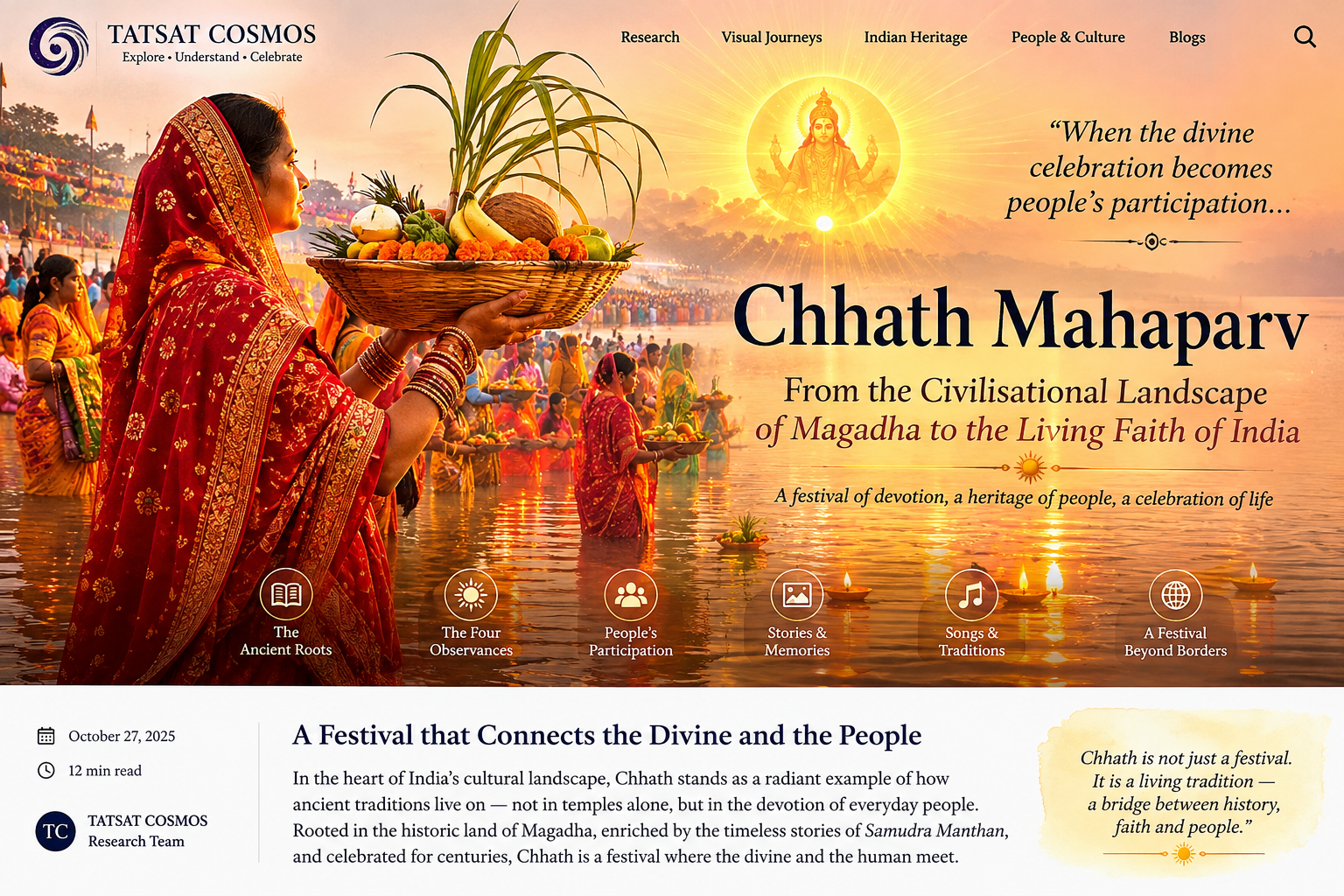
Chhath Mahaparv: The Living Sanctity of a Festival of the Gods
A first-phase research inquiry into the sacred experience of Chhath, the civilisational landscape of Magadha, the cosmological memory of Samudra Manthan, and the extraordinary participation of people across generations.
There are festivals that people remember, festivals that people inherit, and festivals that people themselves keep alive. Chhath Mahaparv belongs to the deepest category of living traditions. Its sanctity is not encountered only in a written account, a temple, or a description of an ancient ritual. It is experienced every year—in the discipline of the vrat, the purity with which offerings are prepared, the prayers offered to the setting and rising Sun, the reverence for Chhathi Maiya, the relationship with water, and the extraordinary collective effort of families and communities.
For the devotee, this living sanctity is itself a testimony to Chhath as a festival of God. Its sacred character is not an abstract proposition. It is renewed through faith, restraint, gratitude, service and participation. Historical research can investigate when particular practices were recorded and how they travelled; it cannot reduce the meaning of a living act of devotion to the limits of a surviving document.
1. The land of Magadha: a historical and civilisational setting
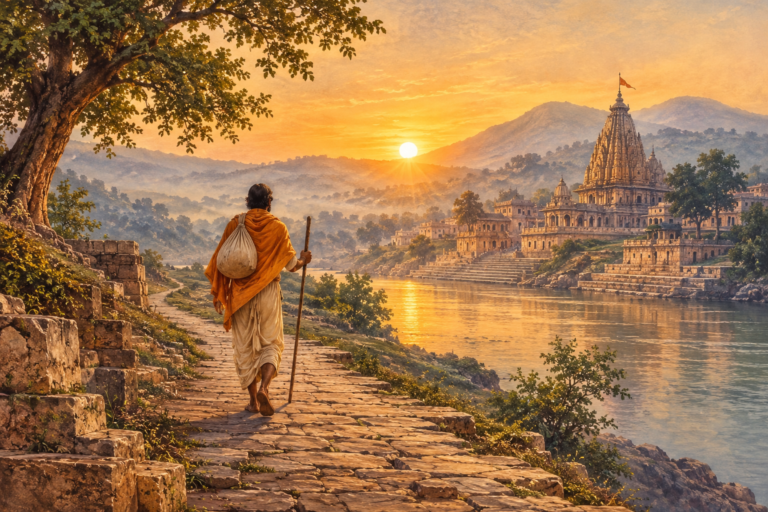
Any serious inquiry into Chhath must pay attention to the historical geography of Bihar and the middle Gangetic plains. The region associated with the rise of Magadha became one of the decisive centres of early Indian political and cultural history. Magadha emerged among the sixteen Mahajanapadas and grew in power from around the sixth century BCE. Its expansion accelerated under the Nandas and Mauryas. Fertile alluvial land, access to iron resources, forests, river routes, agricultural production and the growth of towns all contributed to its rise.
This history matters because it locates Chhath within a region that has carried long and layered traditions of settlement, agriculture, river life, religious practice and cultural exchange. Magadha’s political expansion is documented in historical scholarship. The precise date at which Chhath took the form known today, however, and the exact route by which it spread, cannot at present be established with the same certainty. We should therefore speak of a strong regional and civilisational association, not claim that the Mauryan or Magadhan state itself created or formally spread the festival.
Over centuries, families moved for work, trade, education, service and livelihood. They carried their languages, food, songs, vows and festivals with them. The spread of Chhath among Bihari communities across India and the world can be understood in this living history of migration and cultural continuity. The festival travelled not simply because an institution instructed people to observe it, but because households continued to practise it and brought others into its shared world.
Historical reference: The Indira Gandhi National Open University’s study of the rise of Magadha describes its emergence in the sixth century BCE and the later expansion under the Nandas and Mauryas. Read the IGNOU unit, “Rise of Magadha”.
2. The sacred dimension: more than the worship of the Sun
Chhath is widely recognised as a major observance connected with Surya, the visible source of light, energy and life. Yet to describe it only as Sun worship would leave out much of the experience through which devotees understand the festival. Chhathi Maiya is invoked with deep reverence; water is not merely a convenient location for the ritual but an essential part of its sacred setting; the offerings arise from the agricultural and seasonal world; and the vrat joins personal discipline with the well-being of family and community.
The setting Sun receives arghya, and so does the rising Sun. This is a striking feature of Chhath. The devotee acknowledges not only the radiance of the day but also the moment of setting, transition and return. The ritual brings together gratitude, humility, continuity and hope. The riverbank or pond becomes a shared place of prayer, while the household becomes a place of preparation, restraint and care.
In this sense, Chhath is not a festival in which nature is simply used as a backdrop for worship. Sun, water, earth, seasonal produce and human life are brought into one sacred relationship. Its material details—the bamboo soop and daura, fruits, sugarcane, thekua, earthen lamps, clean water and carefully prepared prasad—are not incidental decorations. They are part of the way devotion becomes tangible.
For a devotee, the sanctity of Chhath is self-evident through the lived experience of the vrat and the grace sought through it. A research article should respect that conviction. At the same time, it should distinguish religious understanding from what historical methods can independently demonstrate. Respecting faith does not require inventing a date or a single origin story; careful research can honour the sacred without overstating the evidence.
3. Samudra Manthan and the larger cosmological imagination of Kartik
A civilisational reading of Chhath invites us to look beyond an isolated festival and consider the larger sacred imagination of the month of Kartik. The Samudra Manthan—the churning of the cosmic ocean by the Devas and Asuras—is one of the great Puranic narratives of emergence, struggle, transformation and the appearance of divine treasures. It speaks to a cosmos in which the forces of existence are brought into relationship and the order of life is renewed.
We propose Samudra Manthan here as a cosmological lens through which to reflect on Kartik’s sacred season, not as a historically proven origin of Chhath. The Puranic story contains its own textual and regional variations, and the relationship between that narrative and the calendar of individual festivals requires further textual study. This distinction is important: a meaningful civilisational interpretation should be made stronger, not weaker, by being honest about what is established and what remains an avenue for research.
Within Kartik, Deepawali, Chhath and Kartik Purnima create a remarkable sequence of public and household observances. Chhath falls on the sixth day of the bright fortnight in the Kartik observance described in the regional tradition. On Kartik Purnima, Kashi’s Dev Deepawali gives a particularly vivid public expression to the belief that the gods celebrate on the ghats of the Ganga. The Kartik Purnima tradition is also associated with Shiva’s victory over Tripurasura, remembered as Tripurari Purnima.
Chhath and Dev Deepawali are not the same festival and should not be collapsed into one origin story. Yet they offer a compelling comparison. In Chhath, the sacred observance is carried outward through households and communities wherever people settle. In Kashi, Dev Deepawali has become especially identified with the illuminated ghats and the sacred geography of the city. In both, a divine or cosmological memory is made visible through human participation: people prepare, gather, serve, sing, offer, illuminate and celebrate.
Perhaps this is one of the great strengths of India’s living traditions: a celebration remembered in the language of the gods does not remain distant from human life. It enters the household, the neighbourhood, the riverbank and the city. Sacred memory becomes shared practice.
4. Four observances: a journey of discipline and devotion
The four principal observances of Chhath form a connected sequence. Local customs and family practices vary, but the following structure is widely recognised:
- Nahay-Khay: The observance begins with purification, bathing and the preparation of a simple, carefully prepared meal. The home and the materials of worship are readied.
- Kharna (also called Lohanda-Kharna): A day of fasting culminates in the evening offering and prasad, commonly including preparations such as kheer. The vrat then enters its more demanding phase.
- Sandhya Arghya: Devotees gather at rivers, ponds and other water bodies to offer arghya to the setting Sun. The gathering, songs, baskets of offerings and shared arrangements make the community dimension especially visible.
- Usha Arghya and Parana: Before or at sunrise, devotees offer arghya to the rising Sun. The fast is then concluded according to the family and regional observance, and prasad is shared.
This sequence is not merely a timetable of ceremonies. It is a progression from preparation to restraint, from collective offering at sunset to the hope and renewal associated with sunrise. The official Bihar Tourism description records this four-day structure and the gathering of devotees at water bodies. See Bihar Tourism’s account of Chhath Puja.
5. The people are not spectators: they are the keepers of the sacred tradition
One of the most remarkable features of Chhath is the scale and intimacy of participation. Women who undertake the vrat carry an extraordinary responsibility of discipline and continuity. Their work is supported by families, children, relatives, neighbours, artisans, farmers, vendors, local volunteers and people who prepare and maintain the ghats. Bamboo workers make the baskets; cultivators and traders bring seasonal produce; households prepare prasad; communities organise access to water and help one another through the observance.
The festival therefore cannot be understood only by looking at the person standing in the water and offering arghya. It must also be understood through everyone whose contribution makes that moment possible. Some participate through the vrat, some through preparation, some through service, some through song, and some by returning home from distant places to be with their families. Participation is distributed across generations and across forms of work.
This is also why Chhath has travelled so widely. A family that moves from Bihar to another Indian state or another country can recreate the observance around a local river, lake, pond or suitable water body, adapting to its circumstances while retaining the core of its devotion. The festival’s geographical reach is thus inseparable from the movement and memory of people. It is a living cultural inheritance, not simply a regional label.
6. Sanctity, ecology and the responsibility to care
Because Chhath brings large numbers of people to water, it also makes the condition of rivers, ponds and neighbourhood water bodies a matter of shared responsibility. Cleanliness is not an optional decoration around the festival. It is closely connected with the preparation of the sacred setting. The observance can therefore invite a wider public ethic: keeping water bodies clean, reducing avoidable waste, supporting safe access, respecting local ecosystems and ensuring that public arrangements protect the dignity and safety of devotees.
This ecological dimension should not be romanticised. A large gathering can place real pressure on water bodies and public infrastructure. The answer is not to question the devotion of people, but to strengthen collective care, municipal planning, responsible material use and community stewardship. The sanctity people experience should encourage us to care for the places in which that sanctity is expressed.
7. A research invitation: let families speak in their own voices
This first article is the beginning of a larger inquiry, not the final word on the history of Chhath. We want to bring together historical research and the living archive of families. Written records can help us understand political settings, textual traditions and the changing public recognition of a festival. Family accounts can show how the observance is actually lived: what is prepared, who teaches the songs, how the vrat is understood, what changes after migration, and what each generation chooses to preserve.
We invite families from Bihar and from every place where Chhath is celebrated to contribute stories, photographs, short videos, songs, memories and reflections. We are particularly interested in the experiences of women who undertake or support the vrat, the work of artisans and farmers, the ways children learn the tradition, and the different forms Chhath takes in different regions and countries.
Contributions will be handled with care. A memory will be identified as a family memory; a historical claim will be checked separately. No photograph, recording or personal account will be published merely because it has been submitted. Attribution and publication permission will be sought clearly, and contributors may ask for anonymity or withdrawal in accordance with the archive’s editorial process.
Share your family’s Chhath story through the Chhath: The People’s Living Archive. You can begin with a few lines about your family, your region and what Chhath means to you. We will follow up about photographs, audio or video material where needed.
Conclusion: a living festival of the divine and the people
Chhath stands at a meeting point of devotion, nature, family, memory and collective effort. Its association with the historical landscape of Magadha gives us an important regional setting. Its sacred understanding of Surya, Chhathi Maiya and water gives it a religious depth that cannot be reduced to a single label. The Kartik season and the wider cosmological imagination of Samudra Manthan invite further reflection on how divine narratives become shared celebrations. Its four observances reveal a disciplined journey carried by households and communities.
For the believer, the sanctity of Chhath is living proof of its divine character. For the historian, it is a living tradition whose documentary trail, regional variations and cultural transmission deserve careful study. For the community, it is an inheritance that survives because people continue to practise it, support it and pass it on.
Perhaps the most important truth is this: the people do not merely attend Chhath. Through their faith, labour, care and participation, they keep its sacred world alive.
Research notes and selected references
This is a first-phase interpretive research article. It distinguishes documented historical context from religious tradition and from the interpretive framework proposed here. The precise historical formation of Chhath, the chronology of its present ritual form, and the routes of its spread remain subjects for further research.
- Indira Gandhi National Open University, “Rise of Magadha” — historical context for Magadha’s emergence and expansion.
- Bihar Tourism, “Chhath Puja” — overview of the four-day observance and its public practices.
- Incredible India, “Chhath Puja” — national tourism account of the festival’s ritual sequence and regional presence.
- Ministry of Tourism, Utsav portal, “Chhath Puja” — government event description and four observances.
- Susmita Basu Majumdar, “Magadha, Kingdom of” — scholarly overview of the early historic context.
TATSAT COSMOS | Research, Culture and Living Heritage




This article on Chhath Puja is truly appreciable. You have beautifully presented not just the festival, but also its diverse dimensions, history, traditions, and deeper cultural significance. The way you have brought these aspects together makes the article thoughtful, enriching, and truly worth reading.
Om Tatsat 🙌🙌
🙏om tatsat