Truth, Ethical Reality and the Dimensions of Existence
A Tatsat Cosmos Inquiry into Collective Belief, Consciousness, Parallel Realities and Time
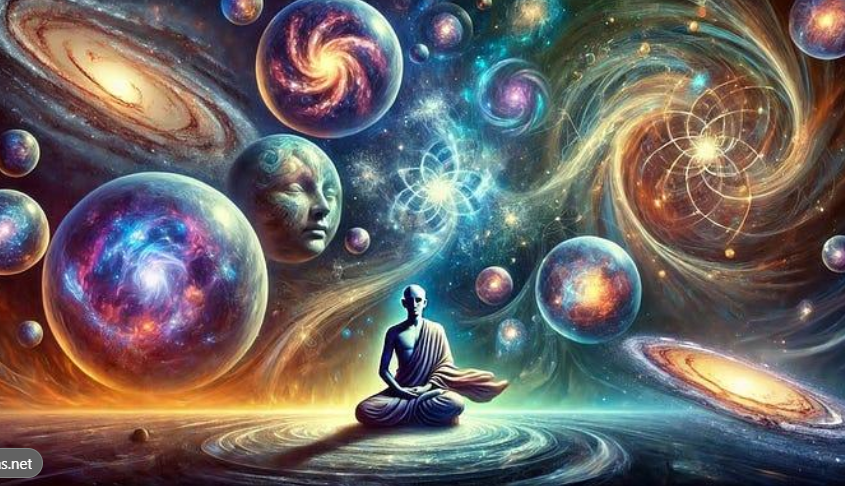
The question examined here is not simply whether more than one world may exist. It is whether what we experience as one continuous reality could be one expression of a more fundamental existence; whether distinct expressions can meet, affect one another or converge; and what conditions would make such interaction possible. If they do interact, is the determining factor truth, ethical order, consciousness, the nature of an event, or something more subtle that has not yet been identified?
This inquiry begins from the possibility that existence may be more extensive than the field available to ordinary perception. It does not assume that every imagined world is real, nor does it equate philosophical dimensions with the additional dimensions or multiverse models of physics. It asks whether the limits of an observer’s access should be mistaken for limits in existence itself. The propositions developed below are original Tatsat Cosmos hypotheses, considered alongside selected Upanishadic and Yogic texts without attributing to those texts conclusions they do not state.
1. One existence, many expressions
When we speak of a world, we usually mean the reality within which our bodies, memories, relationships and actions are situated. Its continuity is so familiar that we rarely ask whether it is the only possible expression of existence. Yet the continuity of an experienced world does not, by itself, establish that existence has only one mode or level.
The Tatsat Cosmos proposition is that what appear as parallel realities may be different expressions of a more fundamental reality. They need not be identical copies of one another, nor need they be wholly independent universes. Each expression may have its own conditions of manifestation, its own relations between events, and its own means by which an experiencing being becomes situated within it.
This formulation leaves an essential question open. If these expressions arise from, or belong to, a more fundamental reality, what is the relation between them? A common origin does not automatically mean that they can communicate. Similarity does not prove interaction. Nor does difference prove separation. The relation must be examined rather than assumed.
2. Convergence and interaction: the central problem
The possibility of interaction is more consequential than the mere possibility of plurality. If two expressions of reality never meet, influence one another or share any condition, their plurality may remain inaccessible to an observer within either one. If they can interact, however, the nature of that interaction becomes a central problem: what passes between them, what permits the passage, and what changes when contact occurs?
Convergence may not mean that two complete worlds physically collide or merge. It may mean that an event in one expression corresponds to, conditions, or becomes intelligible through an event in another. It may involve a shared principle, a common origin, a relation between states of consciousness, or a condition that is not ordinarily recognised. These are possible forms of relation to be distinguished, not interchangeable descriptions of one established mechanism.
The inquiry therefore asks whether interaction is governed by a single principle or by several conditions acting together. Truth and ethical reality may be among those conditions, but the present hypothesis does not make either a universal key. A being may inhabit and move freely within one expression without being able to cross into another. The ability to function within a reality and the capacity to pass between realities are different questions. Nor is moral virtue proposed as a simple admission test for belonging to, or moving within, one particular expression.
What a being carries, understands, offers or relinquishes may matter. So may the consequences attached to a transition, the degree of preparation, and conditions not yet understood. The possibility that a transition creates obligations or consequences extending beyond the immediate event also remains open for examination. At this stage, these are questions within the Tatsat Cosmos framework, not rules that can be presented as settled knowledge.
3. Events, sequence and the question of time
Our ordinary experience arranges events into a sequence: one event occurs, another follows, and memory preserves what has passed. This ordering is indispensable to practical life. Yet the order in which events become available to an observer need not answer every question about the relations between those events.
The Tatsat Cosmos hypothesis asks whether events that appear separate or sequential within one expression of reality could be related in a different way from another standpoint. What is experienced as a succession here might, in a wider order, belong to a relation that is not sequential in the same sense. This is not a claim that all events happen simultaneously, or that ordinary time is unreal. It is a question about whether experienced sequence exhausts the possible relations between events.
It is also necessary to distinguish simultaneity from transition. Events may be related across expressions without an individual moving between them. Conversely, a being might undergo a transition without comprehending the wider relation between the events involved. The conditions for an event to be shared, echoed, anticipated or recognised across expressions may therefore differ from the conditions for an individual to pass from one expression to another.
Words such as dimension, parallel and simultaneous are used here in a philosophical inquiry. They should not be mistaken for technical terms in physics unless a precise correspondence is demonstrated. The hypothesis requires its own conceptual clarity before any comparison with scientific models can be meaningful.
4. Consciousness, participation and the limits of perception
To examine whether an individual can encounter more than one expression of reality, we must distinguish existence from access to existence. A thing may be present without being perceived; a perception may occur without being correctly interpreted. These are different limitations, and confusing them leads to premature conclusions.
The Earth appears stationary to an observer standing upon it, although this appearance does not describe its larger motion. A straight object partly immersed in water appears bent, although the appearance is produced by the passage of light through different media. A distant object occupies a smaller visual angle than the same object nearby. In a dream, experiences may possess an immediate coherence while the dreamer is within them, although their relation to waking circumstances is not what it first seems.
These examples do not establish that the world is created by an individual mind. They establish a more limited but important distinction: the experience is real as an experience, while the interpretation of what it discloses may be incomplete or mistaken. Perception is not the same as the whole of that which is perceived, and the limits of a perceptual instrument do not by themselves define the limits of what exists.
The deeper Tatsat Cosmos question concerns the relation between consciousness and the reality it encounters. Is consciousness only a witness to an independently continuing world? Does it participate in the manifestation of the world available to it? Can it disclose aspects of existence that remain inaccessible under ordinary conditions? The hypothesis does not collapse these questions into one answer. It allows that consciousness may be related to reality in more than one way: sometimes as participant, sometimes as witness, and sometimes through a capacity that has not yet been adequately described.
This also requires care with the word self. The self that participates in an event and the standpoint from which that participation is observed may appear distinct in experience. Whether this distinction is between two functions of one consciousness, between individual and universal dimensions, or between different principles is a question for philosophical analysis. It should not be settled merely by choosing a familiar label.
5. Yoga: discipline, extraordinary capacities and the limits of the text
Patañjali’s Yoga Sūtra is relevant because its third chapter, the Vibhūti-pāda, examines results associated with saṃyama: the integrated discipline of concentration (dhāraṇā), meditation (dhyāna) and absorption (samādhi) directed towards a chosen subject. The chapter does not treat these attainments as a substitute for the final aim of Yoga. Its extraordinary capacities must be read within the larger discipline and its account of liberation.
Yoga Sūtra 3.16 reads: pariṇāma-traya-saṃyamād atītānāgata-jñānam — through saṃyama on the three transformations, knowledge of past and future arises. The three transformations are explained in relation to the changing characteristics, conditions and states of a phenomenon. The sūtra concerns knowledge of temporal change; it does not say that a practitioner travels to another universe.
Yoga Sūtra 3.18 reads: saṃskāra-sākṣātkaraṇāt pūrva-jāti-jñānam — through direct insight into saṃskāras, knowledge of previous births arises. Here the text relates knowledge of former births to latent impressions. The statement belongs to the Yogic account of mind, impressions and rebirth; it should not be converted without argument into a claim about movement between parallel realities.
Yoga Sūtra 3.21 describes saṃyama on the form of the body and the interruption of the connection that makes it perceptible to the eye, resulting in invisibility. The sūtra is precise in its own conceptual language. It concerns the body’s visibility and the conditions of visual apprehension; it is not a general statement that the body can enter another dimension.
Yoga Sūtra 3.42 states that through saṃyama on the relation between the body and ākāśa, and through the attainment of lightness like that of cotton, movement through space becomes possible. The passage belongs to the traditional discussion of yogic accomplishment. Its language and the accompanying Yogabhāṣya deserve close study before any modern interpretation is proposed.
These sūtras make it legitimate to investigate how classical Yoga understands transformations of perception, knowledge and bodily capacity. They do not explicitly teach travel between parallel worlds. The Tatsat Cosmos hypothesis asks a further question: if disciplined practice can transform the relation between the practitioner and ordinary conditions of experience, could some forms of transition or access be understood through a more extensive account of reality? That is an interpretive possibility, not a translation of Patañjali’s words. The distinction protects both the integrity of the text and the originality of the question.
6. Upanishadic passages: unity, manifestation and the witness
The Upanishads do not set out the Tatsat Cosmos theory of parallel realities and their interaction. Their texts belong to distinct Vedic contexts and speak in different forms: cosmological account, instruction, dialogue, symbolic image and concentrated declaration. They are relevant here because they examine the relation between Ātman, the world, the individual and the ground of existence. The following passages are points of philosophical engagement, not proof of a modern multiverse.
6.1 Ātman and the emergence of worlds — Aitareya Upaniṣad 1.1.1
आत्मा वा इदमेक एवाग्र आसीन्नान्यत्किञ्चन मिषत् ।
स ईक्षत लोकान्नु सृजा इति ॥
Ātmā vā idam eka evāgra āsīt; nānyat kiṃcana miṣat; sa īkṣata lokān nu sṛjā iti.
A working rendering is: “In the beginning, Ātman alone was this; nothing else whatsoever was active. It considered: ‘Let me create the worlds.’” The word miṣat has a range associated with moving or blinking; translations differ in how they render it. The grammatical subject of sa īkṣata is the Ātman already named. The passage does not introduce a second independent creator alongside it. Its sequence—Ātman alone, the act of seeing or considering, and the creation of worlds—makes it a significant text for asking how unity and manifestation are related.
The passage does not describe several parallel universes in the contemporary sense. Nor does the verb īkṣ by itself establish a theory that an individual mind creates its external world. Those would be further interpretations. What the text gives us is a cosmological statement in which the emergence of worlds is related to Ātman. The question of how this relation should be understood must be pursued through the remainder of the Upanishad and its commentaries.
6.2 The person and the cosmos — Aitareya Upaniṣad 1.1.4
In the subsequent account, bodily openings and faculties are paired with deities and cosmic powers: speech with Fire, breath with Wind, sight with the Sun, hearing with the directions, and mind with the Moon, among other correspondences. The text presents the embodied person not as an isolated unit but through a series of relations with the wider cosmos. These correspondences belong to the Upanishad’s cosmological and ritual-intellectual setting. They should neither be dismissed as decorative symbolism nor recast as modern anatomy or physics. Their importance here lies in the text’s deliberate refusal to treat the individual and the cosmos as unrelated domains.
6.3 “That thou art” — Chāndogya Upaniṣad 6.8.7
तत् त्वम् असि, श्वेतकेतो ।
Tat tvam asi, Śvetaketo. — “That thou art, Śvetaketu.”
The refrain belongs to Uddālaka Āruṇi’s instruction to Śvetaketu in chapter six. It follows a series of examples through which the subtle essence underlying things is made the subject of inquiry. The force of the sentence has been interpreted differently by later Vedānta traditions. It cannot be detached from its dialogue and treated as a slogan whose meaning is self-evident. For the present inquiry, it places the relation between the individual and the fundamental reality at the centre of discussion; it does not independently establish the possibility of crossing between realities.
6.4 All beings in the Self — Īśā Upaniṣad 6–7
यस्तु सर्वाणि भूतान्यात्मन्येवानुपश्यति ।
सर्वभूतेषु चात्मानं ततो न विजुगुप्सते ॥
Yas tu sarvāṇi bhūtāny ātmany evānupaśyati, sarvabhūteṣu cātmānaṃ tato na vijugupsate.
The verse describes one who sees all beings in the Self and the Self in all beings, and therefore does not recoil from them. The following verse describes the vision in which all beings have become the Self for the one who knows. These verses connect a vision of unity with a transformation in the relation to other beings. They are important to the ethical dimension of this inquiry, but they should not be used to claim that every human assertion of unity is correct or that the text offers a ready-made theory of parallel worlds.
6.5 Two birds on one tree — Muṇḍaka Upaniṣad 3.1.1–2
द्वा सुपर्णा सयुजा सखाया समानं वृक्षं परिषस्वजाते ।
तयोरन्यः पिप्पलं स्वाद्वत्ति अनश्नन्नन्यो अभिचाकशीति ॥
Dvā suparṇā sayujā sakhāyā samānaṃ vṛkṣaṃ pariṣasvajāte; tayor anyaḥ pippalaṃ svādv atti, anaśnann anyo ‘bhicākaśīti.
Two birds, companions, cling to the same tree. One eats the fruit; the other looks on without eating. The next verse describes the experiencing person as immersed in the tree and sorrowing, until seeing the other, the Lord, and recognising its greatness. Śaṅkara’s Advaita commentary reads the image through the distinction between the individual experiencer and the witnessing or Lordly principle. Other Vedānta traditions develop the relation differently. The image therefore does more than place two observers side by side: it stages a relation between participation in experience and the one who witnesses. That relation is pertinent to the question of whether consciousness can be both involved in a world and aware of a standpoint not exhausted by that involvement.
6.6 Truth and the path — Muṇḍaka Upaniṣad 3.1.5–6
सत्येन लभ्यस्तपसा ह्येष आत्मा सम्यग्ज्ञानेन ब्रह्मचर्येण नित्यम् ।
सत्यमेव जयते नानृतं सत्येन पन्था विततो देवयानः ॥
Satyena labhyas tapasā hy eṣa ātmā samyagjñānena brahmacaryeṇa nityam; satyam eva jayate nānṛtaṃ, satyena panthā vitato devayānaḥ.
The verses place truth alongside disciplined practice, right knowledge and brahmacarya in the pursuit of Ātman. “Truth alone prevails, not untruth” is therefore part of a teaching about the path to the highest reality. It should not be reduced to a prediction that every truthful person will win every worldly contest. Its significance is deeper: truth is not merely a public agreement or a convenient instrument. This gives a textual point of comparison for the Tatsat Cosmos proposition that truth may have a place in the order of existence beyond the temporary success of a particular account.
6.7 Turīya and the limits of familiar awareness — Māṇḍūkya Upaniṣad 7
The seventh mantra of the Māṇḍūkya Upaniṣad describes the fourth, Turīya, through a carefully ordered series of negations: it is not inwardly cognitive, not outwardly cognitive, not both, not a mass of cognition, not simply cognitive or non-cognitive. It is described as unseen, beyond ordinary transaction, ungraspable and the cessation of phenomenal elaboration; it is peaceful, auspicious and non-dual. The mantra concludes: “That is the Self; that is to be known.”
Turīya should not be casually equated with another universe or a spatial dimension. The text is examining the nature of Ātman in relation to the states and modes of awareness. Its relevance is that ordinary categories of experience may not exhaust the question of consciousness. This is a demanding philosophical claim in its own right; it need not be converted into a modern cosmological theory to retain its force.
7. Truth and ethical reality: important factors, not the whole explanation
The inquiry began with the relation between different expressions of reality, not with a moral theory. Truth and ethics enter because they may be among the conditions that shape events, relations and transitions. They are not assumed to explain every form of interaction.
A collective may accept an account that is false. The belief can nevertheless alter conduct, institutions and the lives of those who act upon it. The resulting consequences are real, while the accepted account may remain untrue. This distinction matters because the power of a belief and the truth of its content are not identical.
From this distinction follows an ethical question: what responsibility belongs to one who knowingly presents an untruth as reality? The harm does not disappear merely because the claim is false. Yet the present hypothesis goes further than social responsibility. It proposes that ethical reality may be independent of human existence and human approval. Human beings may recognise it, misread it or violate it; their agreement would not create its underlying validity.
This proposal does not mean that every moral question has an obvious answer, or that history always rewards the truthful in visible ways. It means that popularity, power and immediate success cannot by themselves settle the ethical character of an action. Within the larger inquiry, truth and ethical order may influence how realities are shaped or how transitions become possible, but other conditions may also be involved. Their precise relation remains to be investigated.
8. The Tatsat Cosmos hypothesis and the questions it leaves open
The argument can now be stated more precisely. Tatsat Cosmos proposes that what is ordinarily experienced as one continuous world may be one expression of a more fundamental reality. Other expressions may exist under conditions not available to ordinary perception. These expressions may be distinct without being wholly unrelated. Their relation may permit forms of convergence or interaction, but the conditions and mechanisms of such interaction are not yet established.
Consciousness may participate in the reality it experiences and may also disclose a standpoint not exhausted by that participation. Events that appear sequential within one expression may have relations that are not sequential from another standpoint. Yoga raises questions about disciplined changes in knowledge, perception and capacity; the Upanishads provide profound accounts of Ātman, manifestation, the witness and the limits of ordinary awareness. None of these textual materials, taken alone, proves the complete hypothesis.
The next stage of this research must therefore examine several connected questions: Do distinct expressions of reality converge, and what would count as evidence of convergence? Can an event in one expression affect another without an individual crossing between them? What distinguishes inhabiting a reality from transitioning beyond it? Is consciousness a necessary condition of such transition, or one condition among several? How might truth, ethical order, intention, capacity and consequence relate to one another? Can the proposed relations be described without confusing philosophical dimensions with physical ones?
These questions should remain open where the available arguments do not settle them. A hypothesis gains strength not by being protected from difficulty, but by making its claims clear enough to be examined, refined or rejected. The purpose is not to force the Upanishads or Yoga Sūtra into agreement with a contemporary proposal. It is to bring a new philosophical question into disciplined relation with primary texts while preserving the distinction between what the texts say and what Tatsat Cosmos is proposing.
Conclusion: what appears as one may not exhaust what is
The central question is whether the reality available to ordinary experience is the whole of existence or one expression within a wider order. If there are other expressions, their relation to one another becomes decisive. They may be separate, connected, convergent or capable of interaction under conditions that are not yet understood. Consciousness, time, disciplined practice, truth and ethical reality all enter the investigation, but none should be made to answer every question in advance.
The Upanishadic passages considered here offer distinct ways of thinking about the emergence of worlds, the relation between person and cosmos, the witness, truth and the limits of familiar awareness. Patañjali’s Yoga Sūtra examines transformations of knowledge and capacity through disciplined practice. These sources do not state the Tatsat Cosmos hypothesis in its present form. They provide serious philosophical material with which it can be brought into dialogue.
The inquiry therefore remains deliberately unfinished at the point where further understanding is required. What appears as one may not exhaust what is; but the possibility of a wider reality must be investigated through careful distinctions, not assumed through analogy. The task is to understand whether different expressions of existence can meet, how such meeting might occur, and what deeper order—if any—makes it possible.
Primary texts and selected references
- Aitareya Upaniṣad 1.1.1–4, in the Aitareya Āraṇyaka of the Ṛgveda.
- Chāndogya Upaniṣad 6.8.7, read within Uddālaka Āruṇi’s instruction in chapter six.
- Īśā Upaniṣad 6–7.
- Muṇḍaka Upaniṣad 3.1.1–8.
- Māṇḍūkya Upaniṣad 7.
- Patañjali, Yoga Sūtra 3.16, 3.18, 3.21 and 3.42, with the Yogabhāṣya traditionally attributed to Vyāsa.
- Olivelle, Patrick. The Early Upaniṣads: Annotated Text and Translation. Oxford University Press, 1998.
- Gambhirananda, Swami, trans. Eight Upaniṣads, with the Commentary of Śaṅkarācārya. Advaita Ashrama, 1957.
- For the Yoga Sūtra, the Sanskrit sūtra text and the Yogabhāṣya should be read together; translations alone do not settle the interpretive questions raised here.
Editorial distinction: This essay separates (1) the wording and context of primary Sanskrit texts, (2) traditional interpretations, including but not limited to Śaṅkara’s Advaita reading, and (3) the original Tatsat Cosmos hypotheses. The proposed account of parallel realities, convergence and transition is a philosophical research hypothesis. It is not presented as an established Upanishadic doctrine or as a result verified by contemporary physics.