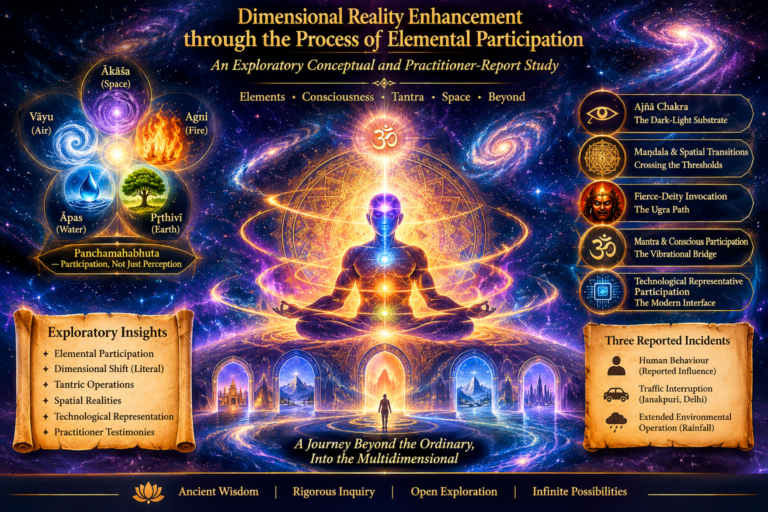
The Fire Within: Breath, Sound and the Upanishadic Map of the Cosmos
A Tatsat Cosmos exploration of Prāṇa, Vāyu, Śabda, Nāda Yoga and the relationship between the individual and the living cosmos

What if the human being is not merely a body placed inside the universe, but a living meeting point of the same principles through which the universe is understood? The Aitareya Upanishad invites us to consider precisely this relationship. It connects the faculties of the human form with cosmic powers: speech with Agni, Prāṇa with Vāyu, sight with the Sun, hearing with the Directions, mind with the Moon, and other bodily functions with the living elements.
These correspondences are a starting point, not a complete explanation of the human being or the cosmos. Other Upanishads develop the ideas of Prāṇa, mind, sound, food, consciousness and manifestation in different ways. Yoga and later contemplative traditions offer methods for working with attention, breath and sound. This article brings these strands together in a limited, practical introduction while keeping their distinct textual settings clear.
The central invitation is simple: study the relationship between the body and the cosmos, begin with disciplined and safe practice, and let understanding deepen through sustained inquiry rather than through the pursuit of extraordinary claims.
1. The Aitareya map: the human being and cosmic powers
In Aitareya Upanishad 1.1.4, the cosmic person is formed and the bodily openings, faculties and their corresponding deities emerge in a connected sequence. The passage associates the mouth with speech and Agni; the nostrils with Prāṇa and Vāyu; the eyes with sight and Āditya; the ears with hearing and the Directions; the skin and hair with vegetation; the heart and mind with the Moon; the navel and Apāna with Death; and the generative faculty with reproductive fluid and Water.
It is important to preserve three levels in this description: the bodily locus, the faculty or vital function, and the cosmic power associated with it. The Upanishad is not saying that the physical ear is literally a direction, that hair is literally a forest, or that the navel is the anatomical location of Death. It is presenting a correspondence through which the individual form is understood in relation to a wider order.
The correspondences also vary across the Upanishads. The Bṛhadāraṇyaka, Chāndogya and Taittirīya do not simply repeat one fixed chart. Each uses relationships between the individual and the cosmos to illuminate a different inquiry. Their differences are worth studying rather than forcing into a single system.
2. Breath is Air: Prāṇa and the movement of life
Prāṇa — Vāyu
The Aitareya associates Prāṇa with Vāyu. Breath is the most immediate experience of our connection with the surrounding world: we receive air, release it, and continue to live through a movement that never belongs to the individual alone. Yet Upanishadic Prāṇa is not simply the physical air entering the nostrils. It is the vital principle expressed through the organism’s life-sustaining functions.
The Prashna Upanishad develops this subject in its second and third questions. It presents Prāṇa as a central life principle and describes its distribution through five principal functions: Prāṇa, Apāna, Samāna, Vyāna and Udāna. These names describe traditional patterns of vital functioning, not five separately measurable substances. The Taittirīya Upanishad’s teaching of the Pañcakośas places the Prāṇamaya Kośa, the vital sheath, between the physical and mental dimensions of embodied life.
The Bhagavad Gītā also refers to the regulation and relationship of Prāṇa and Apāna in its discussion of Yoga (4.29; 5.27–28). Patañjali’s Yoga Sūtras describe Prāṇāyāma as a limb of Yoga (2.49–2.53). Later Haṭha Yoga texts develop more detailed methods of breath regulation, bandha and mudrā. These are related fields of practice, but they should not be treated as one identical technique.
A practical beginning: observe the natural breath without forcing it. Notice how breathing changes with posture, activity, attention and emotion. A beginner can develop steadiness through gentle breath awareness and, with appropriate instruction, learn simple Prāṇāyāma. Forceful retention or attempts to stop the breath are not a safe starting point.
At Tatsat Cosmos, we are interested in the relationship between Tapas and Prāṇa as a subject for further study. Tapas can describe disciplined intensity and sustained inner effort; Prāṇa describes the vital principle and its functions. They are related in some practical and philosophical discussions, but they should not be declared identical or reduced to a single physical energy.
3. Hearing is the Directions: Śabda, Nāda and the space of awareness
Śrotra — Diśaḥ
The association of hearing with the Directions is especially suggestive. Sight ordinarily reveals what lies within the visible field; hearing can disclose what is beyond it. A sound may arrive from behind, from a distance or from a place we cannot see. Hearing therefore gives us an awareness of space and orientation beyond the immediate visual scene. In the Aitareya, the Directions are the cosmic counterpart of the faculty of hearing.
The Kena Upanishad takes the inquiry deeper through the expression śrotrasya śrotram — “the Ear of the ear” (Kena 1.2). Its question is not about the anatomy of hearing, but about that by which hearing itself is possible. The Bṛhadāraṇyaka Upanishad 1.5.3 also observes that the mind must be present for perception to be registered: a person may fail to see or hear when attention is elsewhere.
Indian traditions give sound several related but distinct meanings. Śabda can mean sound, word or verbal expression. In Vedic life, spoken recitation preserved texts and ritual knowledge with extraordinary care. Mantra uses sound in a disciplined form: its syllables, rhythm, pronunciation, repetition and meaning can shape attention, memory, devotion and conduct. This is one reason sound has such a significant place in Indian contemplative traditions.
The Ṛgveda 1.164.45 speaks of four quarters of Vāk (speech), of which three are hidden and one is spoken by human beings. Later philosophical and Tantric traditions develop a fourfold account of speech commonly named Parā, Paśyantī, Madhyamā and Vaikharī: the most subtle source, an inwardly apprehended form, mental formulation, and articulated speech. This later framework is an interpretive development; it should not be presented as though the Ṛgvedic verse itself sets out the complete later system.
The Māṇḍūkya Upanishad makes Oṃ central to its inquiry into consciousness. Its twelve mantras relate Oṃ and its components to waking, dreaming, deep sleep and Turīya, the reality that is not adequately described as just another ordinary state. The Chāndogya Upanishad 1.1 also begins its meditation on the Udgītha with Oṃ. In both contexts, sacred sound is not merely a pleasant vibration: it becomes a disciplined support for contemplation and inquiry.
Later Yoga traditions develop Nāda Yoga and nāda-anusandhāna, the contemplative investigation of sound. The Nāda-Bindu Upanishad and the fourth chapter of the Haṭha Yoga Pradīpikā discuss Oṃ, inner sound and the practitioner’s attention. Details and interpretations differ between texts and lineages. These practices are not simply ordinary listening exercises, nor should every sound perceived during meditation be treated as a supernatural message.
What does this mean for the seeker? Sound can organise attention. Repeated mantra can steady the mind; careful listening can reveal how quickly attention moves; silence can make habitual inner speech more noticeable. A sound may also evoke memory, emotion and a sense of place. These are meaningful effects that can be observed in practice.
The Tatsat Cosmos inquiry wishes to explore a further possibility: whether sound, mantra and consciousness have dimensions of relationship that ordinary explanation does not exhaust. This remains a philosophical and experiential question, not proof that all hidden cosmic knowledge literally travels through audible sound waves. Nor does the Aitareya’s association of hearing with the Directions establish that each direction is a separate universe. The Directions first signify the ordered spatial field; their wider ritual and symbolic meanings can be studied separately.
A suitable beginning is simple: listen carefully, practise a mantra appropriate to your tradition, learn its meaning and pronunciation, and observe its effects on attention and conduct. The aim is not to collect unusual sounds, but to refine awareness.
4. Sight is the Sun: illumination and the witness
Cakṣus — Āditya
The Sun illuminates the visible world, and the eye receives the light by which objects become visible. The Aitareya’s association of sight with Āditya therefore has an immediate cosmic meaning. Yet the Kena Upanishad asks about the deeper ground of perception through the phrase cakṣuṣaś cakṣuḥ, “the Eye of the eye” (Kena 1.2).
This distinction invites the seeker to observe the object seen, the faculty of sight and the awareness in which seeing is experienced. The physical Sun illuminates the external scene; the Upanishadic inquiry asks what makes experience possible. This is a transition from cosmological correspondence towards the philosophy of consciousness.
5. Hair and vegetation: the body within the living Earth
Lomāni — Oṣadhi-Vanaspatayaḥ
The Aitareya connects bodily hair with herbs and trees. The image suggests that the human form belongs within a wider living order. The Chāndogya Upanishad 5.18 uses the cosmic person, Vaiśvānara, to describe the human being through universal correspondences; in 5.18.2, bodily hair is associated with sacrificial grass. Chāndogya 6.5 examines how food and the elements contribute to the formation of bodily constituents.
These passages do not make the human body identical to a forest. They invite us to recognise our dependence on the natural world. Food, water, air and the living environment are not incidental to embodied existence; they are among its conditions. This correspondence can therefore support an ecological understanding of the body as part of the larger order of life.
6. Mind is the Moon: the changing inner world
Manas — Candramā
The Moon’s changing phases provide a suggestive image for the changing conditions of mind. Thoughts, memories, desires, doubts and emotions arise and pass. The Bṛhadāraṇyaka Upanishad 1.5.3 describes the mind’s role in perception and associates it with desire, resolve, doubt, faith, memory and fear.
This correspondence should not be reduced to the claim that the Moon literally controls every thought or emotion. Its value is contemplative: it directs attention to the changing nature of mental experience and to the role of attention in shaping what we notice, remember and understand. Mantra, meditation, self-study and observation of thought can help a seeker investigate this relationship.
7. The navel, Apāna and Death: life includes release and change
Nābhi — Apāna — Mṛtyu
The Aitareya associates Apāna with Death. This is a profound correspondence, but it is not an anatomical claim that the navel is the location of death. In the Prashna Upanishad’s account of the five vital functions, Apāna is associated with downward-moving bodily processes. The Aitareya places this vital function in a symbolic relationship with mortality.
Life involves receiving, transforming and releasing. The organism cannot retain everything it takes in. Its functioning depends upon continuous movement and change, while mortality remains a condition of embodied existence. This offers a way to contemplate Death not as an entirely external subject, but as a reality inseparable from the life of the body.
Later Haṭha Yoga and Tantric traditions explore the relationship between Prāṇa and Apāna, including practices intended to regulate or unite these currents. Such teachings belong to their own textual and initiatory settings. They should not be simplified into a claim that a practitioner can reverse biological existence, suspend death or automatically enter another universe. The Aitareya itself does not describe those later techniques.
For practice, the first step is to understand the vital functions and the limits of the body with care. Advanced breath retention, bandhas and subtle-body methods require qualified guidance. Deliberately stopping the breath or depriving the body of oxygen is not a safe method of spiritual exploration.
8. Reproductive fluid is Water: generation and continuity
Retas — Āpaḥ
The Aitareya associates reproductive fluid with Water, returning the reader to the importance of waters in Vedic cosmological imagery. Water is connected with nourishment, fertility and the conditions that sustain life. The Chāndogya Upanishad 6.2–6.5 examines the emergence of Tejas, Water and food within its account of manifestation and then considers their relationship with embodied existence. The Taittirīya Upanishad 2.1 presents a related sequence of elemental emergence from Ātman through Ākāśa, Vāyu, Agni, Water and Earth.
These are philosophical accounts of manifestation, not modern scientific descriptions of the formation of matter. Read together, they invite reflection on the continuity between cosmic creation, nourishment, bodily life and generation. They also remind us that creative power calls for responsibility and discipline.
9. Tapas, Agni and Yajña: the discipline of transformation
The correspondences become more meaningful when considered alongside the Vedic and Upanishadic language of Tapas and Agni. Agni is the sacred fire and a principle of transformation in Vedic ritual and imagery. Tapas can mean heat, intensity, disciplined effort and the concentrated power of inquiry. These meanings are related, but they are not interchangeable in every text.
In Aitareya 1.1.4, the cosmic person is subjected to an intense heating or brooding before the faculties emerge. The verbal imagery of heating is suggestive, but it should not automatically be equated with every later meaning of yogic austerity. The Taittirīya Upanishad 3.1 instructs Bhṛgu to seek Brahman through Tapas; here Tapas is the disciplined method of inquiry. The Taittirīya’s elemental sequence in 2.1 places Agni within a cosmological account of manifestation.
Yajña adds the dimension of offering. The Bhagavad Gītā 4.24 presents the offering, the oblation, the fire and the act of offering within a vision of Brahman; 4.29 describes forms of inner discipline involving Prāṇa and Apāna. These passages allow us to contemplate how attention, effort, speech and action may become offerings within a disciplined life.
As a practical interpretation for this series, we may say: Tapas gives discipline and intensity to the work; Agni represents transformation; Prāṇa is a vital principle through which embodied life functions; Vāk and action give intention expression; and Yajña teaches the seeker to offer effort responsibly. This is a working synthesis for reflection, not a single formula quoted from one scripture.
10. From practice to the question of different realities
Disciplined practice can change the way a person experiences the world. Attention becomes steadier; habitual reactions may weaken; perception, memory, emotion and conduct may be understood differently. Changes in one person’s choices can also affect relationships and communities. In this sense, a different lived reality can emerge through sustained practice.
Tatsat Cosmos is also pursuing a wider philosophical question: whether existence may include dimensions or expressions that are not available to ordinary perception, and whether disciplined consciousness can disclose aspects of experience that are normally overlooked. We use terms such as “parallel realities” and “dimensional realities” as questions within an ongoing inquiry. They should not be confused with established scientific evidence for alternate physical universes, nor should unusual meditative experiences alone be treated as proof of such universes.
Likewise, the word “vacuum” may be used metaphorically in this inquiry for a condition of stillness, withdrawal or absence of ordinary mental content. It is not a recommendation to create a physical vacuum in the body or to interrupt breathing. The seeker’s task is to distinguish experience from interpretation, and possibility from established knowledge.
11. A safe beginning: a simple discipline for seekers
Readers can begin without advanced techniques. The following is a gentle foundation, not an initiation or a substitute for instruction in a particular lineage:
- Observe the breath: sit comfortably and notice natural breathing without forcing inhalation, exhalation or retention.
- Listen: spend a few minutes noticing sounds from different directions, then observe how attention responds.
- Practise mantra: choose a mantra appropriate to your tradition, learn its meaning and pronunciation, and recite it steadily rather than mechanically.
- Observe the mind: notice thoughts, moods and reactions without immediately believing or suppressing them.
- Study: read the cited passages in context and compare translations before drawing conclusions.
- Live the discipline: practise truthfulness, restraint in speech, responsible action and consistency in daily conduct.
Do not force breath retention, attempt to stop Prāṇa, or practise intense bandhas and advanced subtle-body methods without a suitably qualified teacher. If a practice causes dizziness, distress or breathlessness, stop and return to normal breathing. Yoga is a disciplined path, not a contest in endurance or extraordinary experience.
12. Continue the inquiry with Tatsat Cosmos
The Upanishads are already available to anyone who wishes to read them. The purpose of Tatsat Cosmos is not simply to repeat their words. We seek to make the texts approachable, compare their teachings without erasing their differences, identify where later Yoga and contemplative traditions extend the inquiry, and help interested readers move from reading towards thoughtful participation and responsible practice.
Our work on Prāṇa, sound, Nāda Yoga, Tapas, Agni, the subtle body and the dimensions of experience will continue through focused articles and discussions. We invite seekers to join the inquiry, ask questions, share corrections and study with patience. No article or organisation can promise supernatural powers or guaranteed access to parallel universes. The value of participation lies in sustained learning, careful practice, dialogue and the honest examination of experience.
Connect with Tatsat Cosmos
Website: tatsatcosmos.com
YouTube: Official Tatsat Cosmos channel — explore our videos on the five Prāṇas, the mind, Yoga and inner inquiry.
WhatsApp article updates: +91 84009 55079 — request to join WhatsApp updates. Send the message yourself to opt in; opening the link does not automatically subscribe you.
Join the work: Join the Tatsat Cosmos journey to receive new articles by email or explore ways to participate. For personal enquiries, research suggestions or corrections, use our contact page.
Selected texts for further study
- Aitareya Upanishad 1.1.1–1.1.4 — the emergence of worlds, the cosmic person and the bodily-cosmic correspondences.
- Prashna Upanishad questions II–III — Prāṇa and its five principal functions.
- Taittirīya Upanishad 2.1 and 3.1 — elemental manifestation and Tapas as a method of inquiry.
- Bṛhadāraṇyaka Upanishad 1.5.3 and 1.5.13 — mind, perception and differing correspondences involving Prāṇa.
- Chāndogya Upanishad 1.1, 5.18 and 6.2–6.5 — Oṃ, Vaiśvānara and elemental nourishment.
- Kena Upanishad 1.1–1.2 — the power behind mind, speech, breath, sight and hearing.
- Māṇḍūkya Upanishad 1–12 — Oṃ and the states of consciousness.
- Ṛgveda 1.164.45 — the four quarters of Vāk.
- Yoga Sūtras 2.49–2.53; Bhagavad Gītā 4.24, 4.29 and 5.27–5.28 — breath discipline, offering and contemplative practice.
- Nāda-Bindu Upanishad and Haṭha Yoga Pradīpikā, chapter 4 — later contemplative approaches to Oṃ and inner sound. Interpretations and verse numbering may vary by edition and lineage.
The Upanishads provide the direction. Yoga provides a disciplined field of practice. The seeker must undertake the work of understanding.