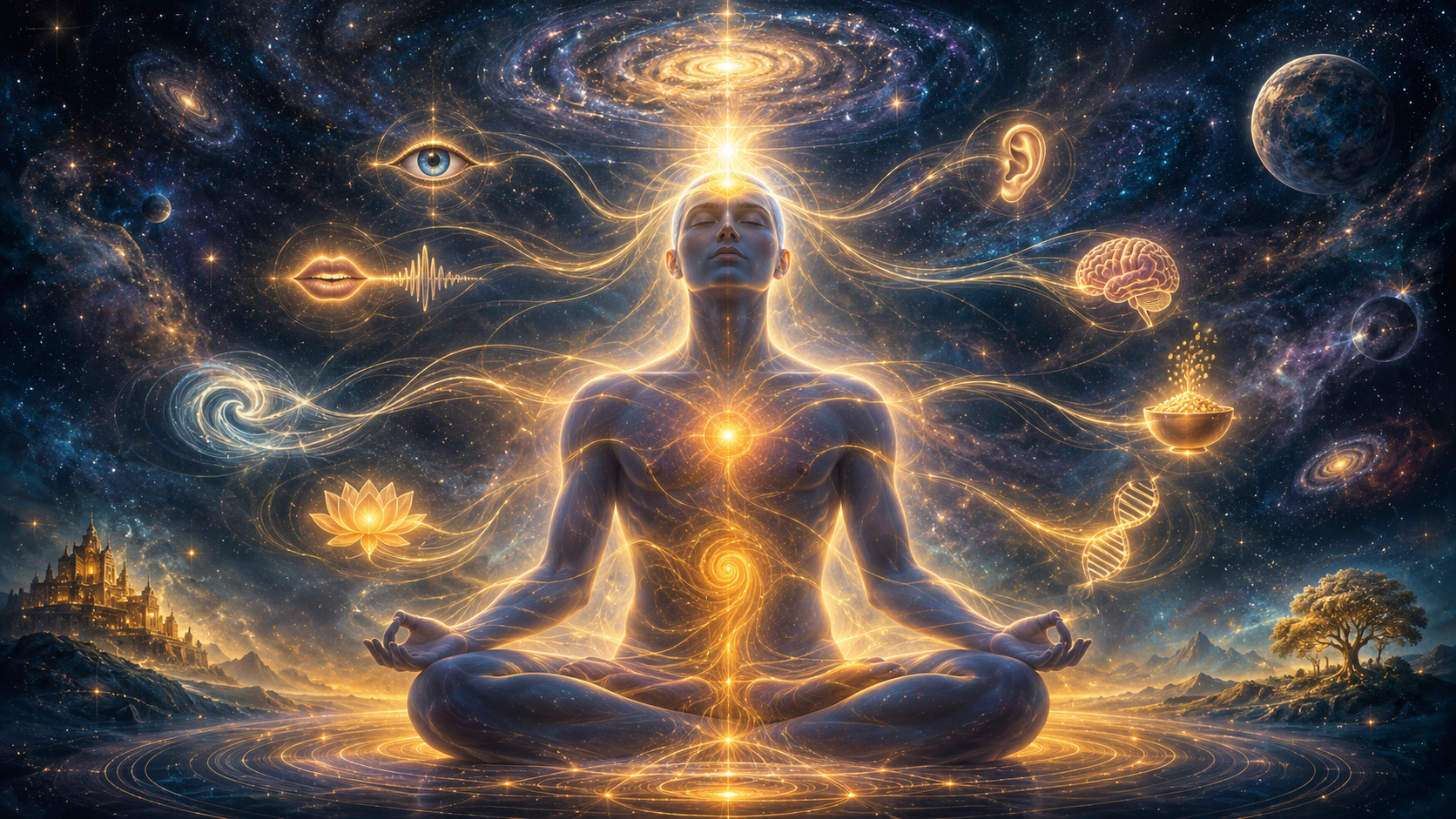
The Three Openings of Human Existence: Senses, Nourishment and the Creation of Parallel Realities
An exploratory study of the Aitareya Upaniṣad, examining the relationship between the human senses, nourishment, the three states of experience and the possibility of expanded human functioning.
Introduction: The human being as a meeting point of realities
The Aitareya Upaniṣad presents an account of creation that gradually moves from the formation of the universe towards the formation and functioning of the human being. It does not begin by treating the human body as an isolated biological structure. Instead, it describes the emergence of cosmic powers, their relationship with the organs of the human body, the arrival of hunger and thirst, the creation of food and, finally, the entry of the Self into the embodied form.
This sequence offers an opportunity to examine human existence through several interconnected dimensions.
The senses are not presented merely as instruments belonging to the individual. Each is associated with a corresponding cosmic power. The body becomes a meeting point where these powers find expression. Hunger and thirst introduce the needs that accompany embodied existence, while food provides the means of sustaining it.
Yet the narrative does not end with the successful functioning of the senses or the satisfaction of bodily needs. It reaches a deeper question:
Atha ko’ham iti — Then, who am I?
This question, appearing in Aitareya 1.3.11, changes the direction of the inquiry. It takes us from the functioning of the embodied arrangement towards the principle that makes it a living existence.
The following study develops this progression and explores a further possibility: that the three states of human experience—Jāgrat, Svapna and Suṣupti—may be understood as participating modes of human functioning, and that their interaction may provide a framework for understanding the creation of realities beyond the ordinary limits of experience.
The interpretation of three distinct positions at the crown of the head, developed in this article, is proposed as a contextual research model. It is not presented as an anatomical description explicitly stated by the Aitareya Upaniṣad.
1. The senses and their cosmic correspondences
In Aitareya Upaniṣad 1.1.4, the creation narrative establishes a relationship between the human body’s faculties and corresponding cosmic powers.
The text describes how the different faculties find their respective places in the human form. Each faculty is associated with a particular cosmic principle.
| Human organ or location | Faculty or function | Cosmic correspondence |
|---|---|---|
| Mouth | Speech | Agni |
| Nostrils | Prāṇa | Vāyu |
| Eyes | Sight | Āditya |
| Ears | Hearing | Directions |
| Skin and hair | Bodily covering and growth | Herbs and vegetation |
| Heart | Mind | Moon |
| Navel | Apāna | Death |
| Generative organ | Reproductive fluid | Waters |
This arrangement is significant because the human being is described through a relationship between bodily functions and the wider cosmic order.
Speech is associated with Agni, the principle of fire. Prāṇa is associated with Vāyu, the principle of air. Sight is associated with Āditya, the Sun. Hearing is associated with the directions. The mind is associated with the Moon, while the generative function is associated with the Waters.
These correspondences suggest that human functioning is not being considered independently of the larger environment in which existence unfolds.
The senses provide different ways of engaging with the world. Each has its own range and mode of operation. Sight does not perform the function of hearing; speech does not perform the function of touch. The faculties are distinct, yet their activities contribute to one integrated embodied existence.
This provides our first important observation:
Human existence develops through the interaction of different faculties, each having its own function and relationship with the surrounding reality.
1.1 The significance of the cosmic correspondences
The association of the senses with cosmic powers can be approached as more than a symbolic list.
It offers a way to understand how different dimensions of existence find expression through the human form. The Sun and sight, air and Prāṇa, fire and speech, and the Moon and mind establish relationships between the individual and the larger field of existence.
From a contextual perspective, these relationships can be understood as different channels through which the individual encounters and participates in the world.
The individual does not experience reality through a single faculty. What becomes meaningful in human existence emerges through the combined functioning of perception, thought, expression, bodily activity and interaction.
This interaction also creates possibilities and limitations. Every faculty offers a particular range of engagement, and its relationship with other faculties may extend or modify what becomes possible.
For example, sight provides visual information, but the mind can interpret, compare, remember and imagine. Speech can express an understanding that has emerged through observation and reflection. Hearing can introduce information that modifies existing understanding.
The human experience therefore develops through the relationships among faculties, rather than through the isolated operation of any one sense.
2. Hunger and thirst: The arrival of need in embodied existence
After describing the entry of the different powers into the human form, the Aitareya Upaniṣad introduces another important dimension: hunger and thirst.
In Aitareya 1.2.1, the being is subjected to hunger and thirst. These are personified in the text as:
- Aśanā — hunger.
- Pipāsā — thirst.
The two are not assigned separate bodily organs in the manner of the other faculties.
In Aitareya 1.2.5, hunger and thirst approach the creator and ask for a place in the arrangement. The response is that they will become participants in the portions of the existing deities.
This is an important detail.
Hunger and thirst do not operate as independent faculties with their own separate locations. They accompany the activities of the existing faculties and become conditions shared across embodied functioning.
2.1 Food as a necessary part of the arrangement
In Aitareya 1.3.1, the creator reflects that food must be produced for the beings and their guardians.
The text then describes the emergence of food from the waters through the creative process.
The Sanskrit word is:
अन्न — Anna
Anna means food or nourishment.
The narrative then describes how the different faculties attempt to grasp food.
Speech cannot take it in merely by speaking. Prāṇa cannot take it in merely by smelling. Sight, hearing, touch and mind cannot independently accomplish the act of taking in food.
Finally, in Aitareya 1.3.10, Apāna succeeds.
The text describes this as:
Annasya grahaḥ — the taking or seizing of food.
This episode gives us an important distinction between encountering something and taking it into the process of sustaining embodied existence.
The senses can perceive food, identify it, describe it and think about it. But these activities are not identical to taking in nourishment.
The text thus places the different functions in relationship with one another while recognising their particular capacities.
2.2 Apāna and the relationship with nourishment
The Aitareya Upaniṣad associates Apāna with the navel in its earlier description of the bodily arrangement. In its food episode, Apāna is the function through which food is successfully taken in.
Later Yoga and Āyurveda traditions develop more detailed descriptions of the five principal forms of Prāṇa, including Apāna’s association with downward-moving and eliminative functions. Those later descriptions should not simply be substituted for the particular role Apāna plays in this Upaniṣadic passage.
For the present inquiry, the important point is that the text distinguishes the perception of food from the process by which food becomes part of the embodied being.
Food is not merely an object encountered by the senses. It becomes nourishment through an appropriate process of taking it in.
2.3 Hunger and thirst as shared conditions
The presence of Aśanā and Pipāsā adds another dimension to the arrangement.
The faculties have their functions, but their functioning takes place within the conditions of need. Hunger and thirst accompany the embodied being and make nourishment a continuing concern.
This suggests a relationship among three elements:
- The faculties through which the individual encounters the world.
- The needs that arise within embodied existence.
- The nourishment through which those needs are addressed.
In this way, the narrative moves beyond the mere creation of bodily faculties. It begins to describe an interacting system of perception, need and sustenance.
The human being is not simply a collection of organs. It is an arrangement of functions and relationships through which life continues.
3. The turning point: Atha ko’ham iti — Then, who am I?
After describing the faculties, hunger, thirst and food, the Aitareya Upaniṣad introduces a question that changes the direction of the entire narrative.
अथ कोऽहमिति — Atha ko’ham iti
Then, who am I?
Aitareya 1.3.11 describes the Self reflecting on the functioning of the different faculties.
Speech expresses. Prāṇa performs its function. The eye sees. The ear hears. The skin feels. The mind thinks. Apāna takes in food. The generative organ performs its function.
The question then arises: if all these activities are performed through their respective faculties, who am I?
This question cannot be answered simply by identifying another organ or another bodily function.
The narrative has already described the different activities. Now it asks about the principle to which those activities belong.
The question marks a transition from the functioning of the embodied arrangement towards the recognition of the Self.
The next mantra describes the entry of the Self through an opening at the crown of the head.
4. The opening at the crown: Vidṛti and the entry of the Self
Aitareya Upaniṣad 1.3.12 describes the Self entering through an opening in the crown of the head.
The text calls this opening:
विदृति — Vidṛti
It also refers to it as a door:
द्वार — Dvāra
The passage describes the Self splitting open the crown or seam and entering through this door. It then calls the place Nāndana, associated with delight.
The mantra further introduces an important expression:
Traya āvasathāḥ, trayaḥ svapnāḥ.
There are three abodes and three states or dreams.
The text repeats the expression ayam āvasathaḥ—“this is an abode”—three times.
This reference to three abodes and three states provides the basis for a deeper investigation.
4.1 The three states of experience
Indian philosophical traditions give considerable importance to three principal states:
- Jāgrat — waking.
- Svapna — dreaming.
- Suṣupti — deep sleep.
These are not simply three names for different amounts of physical activity. They represent different modes of experience.
In waking, the individual engages with the external world through the senses and bodily faculties.
In dreaming, experience takes place through an inwardly presented field in which images, impressions, memories and other contents may appear without the same dependence on immediate external sensory input.
In deep sleep, ordinary differentiated experience is no longer manifest in the way it is during waking and dreaming.
The Māṇḍūkya Upaniṣad provides a particularly important later point of comparison because it examines these three states and introduces Turīya as a further dimension of inquiry.
For our present purpose, the three states invite us to investigate whether human functioning can be understood through more than the waking state alone.
4.2 A proposed three-position interpretation
The Aitareya passage speaks of one entrance, Vidṛti, and three abodes or states. It does not explicitly describe three separate anatomical openings at the top of the head.
However, a further contextual model can be proposed.
In this model, three distinct positions in the upper region of the head are associated with the three modes of functioning:
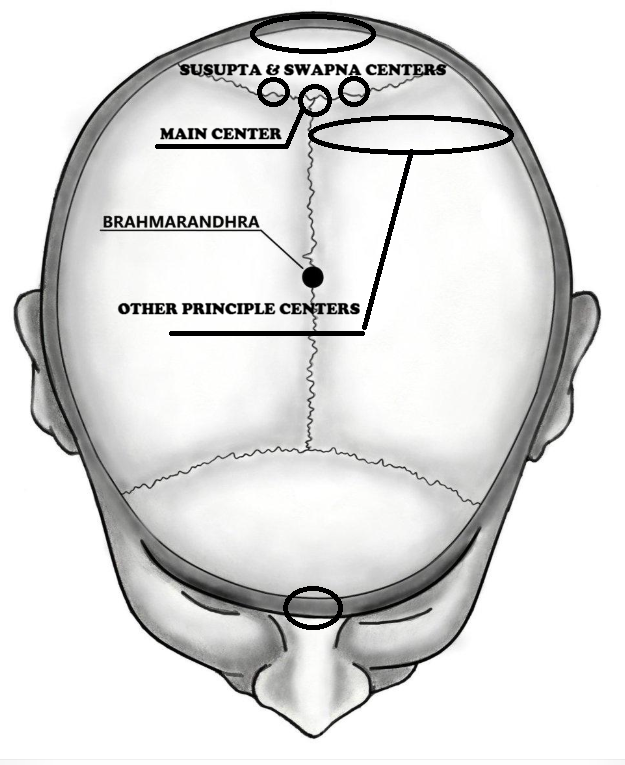
• The central position is associated with Jāgrat.
• One neighbouring position is associated with Svapna.
• The other neighbouring position is associated with Suṣupti.
Within this proposed interpretation, the central position is the principal point associated with Brahman in the context of waking presence, while the two neighbouring positions are associated with the other two modes of experience.
This is a hypothesis for further investigation, not a location mapping established by the Aitareya mantra itself. Its relationship with descriptions of subtle centres and other yogic traditions needs to be examined independently.
The important proposition is that the three modes are not necessarily isolated from one another. They may participate in human functioning in different proportions.
4.3 The collaboration of the three modes
If waking, dreaming and deep sleep are considered as interacting dimensions of human existence, then the individual’s experience need not be understood as arising exclusively from what happens during waking hours.
Waking experience is influenced by memory, imagination, impressions and processes that are not always directly accessible to ordinary attention.
A person may encounter a problem during the day, continue to process it through reflection, experience new associations in a dream, and arrive at a different understanding later.
The resulting insight becomes part of waking activity.
This everyday example does not establish the proposed three-position model anatomically. It does, however, illustrate why it is useful to investigate the relationship between the three states rather than considering waking experience in isolation.
The possibility worth exploring is that the three modes contribute to the formation of human experience in different proportions, and that their integration may expand the individual’s capacity to understand, imagine and act.
5. The transformation of human faculties
The earlier part of the Aitareya narrative described the faculties and their respective functions. The proposed three-position model invites us to investigate whether those faculties can operate in more developed and integrated ways through the interaction of the three states.
This is where the inquiry becomes particularly significant.
The transformation is not necessarily the creation of entirely new faculties. It may involve a change in the range, depth and relationships of the faculties that already exist.
5.1 Speech: From expression to creation
In the earlier description, speech is associated with Agni and finds its expression through the mouth.
Ordinarily, speech is used to communicate information, describe experiences and express thoughts.
However, speech also participates in bringing new realities into existence.
A promise can establish a commitment. An idea expressed through speech can become the foundation of a collective undertaking. A teaching can influence generations. A declaration can give direction to a community.
Speech therefore does more than describe an existing reality. It can participate in shaping what follows.
The development of speech through greater understanding, imagination and purposeful expression may expand the range of possibilities that an individual can create.
5.2 Sight: Beyond ordinary observation
Sight is associated with Āditya in the Aitareya’s description of the faculties.
Ordinary visual perception allows the individual to encounter the external world.
But the development of sight can also involve increasingly refined observation, recognition of patterns, imagination and visualisation.
An architect may perceive a structure that does not yet exist. A researcher may recognise a pattern within observations that initially appear unrelated. An artist may give visible form to something previously held only in imagination.
The question of seeing beyond ordinary physical visual limitations also appears in various spiritual and yogic accounts. Such claims deserve separate study and careful examination. They should not be treated as established merely because the development of perception and imagination is possible.
5.3 Hearing: From receiving sound to deeper understanding
Hearing is associated with the directions.
Its ordinary function is to receive sound. Yet attentive listening can develop into a much more refined capacity.
Music, language, subtle differences in expression and the meaning conveyed through sound all reveal dimensions of hearing that go beyond merely detecting noise.
The development of listening may also change the individual’s relationship with knowledge, communication and the surrounding world.
5.4 The generative faculty: Creation beyond reproduction
The Aitareya associates the generative organ with the Waters.
The biological function of reproduction is one dimension of this association. But the broader concept of generation invites further inquiry.
Human beings also bring forth ideas, forms, institutions, artistic works, knowledge systems and new ways of organising collective life.
The generative principle can therefore become a useful subject for philosophical exploration beyond its immediate biological function.
This broader interpretation should not be confused with the literal meaning of the mantra. It is an extension of the creation imagery into the wider field of human activity.
5.5 Mind: Integration of the faculties
The mind is associated with the heart and the Moon in Aitareya 1.1.4.
It participates in the processes of thought, attention, memory and interpretation.
The development of the mind can influence the functioning of the other faculties. What a person sees, hears, expresses and creates is shaped by the way information is received, organised and understood.
The integration of different modes of experience may therefore be significant for the development of the mind and its relationship with the other faculties.
6. The creation of parallel realities
The preceding discussion brings us to a broader proposition.
Human beings do not merely receive an already completed world. They also participate in creating realities through their faculties, actions, relationships and collective activities.
An idea can become a plan. A plan can become an institution. An institution can create new opportunities and new forms of social organisation. Knowledge can transform how future generations understand their world.
In this sense, human beings create realities that become part of the conditions in which other people live.
These realities can exist alongside one another.
An individual participates in a family reality, a social reality, a cultural reality, a professional reality and a national reality. Each involves different relationships, responsibilities, expectations and forms of interaction.
The same individual may also participate in intellectual, artistic, spiritual and technological realities that overlap without being identical.
This gives us a useful way to explore the idea of parallel realities.
Here, parallel realities need not mean separate physical universes. They can refer to different fields of lived experience, created through different combinations of perception, understanding, memory, imagination, expression and interaction.
The same external circumstances may produce different lived realities for different individuals because their faculties, experiences and relationships are not identical.
The interaction of the three states of experience may provide another dimension to this inquiry. If waking, dreaming and deep sleep contribute to human functioning in different ways, their integration may influence how individuals perceive possibilities and participate in creating new realities.
6.1 Human beings can create realities, but creation is not the ultimate limit
There is an important distinction between the capacity to create a reality and the nature of ultimate reality.
Human beings can create remarkable things. They can develop knowledge, build institutions, establish communities, produce art, transform their surroundings and create possibilities that were previously unavailable.
But the reality created through human activity is not necessarily the ultimate reality.
A discovery can open the way to further discoveries. A philosophical understanding can provide the foundation for deeper inquiry. A spiritual experience can transform an individual’s life without necessarily exhausting the inquiry into the Self.
The capacity to create can expand, while the scope of further exploration remains open.
This is an important philosophical direction for the present study.
The development of human faculties should not be understood as reaching a final point merely because a particular level of achievement has been attained.
7. The opening of the crown as a transformative possibility
We can now return to the opening described in Aitareya 1.3.12.
The Upaniṣad describes the entry of the Self through Vidṛti and then mentions three abodes and three states.
Our proposed interpretation takes this as an invitation to examine the relationship between the three modes of experience and the development of human faculties.
In this model, the opening of the upper centres represents a transformative possibility: the familiar faculties may begin to participate in new relationships, and the individual may develop capacities beyond their ordinary patterns of functioning.
Speech may become more creative. Sight may become more refined. Hearing may become more discriminating. The generative faculty may be understood through broader forms of creation. The mind may integrate different dimensions of experience.
These possibilities require further study. The Aitareya passage itself does not give a practical method for opening three anatomical points, nor does it prescribe a sequence of exercises for acquiring extraordinary abilities.
The research question is therefore not simply how to open a particular point, but how the Indian knowledge traditions understand the relationship between the three states, the Self, subtle centres and the development of human faculties.
This requires bringing together textual study, traditional commentary and careful examination of later yogic accounts without assuming that all of them describe the same system.
8. The recognition of the Self: Beyond the realities created
Aitareya 1.3.13 takes the narrative to its next stage.
The text describes the recognition:
इदमदर्शम् — Idam adarśam
“I have seen this.”
The Puruṣa is recognised as Brahman.
This is important because the narrative does not end with the development of human faculties or the creation of new realities. It moves towards recognition of the Self as Brahman.
A person may develop the senses, refine the mind, expand creative abilities and participate in creating increasingly complex realities. Yet the question of the Self remains.
The recognition of the Self is not simply another achievement within the collection of human faculties.
This gives the entire inquiry a further dimension: the exploration of human possibilities and the exploration of ultimate reality are related questions, but they are not identical.
The final mantra of the first chapter, Aitareya 1.3.14, discusses the indirect name Idandra, which is referred to as Indra. The passage closes by observing that the gods favour indirect names.
The first chapter thus moves from creation and embodiment towards entry and recognition, leaving the inquiry into the Self as the foundation for what follows.
9. A research framework for further exploration
The interpretation developed here brings together several questions that deserve further investigation.
| Area of inquiry | Central question |
|---|---|
| Cosmic correspondences | How are the human faculties related to cosmic powers? |
| Hunger and thirst | How do needs participate in embodied functioning? |
| Nourishment | What is the relationship between perception and assimilation? |
| Three states | How do Jāgrat, Svapna and Suṣupti contribute to experience? |
| Crown and Vidṛti | How should the Upaniṣadic description be understood in relation to later subtle-body traditions? |
| Development of faculties | Can the integration of different modes expand human capacities? |
| Creation of realities | How do perception, imagination, speech and action create new fields of lived experience? |
| Recognition of the Self | How does the inquiry move beyond created realities towards Brahman? |
The next stage of this research should examine the Māṇḍūkya Upaniṣad, which gives a more concentrated treatment of the three states and introduces Turīya.
It should also examine relevant yogic and Tantric traditions that discuss the crown and subtle centres, paying attention to their own terminology and differences.
Only through such a comparative study can we investigate whether the proposed three-position interpretation has parallels in other Indian knowledge systems, and where those parallels may differ.
Conclusion: Human existence as an expanding field of possibilities
The Aitareya Upaniṣad offers a remarkable progression.
It begins with the emergence of the cosmos and the formation of the human form. It describes the relationship between the senses and cosmic powers, introduces hunger and thirst, explains the creation and taking in of food, and then asks the fundamental question:
Who am I?
The narrative proceeds through the entry of the Self and the recognition of the Puruṣa as Brahman.
Our contextual exploration extends this progression by investigating the three states of human experience and their possible relationship with the development of the faculties.
The human being may be understood as participating in multiple realities through perception, thought, imagination, expression, relationships and action. The interaction of Jāgrat, Svapna and Suṣupti offers a further avenue for exploring how these realities are formed and how human capacities may develop.
The proposed three-position model at the crown is an invitation to further research, not a final conclusion. Its relationship with the Upaniṣadic account, later yogic descriptions and other Indian knowledge traditions remains to be examined.
One proposition, however, provides a useful direction for the continuing inquiry:
Human beings may continue to expand the realities they can perceive, understand and create, without that expansion necessarily representing the ultimate limit of existence or knowledge.
The exploration of human possibilities and the recognition of the Self remain open dimensions of the same larger inquiry.
Research references and textual foundation
Primary text
- Aitareya Upaniṣad — Sanskrit text and traditional commentaries
- Aitareya Upaniṣad — Friedrich Max Müller’s English translation
Passages examined
- Aitareya 1.1.4 — The bodily faculties and their cosmic correspondences.
- Aitareya 1.2.1–1.2.5 — Hunger, thirst, embodiment and the participation of needs in the faculties.
- Aitareya 1.3.1–1.3.10 — The creation of food and the attempts of the faculties to take it in.
- Aitareya 1.3.11–1.3.14 — The question of the Self, entry through Vidṛti, the three abodes and recognition of Brahman.
Further texts for comparative research
- Māṇḍūkya Upaniṣad — the three states and Turīya.
- Relevant Upaniṣadic commentaries of Śaṅkara.
- Later Yoga and Tantric texts concerning subtle centres and the crown.
Research note: The distinction between the Upaniṣadic account and the proposed three-position interpretation is intentional. The latter is a developing contextual hypothesis and requires comparative textual and experiential investigation.
Comparative textual references: A wider Upaniṣadic framework
This supplementary section has been added after the original article and its existing references. The earlier text has been retained without rewriting. The passages below broaden the inquiry by placing the Aitareya account alongside related discussions in other Upaniṣads. They are points of comparison, not claims that all these texts teach one identical system.
1. Māṇḍūkya Upaniṣad: The three states and Turīya
The Māṇḍūkya Upaniṣad is the most direct comparative source for the three states named in this research. In mantras 3–5, it describes the waking condition (Vaiśvānara), the dream condition (Taijasa), and deep sleep (Prājña). Mantra 7 then introduces Turīya, which is not simply another ordinary state alongside the first three, but is described through the negation of familiar forms of experience and as the non-dual reality underlying them.
This gives the present inquiry an important refinement. Jāgrat, Svapna and Suṣupti can be examined as distinguishable modes of experience, while Turīya raises the further question of that which is not confined to any one of them. The Māṇḍūkya therefore deepens the philosophical inquiry beyond a simple arrangement of three functions.
For the proposed model in this article, the Māṇḍūkya supports sustained investigation of the three states and their relation to the Self. It does not, however, describe three anatomical points at the crown of the head. That proposed spatial interpretation remains a separate hypothesis.
Passages: Māṇḍūkya Upaniṣad 3–7. Text and translation with Gauḍapāda’s Kārikā and Śaṅkara’s commentary.
2. Bṛhadāraṇyaka Upaniṣad: The dreamer and the making of an experiential world
Bṛhadāraṇyaka Upaniṣad 4.3 is especially relevant to the theme of realities taking form. In 4.3.7, Yājñavalkya describes the person within, associated with the vital powers and the inner light, as moving through the two worlds. In 4.3.9, sleep is discussed as an intermediate condition. In 4.3.10, the text says that in the dream condition the person creates or projects chariots, roads, pleasures and other scenes, although these are not present there in the same way as external objects.
This passage offers a strong textual point of comparison for the article’s discussion of parallel realities. It shows that an Upaniṣadic inquiry can treat dream experience as a world with its own presented forms, rather than as a mere copy of the immediate external surroundings. The following verses, including 4.3.12–16, continue the examination of the person through sleep, dream and waking.
The comparison should be made carefully: the Bṛhadāraṇyaka describes the dreamer’s capacity to form an experiential world; it does not establish that every socially or creatively constructed human reality is identical with the Upaniṣadic dream-world. The article’s use of “parallel realities” remains a broader contextual extension.
Passages: Bṛhadāraṇyaka Upaniṣad 4.3.7–16. Sanskrit and translation, beginning at 4.3.7; 4.3.10 and related passage.
3. Praśna Upaniṣad: Prāṇa, its divisions and the organisation of functions
Praśna Upaniṣad 3 begins with questions about the origin of Prāṇa, its entry into the body, its division and the way it supports embodied life. In 3.3, Prāṇa is said to arise from Ātman. In 3.4, its relationship with the other vital functions is compared to a king assigning responsibilities to officers. In 3.5, the text distinguishes the locations and functions of Prāṇa, Apāna and Samāna; 3.6 discusses Vyāna, and 3.7 describes Udāna and its upward movement.
This is a valuable comparison with Aitareya 1.1.4 and 1.3.10. The Aitareya associates Apāna with the navel in its cosmic-correspondence sequence and later makes Apāna the successful means of taking in food. The Praśna passage gives a more differentiated account of the vital functions. In particular, Praśna 3.5 places Samāna in the middle and relates it to the even distribution of food that has been taken in.
These passages should not be collapsed into one anatomical scheme. They show that different Upaniṣadic discussions develop the language of Prāṇa and its functions for different purposes. They also give the present research a stronger basis for investigating how nourishment, bodily processes and the coordination of faculties are understood in the wider tradition.
Passages: Praśna Upaniṣad 3.3–3.10. Sanskrit and translations, Chapter 3; Text with Śaṅkara’s commentary.
4. Taittirīya Upaniṣad: Food and the inner dimensions of the person
Taittirīya Upaniṣad 2.1–2.2 offers a useful parallel to the Aitareya’s treatment of food and embodiment. The text describes the emergence of beings through a sequence that includes food, and 2.2 states that beings are born from food, live by food and return to food. It then moves from the person constituted by the essence of food to an inner person constituted by Prāṇa.
This progression is relevant to the present article because it places nourishment within a layered account of embodied existence. Food is not treated merely as an object consumed by an individual; it is part of the conditions through which living beings arise, grow and are sustained. The movement from the food-formed person to the Prāṇa-formed person also provides a comparative framework for examining the relationship between material nourishment and vital functioning.
The Taittirīya account should be read in its own sequence and terminology. Its presentation of inner dimensions is not automatically identical with the Aitareya’s account of the organs, cosmic powers and Apāna.
Passages: Taittirīya Upaniṣad 2.1–2.2. Sanskrit and translation of the second chapter; R. E. Hume translation.
5. Chāndogya Upaniṣad: Sleep and return to the underlying reality
Chāndogya Upaniṣad 6.8.1–6.8.7 examines sleep through the teaching of Uddālaka Āruṇi to Śvetaketu. The discussion connects the sleeping person with Sat, the Real or Being, and explains the expression “svapiti” through the idea of returning to one’s own source. The section culminates in the teaching: “Tat tvam asi, Śvetaketo”—“That thou art.”
This passage adds another dimension to the present study. Sleep is not approached only as a condition in which ordinary sensory activity is withdrawn. It becomes an occasion for inquiry into the relation between the individual and the underlying reality. The final teaching connects that inquiry to the identity of the Self and the subtle essence underlying all existence.
Read alongside Aitareya 1.3.11–1.3.13, the Chāndogya passage helps keep the central question in view: the investigation of states and faculties ultimately leads beyond their individual operations towards the inquiry into the Self.
Passages: Chāndogya Upaniṣad 6.8.1–6.8.7. Sanskrit and translation of 6.8.7; Sanskrit and translation in context.
6. What these comparisons contribute to the proposed research model
Taken together, these texts strengthen several strands of the inquiry:
- Three states and the Self: Māṇḍūkya 3–7 provides a systematic account of waking, dream, deep sleep and Turīya.
- Formation of experiential worlds: Bṛhadāraṇyaka 4.3.9–16 explores the dreamer’s formation of a world of experience and the movement among conditions.
- Coordination of vital functions: Praśna 3.3–3.10 develops the relationship among Prāṇa, Apāna, Samāna, Vyāna and Udāna.
- Nourishment and embodiment: Taittirīya 2.1–2.2 relates food to the emergence and sustaining of living beings and to the Prāṇa-formed person.
- Sleep and the underlying Self: Chāndogya 6.8.1–6.8.7 connects sleep with Sat and culminates in “Tat tvam asi.”
These comparisons give the research a wider textual foundation, but they do not establish that the five Upaniṣads present one unified physiological or subtle-body map. Their shared concerns can be studied together while preserving their distinct questions, contexts and vocabularies.
7. The crown, Vidṛti and the limits of the present textual evidence
The Aitareya’s statement in 1.3.12 remains the starting point for the crown-related part of this research: the Self enters through a door called Vidṛti, and the passage then mentions three abodes and three svapnas. The comparative passages discussed above illuminate the states of experience, the Self, the vital functions, nourishment and the formation of dream experience. They do not, by themselves, identify three separate anatomical openings at the crown.
Accordingly, the proposed three-position arrangement shown in this article should continue to be treated as the researcher’s contextual hypothesis. A further stage of research may examine later Yoga and Tantra texts that describe nāḍīs, cakras, the crown and other subtle-body structures. Such texts must be studied directly, with attention to their dates, lineages, terminology and differences; their descriptions should not be retroactively read into the earlier Upaniṣads.
This distinction leaves the inquiry open in a productive way. The comparative material provides a wider conceptual field within which the hypothesis can be examined, refined or reconsidered, without claiming that the textual sources have already settled it.
Supplementary comparative bibliography
- Māṇḍūkya Upaniṣad, mantras 3–7, with Gauḍapāda’s Kārikā and Śaṅkara’s commentary. Text and translation.
- Bṛhadāraṇyaka Upaniṣad, 4.3.7–16. Text and translation.
- Praśna Upaniṣad, 3.3–3.10, with traditional commentary. Text and translations; Text with Śaṅkara’s commentary.
- Taittirīya Upaniṣad, 2.1–2.2. Text and translation.
- Chāndogya Upaniṣad, 6.8.1–6.8.7. Text and translation.
Editorial note: This is a supplementary comparative section. It does not alter the original article’s argument or replace its initial references. Sanskrit passage numbering follows the cited editions; translations are offered as study aids, and interpretive differences should be checked against the relevant Sanskrit text and commentary.