Puppets on a Global Stage: When Power Forgets the People — AI, Firewalls and the Right to Be Heard
Editorial satire and public-interest commentary | Tatsat Cosmos — Gossip Point
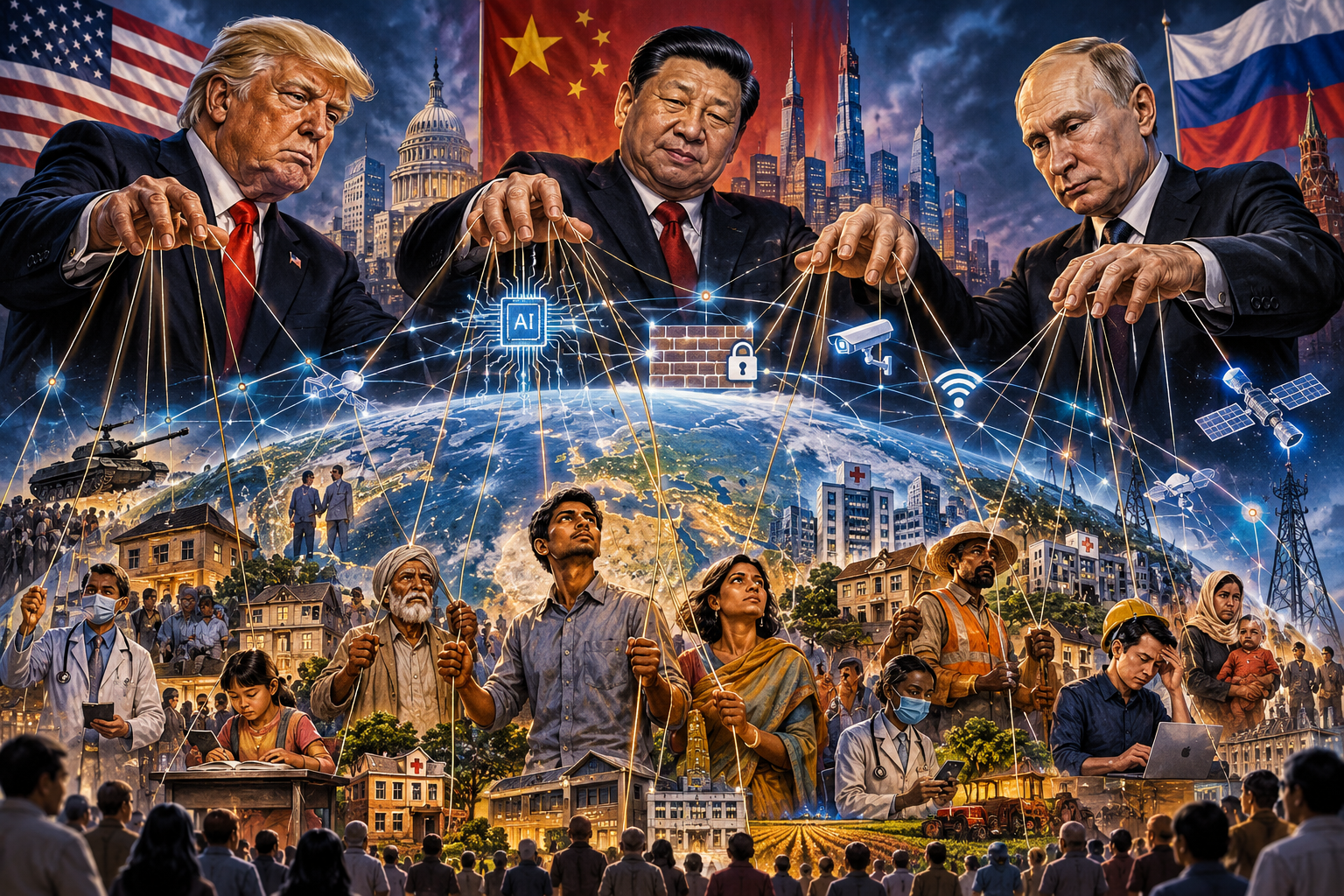
“Hi, puppets. We are here to make you dance. Do surrender more.”
Imagine the announcement from a grand stage: three of the world’s most powerful leaders meet, cameras flash, hands are shaken, and the world is invited to contemplate a new global order. In Shenzhen, on 19 November 2026, Donald Trump, Xi Jinping and Vladimir Putin held their first trilateral meeting. The public symbolism was enormous. The practical results, according to reporting on the meeting, were far less definite: a declaration with broad language on peace, energy and international institutions, but no clear implementation plan and no reference to the wars in Ukraine or Iran. The Guardian’s account of the summit and Associated Press coverage invite a simple question: what does a historic photograph mean to people whose lives are being destroyed far from the conference table?
This is not an argument that three men secretly control every conflict, economy or technology platform. Nor does a meeting prove that the participants have divided the planet between themselves. It is a question about concentrated power: when leaders with immense military, economic, diplomatic and technological influence gather, do they understand the daily reality of people who have no seat in the room? And when they do understand it, what are they prepared to change?
The puppet stage and the people beneath it
The puppet is not merely a person ordered to obey. It is a citizen whose choices are narrowed without meaningful explanation: the worker whose livelihood depends on an opaque platform; the family whose access to information disappears during an internet shutdown; the refugee reduced to a number in a negotiation; the patient unable to reach a clinic; the small business whose visibility is controlled by an algorithm; the student whose future is shaped by systems they cannot question.
Technology can widen human freedom. It can also centralise the power to rank, monitor, exclude, predict and silence. Artificial intelligence does not literally govern the Western world as a single authority, and it is misleading to treat every automated decision as a conspiracy. But governments and private platforms increasingly use automated systems in decisions about information, work, identity, security and access. When a person cannot discover why a decision was made, appeal it, or speak to a responsible human being, the promise of convenience begins to resemble a new form of dependency.
The Freedom House 2025 report on internet freedom recorded a fifteenth consecutive year of global decline. Its findings describe censorship, manipulation and constraints on digital expression in both authoritarian states and democracies. The IFRC World Disasters Report 2026 also discusses the power of content moderation and automated tools to determine what remains visible online. These are documented concerns. They do not prove that every post is being blocked by AI, or that this article will be prevented from reaching readers. They do show why transparent rules, independent review and a real right of appeal matter.
Ten realities that should interrupt every summit photograph
The following are not ten events personally caused by the three leaders at the summit. They are ten documented realities from the world they help shape through diplomacy, trade, arms policy, technology, alliances and international institutions. The point is not to assign identical responsibility to every government. It is to ask why the protection of ordinary people remains so weak when the world’s most powerful states have so many instruments of influence.
1. Gaza: a civilian catastrophe that cannot be reduced to a negotiating position
The UN Secretary-General’s 2026 report on the protection of civilians recorded at least 20,000 Palestinians killed or whose remains were recovered in Gaza during 2025, according to the Gaza Ministry of Health, with thousands of women and children among them. The report also described widespread destruction and severe civilian harm. Whatever position a government takes on the conflict, the test of leadership must include protection of civilians, humanitarian access, accountability and a credible political horizon—not only strategic alignment. UN Secretary-General’s report, S/2026/390.
2. Sudan: families trapped between armed forces and collapsing services
The same UN report recorded more than 11,000 civilian deaths in Sudan in 2025. In November 2026, the UN Human Rights Office reported that at least 1,390 civilians had been killed between January and June 2026, with more than 80 per cent of those casualties attributed to drone strikes. The attacks and the destruction of water, power and health facilities turn warfare into a daily struggle for food, safety and survival. UN Human Rights Office, 17 November 2026.
3. Democratic Republic of the Congo: violence and displacement in the east
The UN’s 2026 protection-of-civilians report recorded more than 3,800 civilian deaths in the Democratic Republic of the Congo during 2025, with a sharp rise in fatalities. Civilians face killings, displacement and the destruction of the conditions needed for ordinary life. The question for influential powers is whether diplomatic pressure, arms-related decisions and regional engagement are being used consistently to protect people—not merely to preserve strategic relationships. UN report, S/2026/390.
4. Myanmar: violence accompanied by the loss of civic space
The UN report documented more than 1,500 civilian deaths in Myanmar in 2025, as indiscriminate aerial attacks intensified. The crisis is also a communications crisis: millions have experienced internet restrictions and shutdowns since the 2021 military takeover, particularly in conflict-affected areas. When people cannot safely report what is happening around them, the world loses witnesses as well as connectivity. UN report, S/2026/390; IFRC World Disasters Report 2026.
5. Ukraine: civilians living under attacks on homes and energy systems
The UN recorded more than 2,500 civilian deaths and 12,000 injuries in Ukraine in 2025. Its report also described 429 attacks on energy infrastructure, a 32 per cent increase from 2024, causing power cuts during freezing conditions. On 19 November, the three leaders’ declaration did not set out a concrete path for resolving the war. A declaration about peace is not a peace process unless those living through the war can see a credible route to security, sovereignty and an end to attacks. UN report, S/2026/390; The Guardian, 19 November 2026.
6. North-east Nigeria: violence that rarely receives the attention it deserves
The UN report recorded approximately 4,000 civilians killed in north-east Nigeria in the first eight months of 2025. The figure is a reminder that human suffering does not become less urgent because it receives less global coverage. The international community’s attention is selective; a family’s need for safety is not. UN report, S/2026/390.
7. Humanitarian workers: even those bringing help are being killed
In April 2026, the UN told the Security Council that at least 326 humanitarian workers had been killed across 21 countries in 2025. These were people delivering food, water, shelter and medicine. When humanitarian workers and clearly marked missions cannot be protected, the failure is not abstract: it reaches the last person waiting for assistance. UN briefing to the Security Council, 8 April 2026.
8. Yemen: hunger and water scarcity become part of the conflict
The UN report found that 18.1 million people in Yemen faced high levels of acute food insecurity in 2025, while more than 13 million lacked access to safe water. Air strikes and damage to ports, fuel facilities and power stations compounded shortages and disrupted humanitarian supplies. These are not distant policy indicators: they determine whether a family can drink safely, feed children or reach medical care. UN Secretary-General’s report, S/2026/390.
9. Healthcare under attack: the place people run to for help is no longer safe
In 2025, the UN recorded 1,356 conflict-related attacks on healthcare in 18 conflict settings, resulting in 1,980 deaths and 1,175 injuries. The report said the number of incidents had risen substantially since monitoring began in 2018. Hospitals, health workers, medical convoys and patients must never become routine casualties of war. UN Secretary-General’s report, S/2026/390.
10. Digital restrictions: the public square can be switched off or quietly narrowed
Freedom House reported that internet freedom declined for the fifteenth consecutive year in 2025. Its India country report described website blocking, content-removal orders and arrests linked to online commentary during the period it assessed, alongside internet shutdowns in Manipur. These examples do not mean every country uses the same methods, or that every moderation decision is censorship. They do establish that access to communication can be restricted through law, infrastructure and platform systems. Freedom House, 2025; India: Freedom on the Net 2025.
When a good tool becomes an instrument of control
Artificial intelligence can help doctors detect disease, farmers plan irrigation, teachers reach students, and citizens understand public services. The danger begins when systems built in the name of efficiency become unaccountable gatekeepers. A recommendation engine can make a voice practically invisible without formally deleting it. Automated fraud detection can freeze access to a service. A facial-recognition match can trigger scrutiny. A moderation system can remove lawful speech by mistake. A government can order a network shutdown. A platform can change its rules without giving users a meaningful appeal.
These mechanisms are different and should not be collapsed into one allegation. Some are state actions; some are private platform decisions; some are technical errors; some are legitimate safety measures applied badly. But together they raise one essential question: who can challenge the decision that changes a person’s life?
We should also resist the claim that this article, or every ordinary person’s message, is necessarily being blocked by AI firewalls. We do not have evidence of a specific system suppressing this article. The concern is broader and testable: are lawful messages being removed, down-ranked or made inaccessible; are people told why; can they appeal; are independent researchers allowed to audit the systems; and can citizens communicate directly without being forced through opaque intermediaries?
Do leaders know what an ordinary day feels like?
A summit room is insulated from the price of cooking oil, the missed wage, the power cut, the hospital queue, the internet outage and the fear of sending a child to school. Leaders may receive reports about all these things. The harder question is whether those reports can change their decisions—or whether ordinary people are present only as numbers, voters, consumers, labour, security risks and bargaining chips.
It is tempting to imagine that leaders consider themselves gods. We cannot know their private beliefs from a photograph or a speech. But political systems can behave as if those at the top are beyond correction: decisions are announced, dissent is treated as disloyalty, and responsibility is passed down to officials, algorithms or distant enemies. That is the real danger of a god-like posture—not a claim about anyone’s inner psychology, but the absence of accountability.
Two nearer illustrations: a railway platform and an unanswered initiative
The distance between a grand account of progress and ordinary life is not visible only in war zones or international statistics. It can be seen in a public place that people use every day. The following account is a first-hand observation shared by the founder of Tatsat Cosmos after visiting a railway station in Bihar. The station is not identified here because its name and an independent facilities assessment have not been supplied. This is an account of what was seen on that visit, not a claim that every station in Bihar or every country is identical.
Illustration one: the railway station where privacy itself was missing
There was a tubewell, and people were bathing in public at the station because there was no facility that provided privacy. The approach to the station appeared to belong to an earlier age of manual labour; the outer portions were described as shattered; basic facilities seemed absent or inadequate. Outside, people were doing hard physical work simply to sustain a livelihood. The scene was not an abstract development indicator. It was the ordinary human body, the need for privacy, the condition of public infrastructure and the struggle to earn enough to live.
What would a discussion about the future of the world look like if those making it had to begin there? Not with a ceremonial photograph, but with questions asked at the platform: Where can a traveller wash and bathe with dignity? Who is responsible for safe, usable facilities? How long have repairs been pending? What does a worker earn for a day’s labour, and what security accompanies that work? Who receives a complaint, and what happens after it is made?
This observation does not, by itself, establish the condition of every railway station or explain which authority is responsible for each deficiency. Those questions require the station’s identity, dated photographs where appropriate, official facility records and responses from the responsible railway administration. But the observed absence of privacy and the visible condition described are serious enough to demand investigation. A global vision that cannot make room for such questions is incomplete.
Illustration two: Tatsat Cosmos and the limits of being able to publish
There is a second illustration closer to the subject of this article. Tatsat Cosmos is an independent initiative that has spent sustained effort documenting older knowledge traditions, developing research propositions, publishing arguments and proposing ways to contribute to public understanding. Its founder reports that the initiative has approached more than a thousand institutions or institutional contacts through its various channels over time. This is the initiative’s account of its accumulated outreach, not an independently audited count of successful deliveries or verified readership.
Despite that extensive effort, the founder reports no confirmed institutional collaboration to date and no substantive response that has translated into a practical route of support. A recent round of ten introductory emails sent with assistance is only one small, recent part of the wider history; it must not be mistaken for the total outreach undertaken by Tatsat Cosmos. Nor can we claim that every earlier message reached the right person, was read or was formally considered. The unanswered question is precisely why so much effort to communicate has not become a meaningful exchange.
This is not evidence that every institution deliberately ignored the initiative, or that a coordinated system has blocked its work. Institutions may have limited capacity, different priorities, unclear procedures or reasons for declining that they have not communicated. But when independent people and small initiatives repeatedly make proposals and receive no useful route to evaluation, the practical result is exclusion even without a single identifiable censor. The ability to send a message is not the same as having access to a process that considers it.
There is an uncomfortable parallel between these two illustrations. At the station, people can be physically present in a public place yet lack facilities that protect their dignity. Online, a person can publish, submit proposals and contact institutions yet remain outside the processes where decisions and resources are allocated. One is a problem of public infrastructure and basic services; the other is a problem of institutional access and meaningful participation. They are not the same hardship, but both expose the gap between formal availability and real access.
That gap should also change how we measure technological progress. A website visit, a social-media impression, an automated acknowledgement or a sent email is not proof that a person has been heard. Meaningful participation requires a route to a responsible human response, a fair opportunity to be considered, an explanation when a proposal is declined, and—where a proposal has merit—the possibility of collaboration or practical action.
These cases do not prove that the world is uniformly collapsing, that all authorities are indifferent, or that mass communication is universally compromised. They do challenge the easy presentation of progress as though connectivity, global meetings and advanced tools automatically improve human life. The test must be what people can actually access, question and change.
India, South-East Asia and Africa must not become testing grounds
India and South-East Asian societies are not empty spaces waiting to be organised by outside powers. Nor is Africa a permanent laboratory for other people’s strategies. These regions contain sovereign states, diverse communities, knowledge traditions, democratic aspirations and people entitled to shape their own futures. Partnerships in AI, infrastructure, minerals, trade and security should be judged by who gains, who bears the risk, who owns the data, who can refuse, and who can seek remedy when harm occurs.
The same standard must apply to Washington, Beijing, Moscow, New Delhi and every other capital. No country should claim a monopoly on freedom while restricting it at home; no country should condemn digital control abroad while building unaccountable systems of its own. The measure is not the flag above the data centre. It is the rights and dignity of the people whose lives run through it.
A demand, not a surrender
The people are not puppets. They are the source of political legitimacy, the makers of economies, the keepers of culture and the ones who live with the consequences of decisions. They do not owe unconditional surrender to presidents, parties, corporations, algorithms or machines.
So let every summit answer questions that cannot be hidden behind a photograph: What measurable steps will protect civilians? What pressure will be applied when aid is obstructed? What transparent rules govern AI in public services and essential private services? Who audits automated decisions? How can people appeal? When will internet shutdowns end? How will workers and communities share in the gains of technology? And where can an ordinary person speak and receive a human answer?
We do not ask the powerful to dance for us. We ask them to stop treating the world as a stage on which everyone else must perform. A technology worthy of humanity must enlarge human agency, not replace it. A leadership worthy of respect must listen before it commands.
Perhaps the most dangerous puppet is not the person whose strings are visible. It is the person who has been made to believe that no strings exist—and that no one is listening when they speak.
Tatsat Cosmos invites readers, researchers and public-interest organisations to examine the evidence, challenge the arguments and contribute documented cases. If you have experienced a specific restriction on communication or an automated decision that affected your life, share verifiable details where it is safe to do so. Critical evaluation is welcome.
Sources and further reading
- United Nations Secretary-General, Protection of Civilians in Armed Conflict, S/2026/390 (7 May 2026)
- UN Human Rights Office: Sudan drone strikes and civilian harm (17 November 2026)
- The Guardian: APEC summit and the Trump–Xi–Putin meeting (19 November 2026)
- Associated Press: the first trilateral meeting of the three leaders
- Freedom House: Freedom on the Net 2025
- Freedom House: India country report, 2025
- IFRC: World Disasters Report 2026
- UN Human Rights Monitoring Mission in Ukraine: protection-of-civilians reports
Editorial note: The ten examples document civilian harm and restrictions reported by UN bodies and independent organisations. They do not establish that the three leaders named above personally caused every event or that they were silent in every diplomatic forum. The article criticises the gap between concentrated global influence and the limited protection experienced by ordinary people.