The Dandiya Dancing Chai Wala Who Has It All!
GOSSIP POINT | ECONOMY · POLITICS · SOCIETY
But are stall visitors entitled to question, or only to pay?
Sunno bhi. Padho bhi. Share bhi karo!
“Chai le lo! AADHA piyo, ruko Ab Pura Chai piyo, ye shubh muhurat hai abhi!
Evaluation ki jagah mast raho!”
The Chaiwala is shouting again. His business is doing well, visitors are coming, and everyone seems to be enjoying the atmosphere. There is Amul milk in his tea, coming all the way from Gujarat. He is proud of it, and why shouldn’t he be? After all, Gujarat has its own identity, its own contribution and its own place in India’s economic journey. Yes, burrowed acumen of social participation, originally originated in UP & Bihar, later transferred to all the part of India.
But, Chaiwala ji, a small question!
The visitors who come to your stall are happy to pay. They are participating in your business, helping you generate revenue and making your stall popular. But are they also entitled to question how the business is growing, where the earnings are going and whether the neighbourhood is benefiting from all this activity?
Or should they simply drink their tea and remain happy?
The people who created wealth beyond their own land
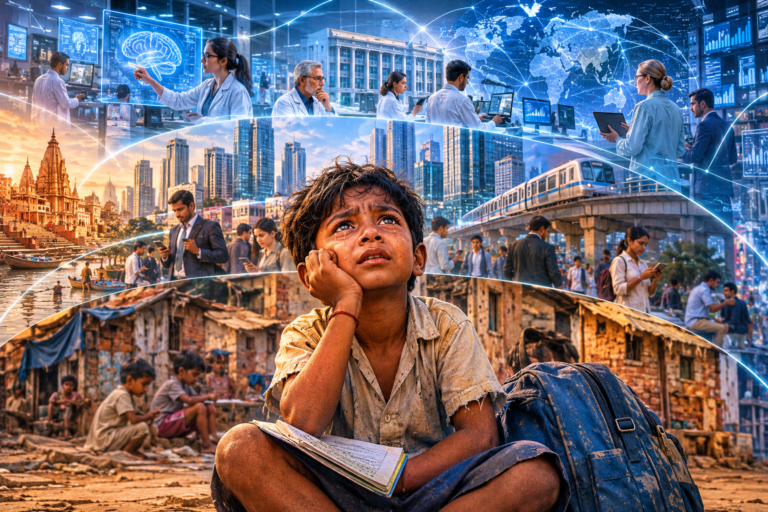
When we discuss India’s economic development, Uttar Pradesh and Bihar often find themselves described through the language of population, poverty, migration and labour.
I think this description misses something much bigger.
The people of these regions have not merely travelled to other parts of India to work as labourers or employees. They have carried their capabilities, knowledge, enterprise, business acumen and willingness to create wealth wherever opportunities were available or truly said THappar mar party forced them to go pyar se.
They have helped expand businesses, industries, trade, services and economic activities across the country. They have participated in building cities and creating new economic possibilities.
But an interesting paradox remains.
They have often retained their ancestral lands, family connections and cultural roots in their home regions, while extending their economic participation across India. Their ability to create wealth travelled beyond their own districts, but the economic advancement generated through their participation did not always translate into comparable development of their home regions.
The question is not whether they should have migrated. Migration itself is not the problem. People should have the freedom to work wherever the opportunity is created.
The real question is why the regions from which so much economic capability has travelled have not developed enough opportunities to attract that capability back.
Why should someone who has acquired experience, skills and financial strength elsewhere find it so difficult to establish a comparable economic activity in their own district?
Why should a person retain land in eastern Uttar Pradesh or western Bihar but find better prospects for investment, business and employment somewhere in Delhi, NCR or another metropolitan region?
Is this really the economic model India wants to continue following?
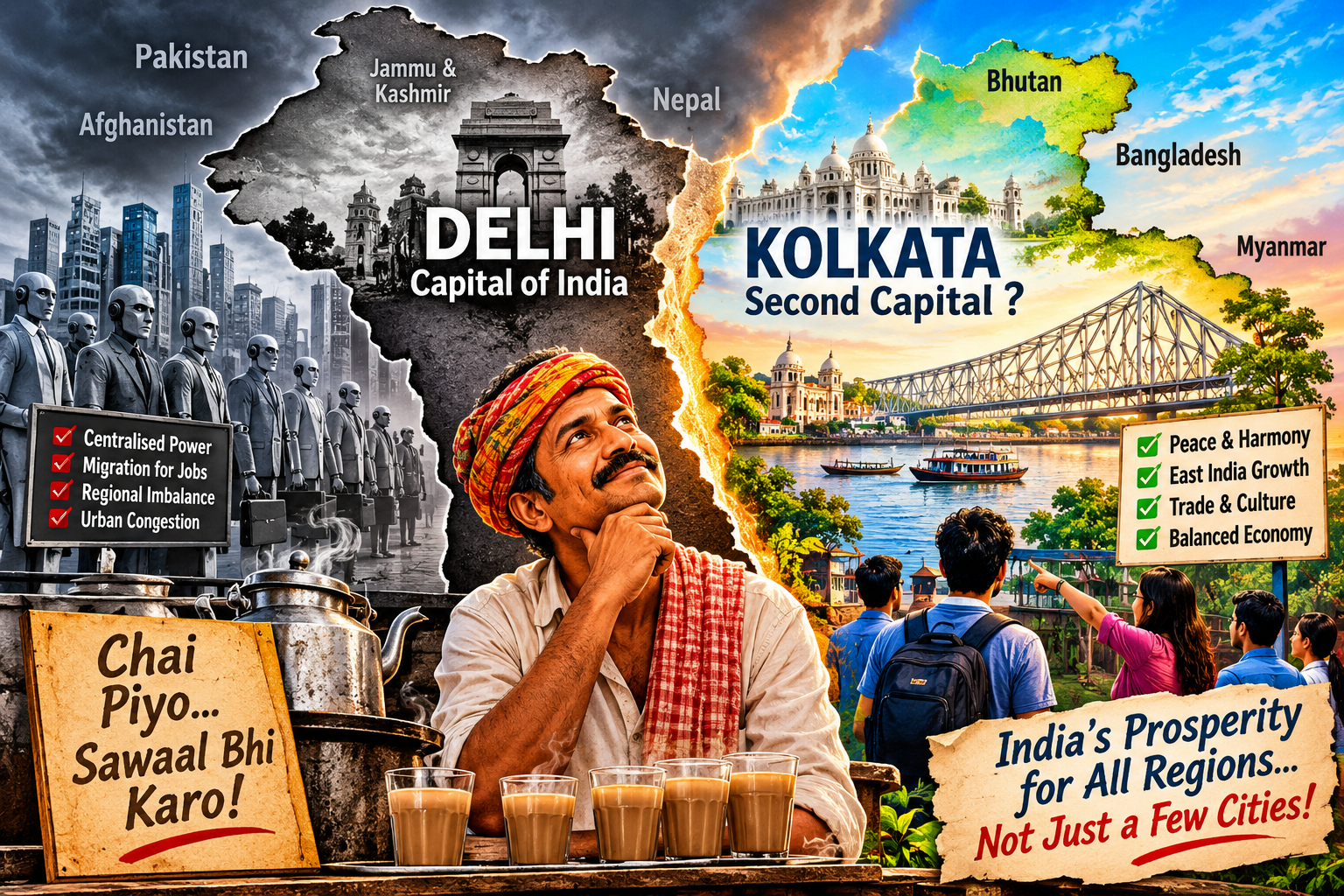
When Kolkata was the capital, where was Kashi?
There is another interesting aspect to India’s development journey.
Kolkata was once the capital of British India. In 1911, the British announced the transfer of the capital to Delhi.
In my view, Kolkata had a stronger logical geographical and economic position to remain the national capital. And if we look at the historical and civilisational geography of India, Kashi occupied a much more central position in the great Gangetic region.
What if the capital had remained in Kolkata? What if the institutional, transport and economic development of the country had evolved with greater emphasis on the Gangetic corridor?
Perhaps India’s economic geography would have taken a different shape.
Of course, nobody can say with certainty what India’s economy would look like under a different historical arrangement. But the question is worth asking: have we given sufficient importance to the geographical distribution of economic power in this country?
A national capital is not merely a seat of administration. Over time, it attracts institutions, infrastructure, investment, employment and associated economic activity.
And when such advantages become concentrated in a few locations, other regions may find themselves participating in the growth of the country without receiving an equivalent opportunity to develop their own economic ecosystems.
The backbone is not meant to remain dependent
Uttar Pradesh, Bihar and West Bengal have contributed enormously to India’s cultural and social identity. These regions are not simply geographical units on a map. They are part of the historical foundation of Indian civilisation and the social fabric that sustains unity in diversity.
But I do not want to describe their people merely as the backbone of the country because they supply workers.
A backbone is not valuable only because it carries weight. It is essential because it makes the entire body functional.
Likewise, the people of these regions have contributed much more than their physical labour. They have extended their intellectual, commercial and entrepreneurial capabilities into other parts of India.
‘Pankti me Khade raho, Note Bandi Hai—Line me lag kar paise milenge.’ Half pant ya full pant ye ab tumhara choice diya gaya hai.’
The economic development they helped create elsewhere should now have a meaningful reflection in the development of their own regions.
This is not a demand to take away the prosperity of other states. It is a demand to create a more balanced economic structure in which prosperity is not restricted to a few metropolitan destinations.
India should not have to create cities merely to accommodate people who leave their own districts in search of employment. It should also create opportunities in those districts so that people can establish businesses, generate employment and build wealth where they already have roots.
The real economic advancement of India lies in the spread of its economy, not merely in the expansion of a few cities.
A little more than a ropeway, Chaiwala ji!
“Chai le lo! Chai piyo!”
The Chaiwala interrupts the discussion once again.
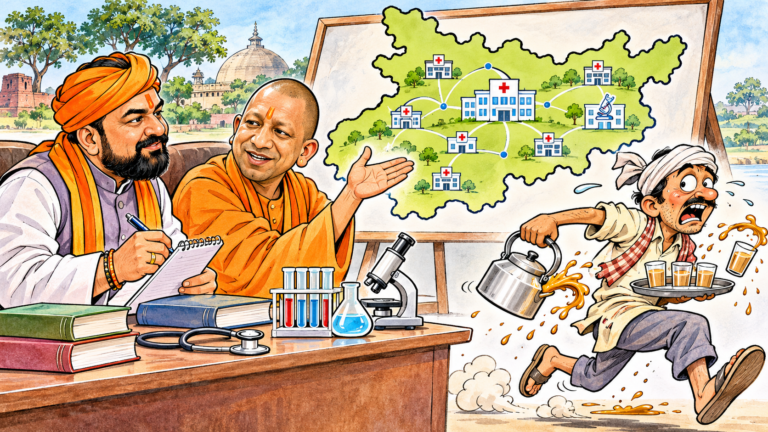
“Rassi par jhula latka diya hai! Teen se chaar kilometre ke shehar ka jhule se darshan karo aur chalte bano!”
Well, Chaiwala ji, a ropeway may certainly be useful. It can serve a purpose where geography and transport requirements justify it. But is a three-to-four-kilometre ride really the development vision that eastern Uttar Pradesh and western Bihar should aspire to?
My point is much larger.
Proper district connectivity across eastern Uttar Pradesh and western Bihar should become a priority for the present governments. The region needs an integrated transport network connecting its towns, district headquarters, agricultural markets, educational institutions, industrial locations and healthcare facilities.
Metro connectivity should be considered wherever urban density and feasibility support it. Elsewhere, rapid rail, suburban rail, better intercity transport and modern road networks may be more appropriate.
The governments should work towards launching meaningful initial projects within two to three years wherever feasible, rather than allowing regional connectivity to remain an endlessly discussed ambition.
But transport is only one part of the picture.
The region also needs investment in industrial development, food processing, warehousing, technology, education, healthcare, tourism and modern agricultural infrastructure.
Imagine what could happen if the people who have developed businesses and acquired experience in other parts of India could bring some of that economic activity back to their home districts.
Imagine young people finding meaningful employment without having to leave their families and ancestral connections behind.
Imagine local entrepreneurs building enterprises that serve national markets.
That is the kind of economic expansion I am talking about.
People are not asking for what belongs to somebody else
“Rukiye is Cricketer ko youth Icon Banate hai, ye apni party ke manifesto par thik baithta hai. Ya sadhu baba bhi thik hai inhe to tota banate hai………..”
There is an important distinction here.
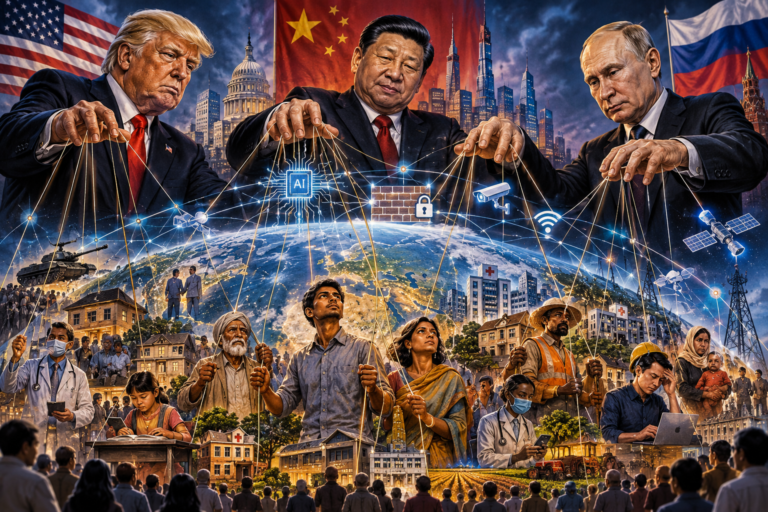
The people of these regions are not asking for somebody else’s prosperity. They are not asking that other states should stop developing. They are asking why the economic capabilities they have contributed to the country have not resulted in stronger opportunities in their own regions.
They still have their lands. They have their families, their knowledge of local conditions and their cultural connections. These are assets that can support economic growth.
But land without infrastructure, capital, technology, connectivity and markets cannot unlock its full potential.
A person may own land in his village, but that does not automatically give him the economic ecosystem available to someone operating in Delhi NCR, Mumbai, Ahmedabad or Bengaluru.
The answer is not to turn every district into another Delhi or Mumbai. The answer is to develop each region according to its own strengths, resources and possibilities.
The country needs a distributed economy in which people can create wealth in different parts of India rather than being compelled to concentrate their economic lives in a few cities.
And perhaps that is where the next chapter of India’s development should begin.
One last question for the Mighty Chaiwala
The Chaiwala has all the ingredients. He has milk from Gujarat, customers from different regions, a successful business and a loud voice.
But the visitors have also contributed to making his stall what it is today.
They are willing to pay. They are willing to participate. They are willing to help the business grow.
Shouldn’t they also have the right to question the way its success is being shared?
The people of Uttar Pradesh and Bihar have participated in India’s economic expansion for generations. Their contribution should not be remembered only when workers, employees, consumers or migrants are needed.
It should also be recognised when the country decides where its next investments, institutions, infrastructure and opportunities will be created.
Let Delhi grow. Let Mumbai grow. Let Ahmedabad grow. Let every city and every state prosper.
But let eastern Uttar Pradesh and western Bihar grow too.
Not as beneficiaries waiting for somebody’s generosity, but as active centres of wealth creation, enterprise and opportunity.
India does not need to shift its prosperity from one region to another. It needs to expand prosperity across all regions.
And, Chaiwala ji, please remember:
Visitors are entitled to pay for their tea. But they are also entitled to question the business.
Chai piyo, magar sawaal bhi karo!
Jai Shree Ram!
P.S. — A personal view of the author
I would also like to see Kolkata become India’s second capital. Delhi, as the national capital, continues to carry for me the symbolism of a colonial inheritance — a reminder of Gulami, with the lingering smell of subjugation. This is a personal and deliberately provocative view, not a claim that changing the capital alone would resolve India’s regional economic imbalance.
Perhaps it is time to rethink the symbolism as well as the geography of national power. A second capital in Kolkata could be one way to give renewed institutional attention to eastern India and the wider Gangetic region. Whether such a proposal is practical is a matter for national debate; the question itself deserves to be heard.