Virāṭ Puruṣa: The Complete Human Being in Pure Consciousness
An experiential and philosophical inquiry from Tatsat Cosmos. This article begins with a practitioner’s repeated meditative observation and asks whether the cosmic-body imagery of the Puruṣa Sūkta can be approached through the unity of the individual body, rather than used to assign inherited identities to human beings.

Abstract
The Virāṭ Puruṣa of the Puruṣa Sūkta is presented as a cosmic whole. Yet the hymn’s association of the mouth, arms, thighs and feet with four social categories has often been read as a map of human society. This article begins elsewhere: with the experience of the complete human body in a standing posture of meditation and worship.
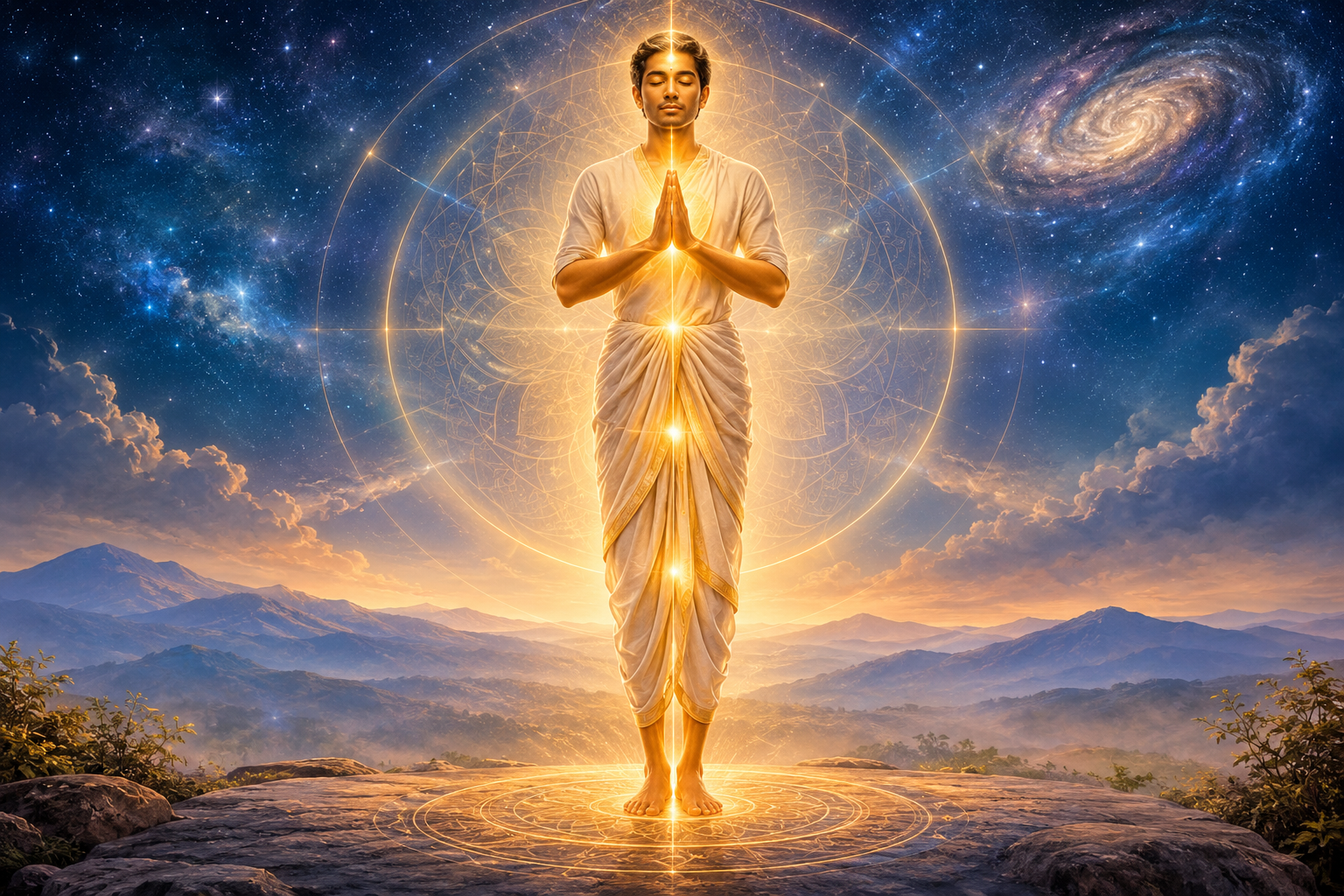
The author’s reported practice, repeated on approximately one hundred occasions, involves standing upright with the hands joined. In this posture, the head is experienced as the centre of conscious orientation; the joined hands as instruments of connection, invocation and action; and the thighs, legs and feet as the supporting structure that bears the body’s weight and enables the head to remain upright and still. The posture is not accomplished by one region alone. It arises through the coordinated participation of the whole body.
From this experiential starting point, the article advances a clear philosophical position: the fourfold bodily imagery should not be used to divide people into inherited or spiritually unequal human types. Different responsibilities may be organised in society, but occupational or social functions do not define the completeness, consciousness or worth of an individual. This is an interpretive proposal, not a claim that the literal wording of Ṛgveda 10.90.12 says that each person contains four varṇas. The article distinguishes textual statement, historical reception, meditative experience and philosophical interpretation.
1. Begin with the whole human being
A question about the Virāṭ Puruṣa need not begin by assigning a social identity to each bodily region. It can begin with the human being as a complete living presence. In meditation, attention may move away from the body’s external appearance and towards the way its regions cooperate in stillness, balance, gesture and awareness.
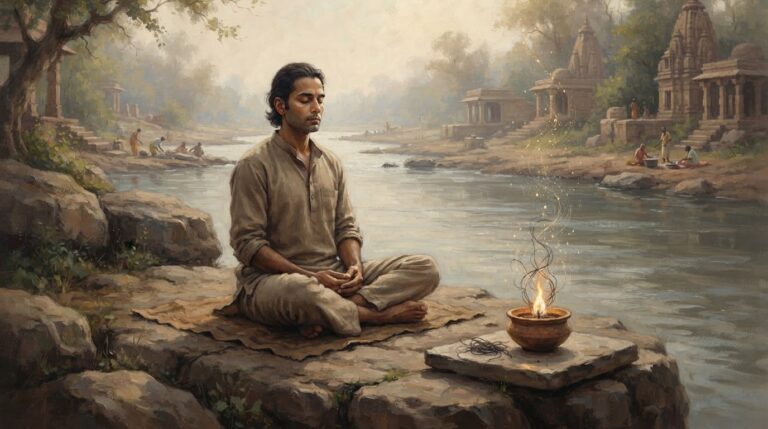
The experience considered here has been undertaken repeatedly by the author, approximately one hundred times, in a standing posture with the hands joined in worship. This is a first-person account. It is offered as experiential material for philosophical examination, not as an independently verified experiment or a universal description of what every practitioner must experience.
In this posture, no region stands alone. The head’s uprightness depends upon the alignment of the torso and the support of the lower body. The hands can remain joined because the arms and shoulders participate. The legs and feet sustain balance. The whole posture is an achievement of coordination.
2. The head: conscious orientation and discernment
In the author’s meditative observation, the head is experienced as a powerhouse of conscious orientation: the region through which attention, perception, thought and discernment are most immediately recognised. The description is phenomenological and symbolic. It does not claim that consciousness has been scientifically located in the head alone, nor that the head can function independently of the rest of the body.
The author uses the word Brahman to indicate the orientation towards ultimate reality or pure consciousness, not as a synonym for Brāhmaṇa, the social category named in Ṛgveda 10.90.12. These are distinct Sanskrit terms and must not be conflated. The head’s symbolic association with conscious discernment is therefore a proposed philosophical reading, not a literal translation of the Vedic word.
3. The hands: connection, invocation and action
The joined hands are central to the posture described. They form a gesture of worship and inward orientation, while also representing the human capacity to connect, touch, receive, give, create, protect and act. In the author’s experience, the gesture is a way of calling upon or aligning with the Virāṭ Puruṣa within the body.
The hands are not presented as a symbol of one class of people. They are instruments through which the individual participates in the world. Their meaning in this inquiry comes from their relationship with the head, torso and supporting lower body: the gesture becomes possible through the whole person’s coordinated presence.
4. Thighs, legs and feet: the responsibility of support
Standing makes the contribution of the lower body unmistakable. The thighs, legs and feet bear weight, maintain balance and provide the support through which the torso and head can remain upright. The head cannot claim the posture as its own achievement. The joined hands cannot sustain it by themselves. The lower body is indispensable to the whole.
This observation challenges any interpretation that turns bodily difference into inherent superiority or inferiority. The region that supports the whole is not lesser than the region it supports. Each has a distinct function; none is the complete body by itself. The posture exists through their coordination.
5. The right and left sides: an observation, not a biological rule
The author’s wider meditative observations include a perceived difference between the right and left sides: the right is experienced as more directly aligned with truthful or settled thinking, while the left is experienced as gauging possibilities, adapting and working through changing circumstances. This is recorded as the author’s subjective experience, not as an established neurological law or a claim that one side of the body is objectively more truthful.
Modern neuroscience does identify some functional lateralisation in the brain, but complex thought, judgement and action depend on interacting networks across both hemispheres and the wider nervous system. The familiar popular division of the left brain as one kind of thinker and the right brain as another is too simple to serve as proof of this meditative interpretation. A careful future study could document practitioners’ descriptions and compare them with validated measures, without presuming that the two accounts are identical.
6. Kundalini, nāḍīs and the experience of alignment
Indian yogic and Tantric traditions describe subtle channels, including Iḍā, Piṅgalā and Suṣumṇā, in accounts of yogic practice and Kundalini. Within the experience considered here, awakening and alignment are described as a change in how the body is perceived and coordinated. The central axis and the relation between the two sides become especially significant to the practitioner.
These traditional nāḍī concepts should not be casually equated with anatomical nerves, blood vessels or measurable structures. Nor does a subjective experience by itself establish a specific physiological mechanism. The research treats Kundalini language as part of a contemplative framework and asks how its descriptions may be understood alongside, but not collapsed into, contemporary studies of attention, posture, breathing and bodily awareness.
7. Palms and soles: points of contact
The palms and soles deserve particular attention because they are major interfaces between the individual and the surrounding world. The palms enable touch, grasping, giving, receiving, making and many forms of communication. The soles contribute to standing, walking, balance and contact with the ground. Both are richly involved in sensory and motor activity.
In this inquiry, the palms and soles are also considered symbolic points of contact between one individual and another, and between the individual and the world. A hand can offer help, care or protection; feet make movement and grounded presence possible. The author regards these regions as especially significant in the experience of embodied connection.
This does not establish the stronger claim that the palms and soles contain all functional centres of the body. Reflexology and other body-mapping traditions make claims of this kind, but those claims should not be presented as established anatomy without reliable evidence. The defensible point here is that hands and feet are important sensory, motor and contact regions.
8. Returning to the Puruṣa Sūkta
Ṛgveda 10.90.1 describes the Puruṣa as having a thousand heads, eyes and feet; verse 2 presents the Puruṣa as encompassing all that has been and all that is to come. Verses 11–12 ask about the cosmic body’s parts and associate the mouth, arms, thighs and feet with Brāhmaṇa, Rājanya, Vaiśya and Śūdra.
The wording of verse 12 must be acknowledged honestly: the four social terms are present in the received text. This article does not erase them or claim that a direct translation yields the author’s individual-body interpretation. It asks whether the cosmic-body image can also be examined through the unity and interdependence of the embodied individual, and rejects the use of the verse to claim that people are inherently incomplete, spiritually unequal or confined by birth to one human function.
The proposed reading gives philosophical priority to the wholeness of the Puruṣa and asks what follows when the bodily symbolism is contemplated as a coordinated whole. The mouth, arms, thighs and feet are not four independent bodies. They are parts of one body. At the level of lived human existence, every person has a head, arms, thighs and feet and participates in many kinds of thought, action, production, support and service.
9. Social responsibilities are not the nature of consciousness
A society may organise responsibilities and occupations for practical purposes. Teaching, cultivation, trade, administration, protection, craft, care and physical work all contribute to collective life. People may specialise, learn new skills and move between responsibilities according to ability, interest, opportunity and circumstance.
But practical differentiation is not a measure of a person’s fundamental nature. An occupation does not determine consciousness. A social label does not establish spiritual worth. No form of labour makes a person less complete, and no position grants exclusive ownership of knowledge or access to ultimate reality.
The distinction is therefore between the coordination of responsibilities in a society and the classification of human beings by inherited status. The former may be practically necessary; the latter cannot be justified as a statement about the intrinsic completeness or spiritual capacity of individuals.
10. What science can—and cannot—contribute
Biology and motor science can examine postural stability, weight-bearing, sensory feedback and coordination. Neuroscience can investigate attention, perception and distributed brain networks. Research on meditation can study reported changes in bodily awareness, breathing and autonomic activity. Phenomenology can carefully describe how practitioners experience stillness, alignment and the sense of self.
These disciplines can test specific observations and clarify which aspects are measurable. They cannot, by themselves, prove the metaphysical reality of Brahman or establish the original intention of the Vedic composers. Equally, spiritual experience should not be dismissed merely because it is not identical to a laboratory measurement. The two forms of inquiry must be clearly distinguished and allowed to speak within their proper limits.
11. Conclusion: the whole cannot be reduced to one part
The standing posture of meditation and worship offers a simple but profound observation: the head remains upright through the support of the whole body; the hands join in a gesture of connection; and the thighs, legs and feet carry the responsibility of balance and stability. No region accomplishes the posture alone.
This article proposes that the Virāṭ Puruṣa be approached through this experience of integrated existence. The cosmic-body image need not be reduced to a justification for dividing humanity into inherited identities or unequal levels of worth. Different functions may be present in one body and different responsibilities may be distributed in society, but neither fact makes one person a lesser or partial human being.
The central proposition is not that all people have identical abilities or perform identical work. It is that every individual is a whole human being, capable of learning, acting, creating, supporting and serving. No one should be reduced to one function, and no social classification should be mistaken for the nature of consciousness.
The head cannot stand without the body. The hands cannot fulfil their purpose without support. The legs are not lesser because they carry the weight. The whole exists through the participation of all its parts.
Research boundaries and questions for critical evaluation
- The individual meditative account is the author’s reported experience and has not been independently replicated.
- The interpretation of the Puruṣa Sūkta offered here is a philosophical extension, not a literal translation of Ṛgveda 10.90.12.
- Brāhmaṇa and Brahman are distinct terms and are not used interchangeably.
- Descriptions of Iḍā, Piṅgalā, Suṣumṇā and Kundalini belong to contemplative traditions; they are not asserted to be anatomical structures.
- The right-left distinction is subjective and is not presented as an established neuroscientific fact.
- The article rejects inherited spiritual hierarchy while recognising that the historical text explicitly contains four social terms; the history of their interpretation remains open to further study.
Selected textual and research references
- Ṛgveda 10.90 — Puruṣa Sūkta, Sanskrit text and verse-by-verse access.
- Ṛgveda 10.90.11, Sanskrit, transliteration and traditional interpretation links.
- Stephanie W. Jamison and Joel P. Brereton, The Rigveda: The Earliest Religious Poetry of India, Oxford University Press, 2014.
- Chāndogya Upaniṣad 3.14.1, for the wider philosophical context of Brahman.
This article is published as an exploratory research contribution by Tatsat Cosmos. Readers are invited to examine its textual distinctions, question its interpretation, and offer reasoned criticism or additional sources.