Meghadūta and the Rāmāyaṇa: Love as One Reality Beyond Physical Form
Research Note · Version 1.0 · 19 November 2026
A preliminary literary and philosophical inquiry by Tatsat Research, the research initiative of Tatsat Cosmos.
Abstract
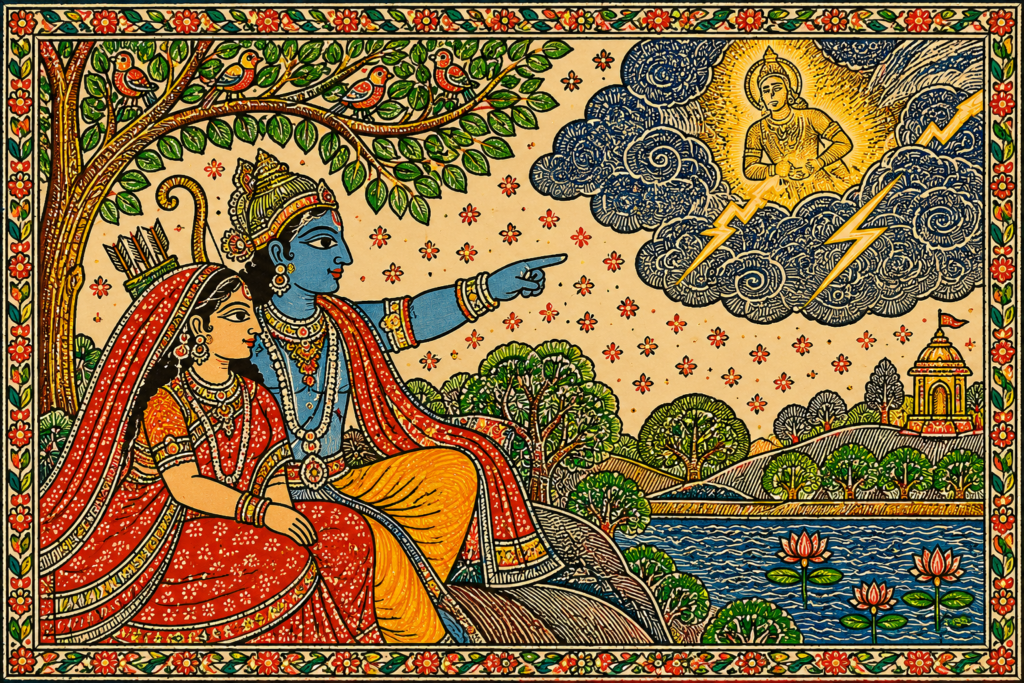
This research asks whether Kālidāsa’s Meghadūta, read alongside carefully selected passages of the Vālmīki Rāmāyaṇa, permits a philosophical exploration of love as a continuity that may exceed the apparent separation of physical forms. The inquiry begins with the Yakṣa’s vision of a cloud resting against a mountain, follows the poem’s movement through monsoon landscape, memory and imagined intimacy, and gives particular attention to the final blessing that the cloud should never be separated from its lightning, even for a moment.
The study does not assume that Kālidāsa is stating a doctrine of non-duality. It treats that possibility as a question to be tested through Sanskrit wording, poetic structure, narrative voice, traditional commentary and relevant scholarship. The Rāmāyaṇa comparison will be made only where close reading establishes a meaningful parallel.
1. The research proposition
Meghadūta is commonly approached through the experience of separation in love (vipralambha-śṛṅgāra), the messenger-poem convention, landscape description and the longing of the exiled Yakṣa for his wife. This project does not set those readings aside. It asks whether they can be accompanied by another question: might the poem’s images of natural relation and its closing blessing invite us to think about love not merely as an emotion sustained across distance, but as a form of continuity in which the apparent two-ness of lover and beloved becomes philosophically significant?
The word “oneness” in this project names a proposed interpretive horizon, not an established statement by the poet. Whether the poem can sustain such a reading remains open to textual examination.
2. Three textual points of departure
The cloud and the mountain
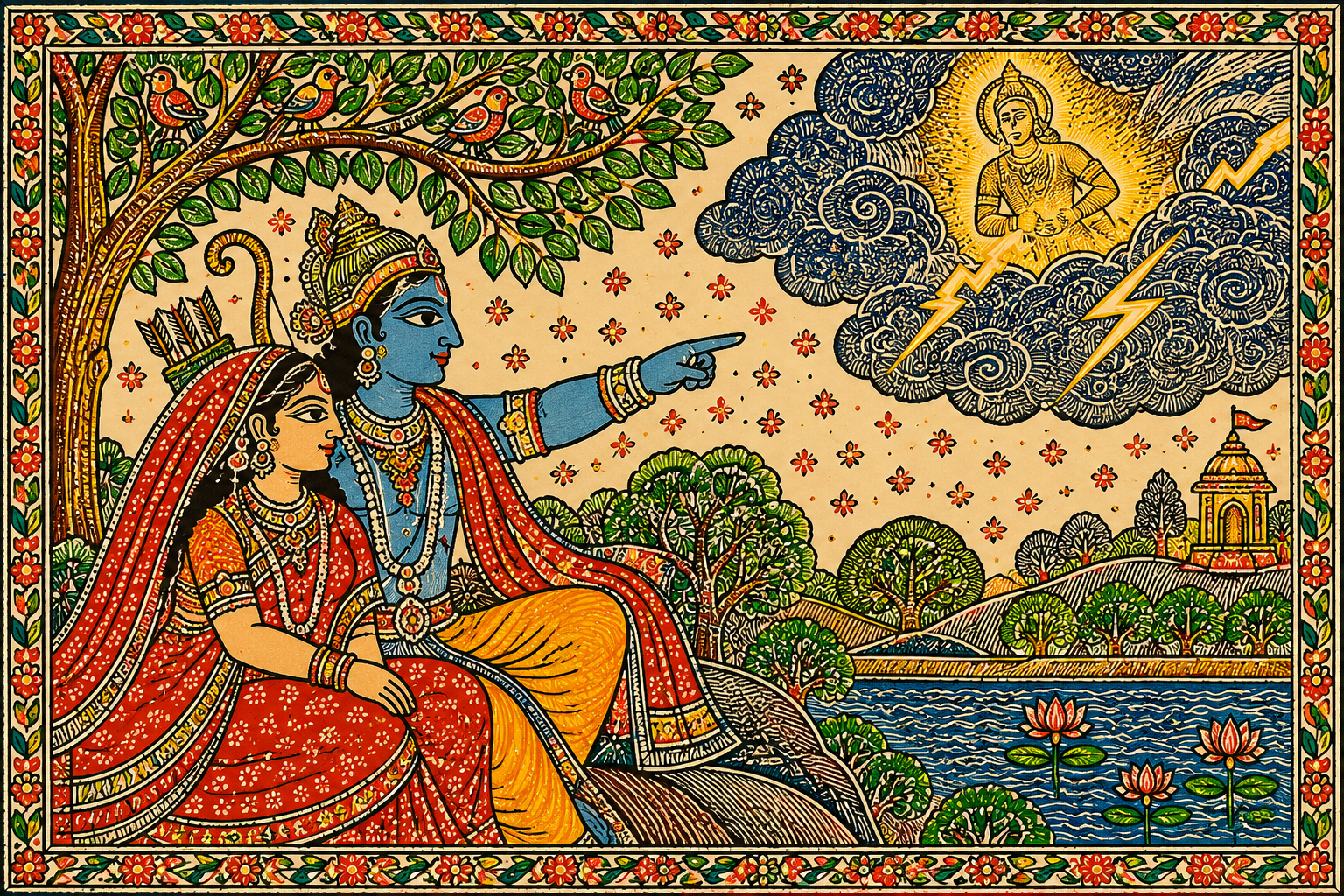
The opening scene presents the Yakṣa seeing a cloud in relation to a mountain ridge. The image is striking because the cloud appears to embrace or cling to the mountain. Before assigning it a philosophical meaning, the study will examine its grammar, simile, visual movement and place in the Yakṣa’s emotional awakening.
Textual note: The opening verse has a reading variation that must be handled transparently. The synopsis initially cites आषाढस्य प्रथमदिवसे (“on the first day of Āṣāḍha”). E. Hultzsch’s 1911 edition with Vallabhadeva’s commentary prints आषाढस्य प्रशमदिवसे and discusses the reading. Verse numbering and readings should therefore be checked against the edition adopted for the final paper; this preliminary note does not silently choose between them.
The cloud as a conjunction
The Yakṣa reflects on the cloud as:
धूमज्योतिःसलिलमरुतां सन्निपातः क्व मेघः
The verse describes the cloud as a conjunction of smoke, light, water and wind, and contrasts it with the capacity of living beings to convey messages. Its immediate dramatic context matters: the Yakṣa’s longing leads him to address an apparently inanimate cloud. The study will consider how this tension between the sentient and the non-sentient functions in the poem. The verse will not be presented as a modern scientific definition of a cloud.
The final blessing: cloud and lightning
At the close, after asking the cloud to perform the favour, the Yakṣa releases it to travel where it wishes and offers a blessing:
मा भूदेवं क्षणमपि च ते विद्युता विप्रयोगः ॥
In working sense: “May there never be, even for a moment, separation between you and your lightning.” The cloud–lightning relation becomes a central point of inquiry. Does this image simply complete the Yakṣa’s affectionate wish, or does its position at the end of the poem allow a larger reflection on inseparability, relation and love? The research will test possible readings against the stanza’s full context and commentary, rather than treating the image as proof of a metaphysical doctrine.
3. Questions guiding the study
- How does the opening image of the cloud and mountain shape the relation between natural form, perception and remembered intimacy?
- How do rain, seasonal movement, landscape and lightning contribute to the poem’s emotional and aesthetic structure?
- Does the final blessing enlarge the meaning of the Yakṣa’s message, and what can the cloud–lightning image reasonably support?
- Can selected passages of the Vālmīki Rāmāyaṇa illuminate a comparable understanding of love, shared destiny or relational continuity without erasing the differences between the two works?
- How have Sanskrit commentators and modern scholars understood these passages, and where might a carefully evidenced interpretation add something useful?
4. Method and safeguards
The project will proceed through close reading of the Sanskrit, comparison of reliable editions, study of available traditional commentaries, literary analysis of imagery and narrative voice, and a controlled comparative method for the Rāmāyaṇa. Terms such as viraha, sneha, sauhārda and viprayoga will be examined in their particular contexts.
Four kinds of statement will be kept distinct: (1) what the Sanskrit text says; (2) what a commentator explains; (3) what historical or modern scholarship argues; and (4) what the present researchers propose as interpretation. The Yakṣiṇī does not directly narrate the poem’s main message. Any suggestion that her voice is present within the Yakṣa’s closing words will therefore remain a hypothesis about poetic voice and relational identity, not a literal claim about the plot.
The Rāmāyaṇa comparison is still to be selected and documented by kāṇḍa and sarga. No parallel will be asserted until the relevant passages have been identified and examined. This note is a statement of a research question and preliminary framework, not a completed proof or a claim that the proposed interpretation is already accepted in scholarship.
5. Proposed direction and outputs
The next stage is to establish the textual base, identify the relevant commentarial and modern scholarship, select the Rāmāyaṇa passages, and prepare annotated Sanskrit excerpts. The intended outputs are a fully referenced research paper or extended essay, a scholarly discussion where possible, and—after the textual work has been reviewed—an educational documentary or learning resource.
Tatsat Research welcomes informed scholarly criticism, suggestions of reliable editions and commentaries, and dialogue with Sanskrit scholars and researchers. The project remains open to revision in light of textual evidence and expert guidance.
Preliminary reference
Kālidāsa. Meghadūta, edited from manuscripts with the commentary of Vallabhadeva by E. Hultzsch. 1911. This edition is an initial reference point; the final study will state the exact edition and readings adopted and will add the Rāmāyaṇa sources and further scholarship after verification.
Research status: Preliminary research note. Version 1.0. Further textual verification, comparative passage selection and scholarly review are in progress.