Tantra in Sanātana Dharma: The Living Architecture of Practice, Consciousness and Sacred Reality
Understanding Tantra beyond popular misconceptions—its place in the scriptural, philosophical and practical worlds of Sanātana Dharma, and why it deserves serious study.
1. Why Tantra needs to be understood again
The word Tantra often produces sharply different reactions. For some, it suggests secret ritual, occult power or sexuality. For others, it evokes mantra, yantra, meditation, temple worship, the Goddess, Śiva, kuṇḍalinī and the disciplined transformation of human awareness. Neither a sensational description nor a romantic one is sufficient.
Tantra is not one book, one sect, one ritual, or one uniform philosophy. It names a wide and internally diverse family of traditions, scriptures, lineages and methods that developed within the religious worlds of South Asia. Hindu Tantric traditions include Śaiva, Śākta and Vaiṣṇava forms, among others. They differ in theology, ritual, metaphysics, initiation and goals. Some share vocabulary and practices; they should not therefore be collapsed into a single system.
This article proposes a foundation for a longer research series. Its central argument is that Tantra is a major and integral dimension of the historical and living landscape of Sanātana Dharma. To understand that claim responsibly, we must distinguish between Vedic antecedents and resonances, the later emergence of identifiable Tantric scriptures and institutions, and the many interpretations that developed across centuries.
2. What does the word Tantra mean?
The Sanskrit word tantra is associated with the verbal root tan, “to stretch” or “to extend”. Traditional explanations connect the word with a framework, system, teaching or method through which knowledge and practice are organised. Such explanations are useful, but no single etymology can define every text or lineage that uses the term.
Tantric scriptures may also be called Āgama, Saṃhitā, Yāmala or by the name of a particular revelation or lineage. These labels are not interchangeable in every historical context. Nor does the word Tantra mean that every text bearing it teaches the same doctrine.
A helpful working definition is this: Hindu Tantra comprises traditions that organise religious knowledge and transformative practice through distinctive combinations of mantra, ritual, initiation, deity visualisation, sacred diagrams, embodied disciplines, subtle-body models, temple practice and philosophical reflection. Not every tradition includes all these elements, and their meanings vary.
3. Tantra and the larger world of Sanātana Dharma
Sanātana Dharma is not a single institution with one central canon or a fixed historical boundary. It is a civilisational and religious field containing Vedic traditions, Upaniṣadic inquiry, Itihāsa and Purāṇic traditions, darśanas, devotional movements, temple cultures, regional practices, and Śaiva, Śākta and Vaiṣṇava lineages. Tantra belongs within this wider field, while also possessing its own distinctive textual histories and ritual systems.
It is important not to make an inaccurate claim that every Tantric doctrine was already fully present in the earliest Vedic hymns. The Vedas contain rich material on divine power, speech, ritual, cosmic order and sacred sound. These provide important contexts for later comparison. But identifiable Tantric scriptures, initiatory institutions and developed systems took shape in particular historical settings, especially during the first and second millennia CE. The relationship is one of layered continuity, reinterpretation and innovation—not a simple equation.
The Devī Sūkta: an ancient Vedic voice of divine power
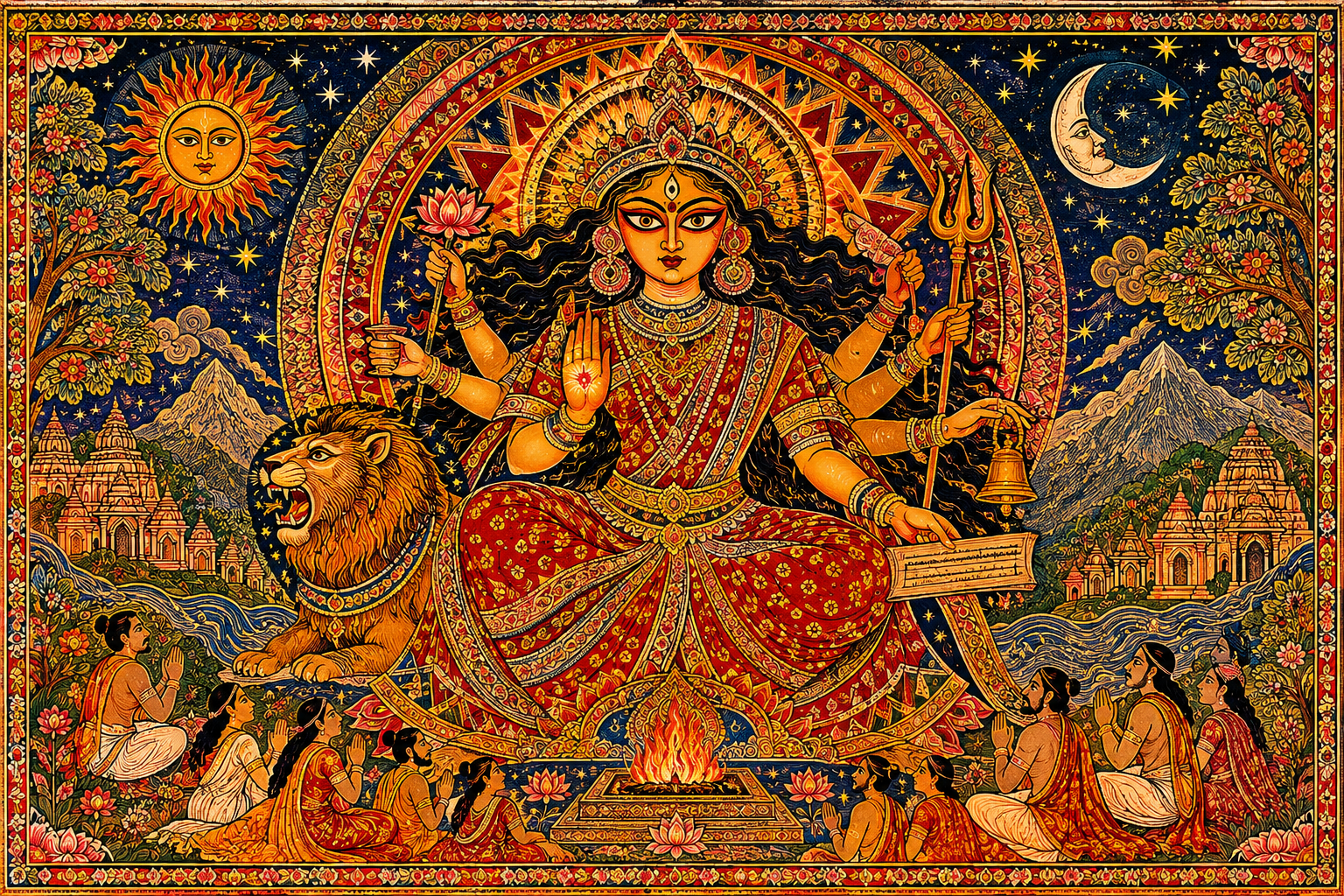
One especially powerful point of comparison is the Devī Sūkta, Ṛgveda 10.125, traditionally associated with Vāk Ambhṛṇī. It is not a Tantric text. It is an ancient Vedic hymn in which the speaking divine voice declares its presence throughout the powers that sustain the cosmos.
ऋग्वेद १०.१२५.१
अहं रुद्रेभिर्वसुभिश्चराम्यहमादित्यैरुत विश्वदेवैः ।
अहं मित्रावरुणोभा बिभर्म्यहमिन्द्राग्नी अहमश्विनोभा ॥“I move with the Rudras and the Vasus; I move with the Ādityas and all the gods. I uphold both Mitra and Varuṇa, Indra and Agni, and the Aśvins.”
Another verse makes the hymn’s vision still more striking:
ऋग्वेद १०.१२५.३
अहं राष्ट्री संगमनी वसूनां चिकितुषी प्रथमा यज्ञियानाम् ।
तां मा देवा व्यदधुः पुरुत्रा भूरिस्थात्रां भूर्यावेशयन्तीम् ॥The speaker describes herself as the sovereign power, the gatherer of treasures, the discerning one and the first among those worthy of the sacrifice, established in many places and entering many forms.
And Ṛgveda 10.125.7 connects this presence with ordinary embodied life:
ऋग्वेद १०.१२५.७
मया सो अन्नमत्ति यो विपश्यति यः प्राणिति य ईं शृणोत्युक्तम् ।
अमन्तवो मां त उप क्षियन्ति श्रुधि श्रुत श्रद्धिवं ते वदामि ॥The hymn presents the divine voice as intimately connected with eating, seeing, breathing and hearing.
These verses should not be labelled “Tantric verses”. Their importance here is comparative: they offer an ancient Vedic language of pervasive divine agency, sacred speech and cosmic participation. Later Śākta and Tantric traditions developed their own sophisticated accounts of Śakti, mantra and manifestation. A serious study can examine resonances without erasing historical differences.
Upaniṣadic and Purāṇic contexts
The Śvetāśvatara Upaniṣad 4.10 states:
श्वेताश्वतरोपनिषद् ४.१०
मायां तु प्रकृतिं विद्यान्मायिनं तु महेश्वरम् ।
तस्यावयवभूतैस्तु व्याप्तं सर्वमिदं जगत् ॥“Know prakṛti as māyā and the great Lord as the wielder of māyā; this entire world is pervaded by that which belongs to him.”
This is an Upaniṣadic passage, not a Tantric formula. It is relevant to later discussions of divine power, manifestation and the relation between the Lord and the world, but it should not be treated as if it already states every later Śaiva or Śākta doctrine.
In the Devī Māhātmya, especially the refrain repeated in its fifth chapter, the Goddess is praised as present in all beings in different forms—such as consciousness, power, intelligence, sleep, hunger and compassion. The well-known refrain yā devī sarvabhūteṣu … rūpeṇa saṃsthitā (“To the Goddess who abides in all beings in the form of…”) became an influential devotional expression of divine presence. The Devī Māhātmya is a Purāṇic text, not a substitute for the distinct Tantric āgamas; its importance lies in the wider Śākta religious world with which Tantric traditions interact.
4. The major streams of Hindu Tantra
Śaiva Tantra
Śaiva Tantric traditions place Śiva at the centre of their understanding of reality, consciousness, liberation and ritual. They are diverse: Śaiva Siddhānta traditions, non-dual traditions of Kashmir, and other regional and initiatory systems cannot be treated as one school. Textual corpora include the Mālinīvijayottara Tantra, Svacchanda Tantra and other Śaiva Āgamas. The philosophical traditions associated with Vasugupta, Utpaladeva, Abhinavagupta and Kṣemarāja offer important resources for studying consciousness, recognition and liberation.
The opening aphorism of the Śiva Sūtras is concise:
शिवसूत्र १.१
चैतन्यमात्मा ॥
“Consciousness is the Self.”
The aphorism belongs to a specific Śaiva textual and interpretive tradition. It should not be presented as a universal definition accepted by every Tantric school. It does, however, show the centrality that consciousness can hold in some Śaiva systems.
Śākta Tantra
Śākta traditions understand the Goddess—Devī, Śakti, Tripurasundarī, Kālī, Durgā or other forms—as ultimate reality, supreme power, or the indispensable divine energy through which the cosmos is manifested and known. Their traditions include Śrīvidyā, Kaula, Krama and other lineages. Texts such as the Yoginīhṛdaya, Nityāṣoḍaśikārṇava and Kulārṇava Tantra belong to particular contexts and should be read with attention to their lineage, date and ritual setting.
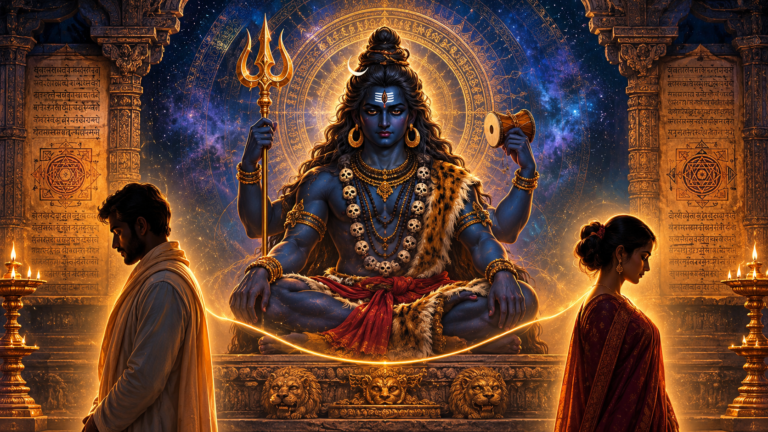
Śākta Tantra is not simply the worship of a female deity. It can offer a developed metaphysics of power, consciousness, manifestation, sound, the body and liberation. The relationship between Śiva and Śakti is interpreted differently across schools: sometimes as inseparable consciousness and power, sometimes through other theological and ritual models. The familiar phrase “Śiva without Śakti is śava” is a popular theological expression; it should not be used as a substitute for careful study of specific primary texts.
Vaiṣṇava Tantra and the Pāñcarātra
Vaiṣṇava Tantric and Āgamic traditions are also significant. The Pāñcarātra corpus, including texts such as the Ahirbudhnya Saṃhitā and Lakṣmī Tantra, develops forms of theology, mantra, initiation, worship and temple practice centred on Nārāyaṇa and his manifestations. Vaiṣṇava Āgamic traditions are not merely a branch of Śākta or Śaiva Tantra; they possess their own histories and doctrinal frameworks.
5. What makes Tantric practice distinctive?
Mantra: sound as disciplined practice
In many Tantric traditions, mantra is not merely a sentence repeated for psychological comfort. It may be understood as a sacred sound-form, a form of the deity, a concentrated expression of consciousness, or a ritual instrument whose use is governed by initiation and discipline. Its pronunciation, meter, sequence, visualisation and ritual setting can matter. The meaning and status of mantra vary widely between traditions.
Yantra and maṇḍala: sacred form and ordered space
Yantras and maṇḍalas give visual and spatial form to sacred relationships. They may organise a ritual space, represent a deity or a cosmos, or serve as a support for meditation and visualisation. They are not simply decorative geometric designs, and no single diagram represents all Tantra. Their construction and interpretation belong to specific textual and ritual systems.
The body as a field of practice
Some Tantric and yoga traditions understand the human body as a site of disciplined spiritual practice. They employ models involving nāḍīs, cakras, kuṇḍalinī, breath, sound, visualisation and the placement of mantras through nyāsa. These are tradition-specific subtle-body maps and contemplative frameworks. They should neither be casually equated with modern anatomy nor dismissed without understanding their own purposes and language.
Ritual, initiation and the teacher
In many lineages, dīkṣā (initiation) establishes a relationship between practitioner, teacher, mantra, deity and community. Ritual may include purification, offerings, nyāsa, mantra recitation, fire rites, worship and visualisation. The sequence and authority of these practices depend on the lineage. Initiation is not a decorative badge, and texts that restrict particular rites to initiated practitioners should be read in their historical and ethical context.
6. Tantra, the human being and consciousness
One reason Tantra deserves deeper study is that it often refuses to separate spiritual inquiry from embodied life. Breath, speech, attention, perception, emotion, posture, ritual action and relationships may all become material for practice. The body is not always treated as an obstacle to be rejected; in many systems it can become a disciplined field through which the practitioner investigates the nature of experience.
This does not mean that every Tantric school teaches that the body is divine in the same way, or that every bodily impulse is spiritually liberating. Tantric disciplines may demand restraint, preparation, ethical conduct, concentration and sustained instruction. Their use of the body is often highly structured—not an endorsement of impulsiveness.
Some non-dual Śaiva traditions ask whether liberation requires rejecting the world or recognising the deeper nature of consciousness within experience. The Śiva Sūtras, Spanda literature, Pratyabhijñā texts and Abhinavagupta’s Tantrāloka offer different but related avenues for investigating these questions. These works deserve close reading rather than being reduced to slogans about “energy” or “vibration”.
7. Tantra and sexuality: neither sensationalism nor denial
Some historical Tantric traditions include ritual practices involving sexuality or substances that other religious systems regarded as transgressive. These practices are not universal to Tantra, are not the defining feature of every Tantric school, and were often restricted by initiation, context and ritual rules. Other major Tantric traditions emphasise mantra, meditation, temple worship, visualisation, philosophical inquiry or other disciplines without making sexual rites central.
Modern commercial uses of the word “Tantra” sometimes focus almost entirely on sexuality. Such presentations should not be confused with the full history of Hindu Tantric traditions. At the same time, responsible scholarship should not erase historical evidence of transgressive practices merely because it is uncomfortable. The task is to examine what particular texts say, when and where they circulated, who was authorised to perform the rites, and how later communities interpreted them.
8. Tantra, liberation and spiritual responsibility
Tantric texts and lineages speak of different aims: liberation (mokṣa), recognition of one’s true nature, union or communion with the deity, purification, divine participation, and in some settings the attainment of siddhis or extraordinary capacities. These aims are not identical, and traditions differ in how they rank them. It would be misleading to say that Tantra is only about supernatural powers—or that all Tantric systems use the same language of liberation.
Power without discernment can become exploitation. Initiation and secrecy can protect specialised knowledge, but they can also be misused to silence questions or shield misconduct. A contemporary study must therefore take seriously the ethics of teachers, consent, financial transparency, the vulnerability of students, and the difference between textual authority and the conduct of people claiming authority. Reverence and critical examination need not be enemies.
9. Why Tantra is integral to the study of Sanātana Dharma
Tantra has shaped important dimensions of Hindu religious life: forms of temple worship, deity installation and consecration, mantra traditions, Śākta theology, Śaiva philosophy, ritual calendars, sacred diagrams, yoga and meditation lineages, iconography, pilgrimage and regional devotional cultures. Its influence is not identical everywhere, and claims about particular temples or practices require local historical evidence. Yet any broad account of Hindu religious history that ignores Tantric and Āgamic traditions will be incomplete.
Tantra also expands the questions that can be asked about spirituality. Can sound become a disciplined mode of knowing? Can the body become a field of contemplative investigation? How are consciousness and power related? How does sacred space shape experience? What is the relationship between ritual action and philosophical understanding? How do different traditions understand liberation while living in the world? These are not marginal questions; they sit close to the heart of Indian religious and philosophical inquiry.
10. An open research programme: the articles to follow
This foundation article is intended to establish the framework, not to close the subject. Tatsat Cosmos will examine particular areas in separate, topic-specific research articles. The proposed sequence is:
- Origins and historical development of Hindu Tantra: evidence, chronology, manuscripts, inscriptions and the emergence of lineages.
- Vedic traditions and Tantra: continuity, reinterpretation and the limits of retrospective claims.
- Śiva and Śakti: consciousness, power and the philosophical foundations of selected traditions.
- Śākta Tantra: Goddess traditions, Śrīvidyā, Kālī, Kaula and other streams.
- Śaiva Tantra: Āgamas, non-dual Śaivism, recognition and the nature of consciousness.
- Vaiṣṇava Āgama and Pāñcarātra: theology, mantra, initiation and temple worship.
- Mantra: sound, language, initiation, recitation and interpretation.
- Yantra and maṇḍala: sacred geometry, visualisation and ritual space.
- The Tantric body: nāḍī, cakra, kuṇḍalinī, breath and the limits of modern analogy.
- Tantra and meditation: the Vijñānabhairava and other contemplative texts.
- Ritual and initiation: dīkṣā, nyāsa, pūjā, homa and the role of the guru.
- Sexuality and transgressive practice: historical evidence without sensationalism.
- Siddhi, jñāna and mokṣa: power, knowledge and liberation across schools.
- Tantra in temples, art and culture: regional histories and living traditions.
- Tantra in the contemporary world: preservation, reinterpretation, public understanding and ethical questions.
11. How this research will be conducted
Each article should begin with identifiable primary sources wherever possible. Sanskrit passages will be presented with Devanāgarī, IAST transliteration, a close translation and an explanation of context. References will identify the text and chapter or verse where the edition permits. Where numbering differs between editions, that difference should be stated rather than hidden.
We will distinguish four levels of discussion: (1) what a primary text actually says; (2) how a traditional commentator or lineage interprets it; (3) what modern historical scholarship concludes; and (4) what remains a philosophical proposal or open hypothesis. No Vedic verse will be labelled Tantric simply because a later tradition finds it meaningful. No single Tantric lineage will be made to represent all others. Nor will a modern scientific claim be inferred from a traditional subtle-body description without independent evidence.
Tantric texts also require care in translation. Technical words such as śakti, mantra, cakra, nyāsa, dīkṣā, spanda and prakāśa can carry meanings that are not captured by a single English equivalent. The series will retain key Sanskrit terms and explain them in context.
12. Selected Sanskrit source map and further reading
Ancient and contextual sources
- Ṛgveda 10.125, the Devī/Vāk Sūkta—an ancient Vedic hymn used here as a point of comparison, not as a Tantric scripture.
- Śvetāśvatara Upaniṣad 4.10—māyā, prakṛti and the wielder of māyā.
- Devī Māhātmya, especially chapter 5 and its repeated praise of the Goddess present in all beings.
Selected Hindu Tantric and Āgamic sources
- Śiva Sūtras 1.1: caitanyam ātmā—“Consciousness is the Self.”
- Pratyabhijñāhṛdayam 1: citiḥ svatantrā viśvasiddhihetuḥ—“Consciousness, free in itself, is the cause of the manifestation of the universe.”
- Vijñānabhairava Tantra—a major text of contemplative methods in a Bhairava-oriented Śaiva setting.
- Mālinīvijayottara Tantra and Svacchanda Tantra—important Śaiva Tantric scriptural sources.
- Abhinavagupta, Tantrāloka—a major synthesis and exposition of non-dual Śaiva Tantric thought and practice.
- Kulārṇava Tantra—a significant Kaula source on initiation, teacher, discipline and ritual.
- Yoginīhṛdaya and Nityāṣoḍaśikārṇava—important sources for Śrīvidyā traditions.
- Ahirbudhnya Saṃhitā and Lakṣmī Tantra—selected Pāñcarātra/Vaiṣṇava Āgamic sources.
Modern scholarship
- Glen A. Hayes, “Tantra,” Oxford Bibliographies in Hinduism.
- The Oxford Handbook of Tantric Studies, edited volume, Oxford University Press.
- André Padoux, The Hindu Tantric World.
- Teun Goudriaan and Sanjukta Gupta, Hindu Tantric and Śākta Literature.
- Alexis Sanderson, “The Śaiva Age: The Rise and Dominance of Śaivism during the Early Medieval Period.”
- Shaman Hatley’s studies of the Brahmayāmala and early Śākta/Śaiva Tantric traditions.
This list is a starting map, not an exhaustive bibliography. Later articles should add the precise edition, editor, publication details and page or verse references for every Sanskrit passage quoted. Where a reliable critical edition is not yet identified, the article will say so rather than imply textual certainty.
Conclusion: Tantra as a path of knowledge, practice and inquiry
Tantra should not be reduced to occult spectacle, sexual technique or a collection of mysterious rituals. Nor should it be idealised as a single timeless system containing every form of Indian spirituality. It is a diverse, historically significant and living dimension of Sanātana Dharma, with its own scriptures, philosophical systems, ritual technologies, lineages and regional histories.
Its importance lies partly in the questions it asks and the disciplines it develops: how consciousness and power relate; how sound, form and ritual shape experience; how the body may become a field of spiritual practice; how divine presence is understood; and how knowledge may be transformed into lived discipline.
The purpose of this Tatsat Cosmos research series is to approach Tantra with reverence but without credulity, with critical inquiry but without prejudice. The subject deserves neither sensational fear nor careless dismissal. It deserves study—through Sanskrit sources, historical context, philosophical clarity and an honest willingness to distinguish what is known from what remains to be investigated.
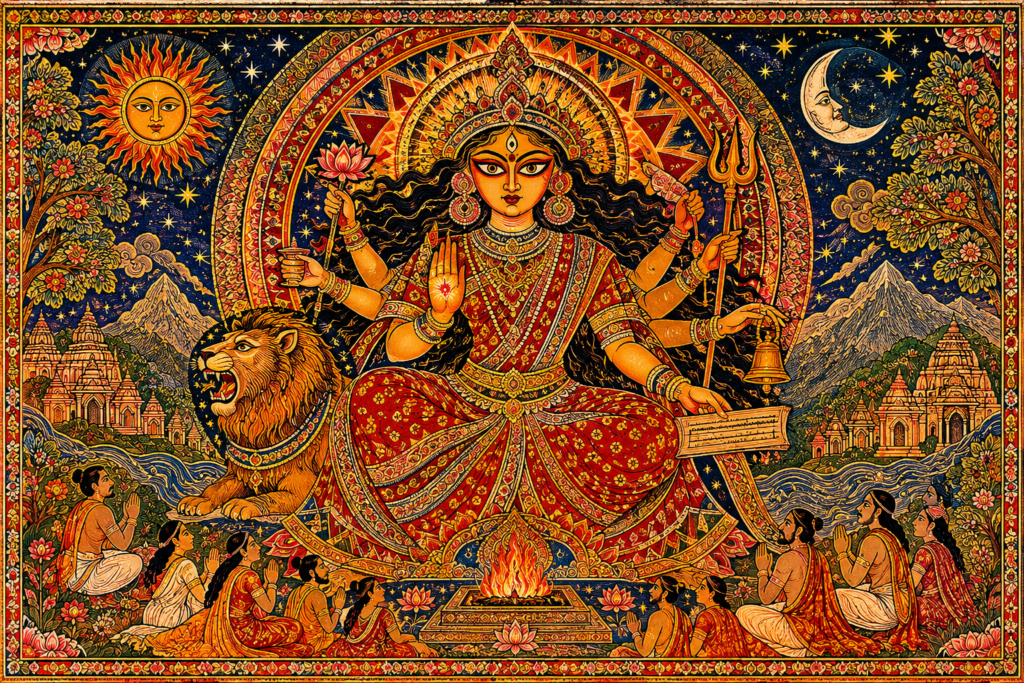
Research note: This is the opening framework article in an ongoing Tatsat Cosmos research series. It is intended for study and critical discussion, not as an instruction manual for Tantric initiation or ritual practice. The Devī Sūkta illustration is a contemporary artistic interpretation inspired by Ṛgveda 10.125; it is not a historical image or a claim that the hymn itself is Tantric.