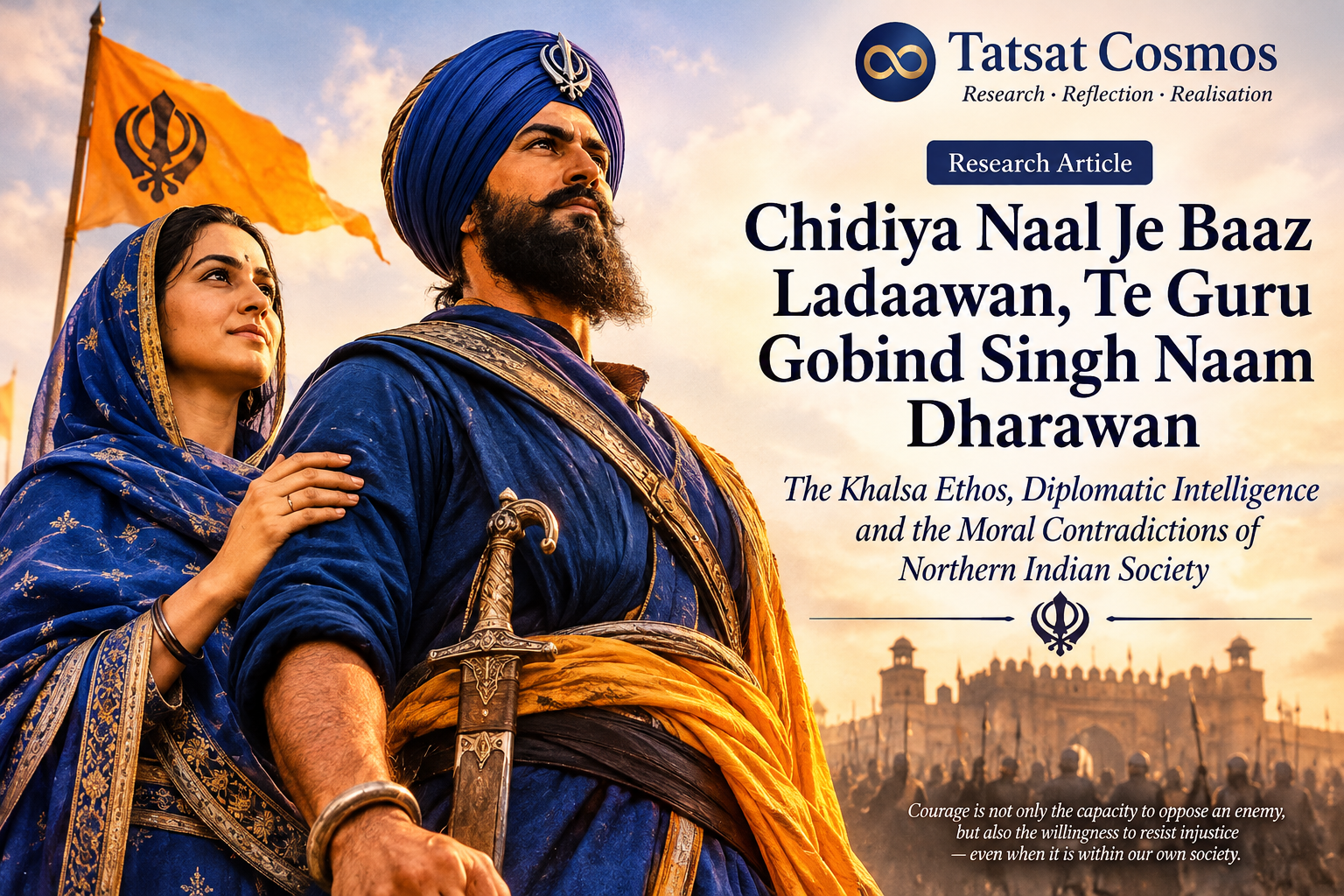
Chidiya Naal Je Baaz Ladaawan, Te Guru Gobind Singh Naam Dharaawan
An observational study in historical anthropology, political culture and social ethics
Abstract. The philosophy associated with Guru Gobind Singh and the Khalsa tradition brings together courage, spiritual discipline, collective responsibility, resistance to injustice and the protection of the vulnerable. This article examines how these ideals have interacted with political power and social change in northern India. It focuses on three tensions: the destruction of a community through politically enabled violence; the weakening of civic courage through passive accommodation of corruption; and the diversion of valour through intoxication, provocation or political manipulation. It also examines diplomatic intelligence as a dimension of strength, and asks what the Khalsa ethos might mean in a participatory democracy. The observations are research propositions, not claims that every Sikh or every resident of a region shares one character or behaves in one way.1. The philosophy: making the apparently weak powerful
The expression popularly remembered as “Chidiya naal main baaz ladaawan, gidraan ton main sher banaawan, sava lakh naal ik ladaawan” has come to represent a striking idea associated with Guru Gobind Singh: that courage, conviction and discipline can enable the apparently weak to confront overwhelming power. The wording and earliest textual provenance of the popular formulation require separate verification; it should not be presented as a verbatim historical quotation without that work.
The idea nevertheless provides a powerful starting point for inquiry. The Khalsa ideal is not simply the celebration of physical strength. It joins spiritual commitment with self-discipline, courage with restraint, solidarity with responsibility, and resistance with the defence of those who are vulnerable. The establishment of the Khalsa in 1699 marked a defining moment in Sikh history. Its later development involved religious institutions, political organisation, military resistance, alliances and state formation. Purnima Dhavan’s When Sparrows Became Hawks is valuable precisely because it studies the making of the Sikh warrior tradition historically rather than treating it as an unchanging inherited trait.
2. Courage and diplomatic intelligence: two dimensions of strength
The popular image of the Khalsa often foregrounds the warrior. Yet political intelligence and diplomacy deserve equal attention. The ability to read circumstances, negotiate, form alliances, communicate with opponents and preserve a community’s interests is as important to political survival as military courage.
Guru Gobind Singh’s Zafarnama, addressed to the Mughal emperor Aurangzeb, is an important text for considering moral argument, political communication and the challenge to unjust conduct. The subsequent history of Sikh political organisation—including the misls and the consolidation of power under Maharaja Ranjit Singh—offers further material for studying negotiation, alliances and statecraft. These histories should not be romanticised: the conduct of a movement, the ideals it proclaims and the actions of a state that later emerges from it are not automatically identical.
The underlying proposition is that the Khalsa ethos includes not only the ability to resist, but the judgement to understand when to resist, when to negotiate, when to build an alliance and when a compromise would betray justice. Courage without judgement can become recklessness; diplomacy without principle can become opportunism. The ideal requires both.
3. The gravest political wrong: turning a community into a target
A society’s warrior traditions do not make its members legitimate targets of the state, political parties or mobs. To kill, terrorise, collectively punish or dispossess people because of their religious or community identity is among the gravest violations a government can permit or commit. A government exists to protect citizens and uphold law; it cannot claim moral authority while abandoning a community to organised violence or shielding those responsible.
The violence against Sikhs in Delhi and elsewhere after the assassination of Prime Minister Indira Gandhi on 31 October 1984 is an essential historical case for this inquiry. The Justice G. T. Nanavati Commission of Inquiry was specifically tasked with examining the causes and course of the criminal violence, whether it could have been prevented, and whether there had been lapses or dereliction of duty by responsible authorities. Its report records the killing of hundreds of Sikhs, attacks on homes and businesses, looting, arson and the displacement of families. It also records affidavits indicating that local Congress leaders and workers had either incited or helped mobs attack Sikhs. The Commission did not find evidence that Rajiv Gandhi or another high-ranking national Congress leader had suggested or organised the attacks. Both parts of that finding matter: the documented role attributed to local party figures must not be erased, and the Commission’s stated limit on the evidence about higher leadership must not be misrepresented.
This is not a defence of Congress, nor an accusation against every member of that party. It is an insistence that political responsibility be assessed from evidence, and that no party, government or leader receive immunity from scrutiny. The failure to protect citizens, investigate crimes impartially or secure accountability compounds the original violence. The decades-long struggle of survivors for justice is itself part of the historical record.
The violence of the Punjab conflict in the 1980s and early 1990s requires a second, distinct examination. Armed militants committed grave violence, including attacks on civilians; those crimes must be named and condemned. They do not, however, justify unlawful state violence. Human Rights Watch and the Human Rights Data Analysis Group, drawing on extensive records, have documented patterns of enforced disappearances, extrajudicial executions and illegal cremations associated with counterinsurgency operations. The evidence demands investigation, accountability and recognition of victims, not a blanket justification in the name of national security.
These episodes must not be collapsed into one undifferentiated story. Mob violence against Sikhs in 1984, militant attacks on civilians, and abuses by state security personnel occurred in different circumstances and require careful, case-specific historical analysis. Condemning one does not excuse another. The principle is consistent: civilians must not be targeted; collective guilt is unjust; and the state must remain accountable under law, especially when it exercises coercive power.
4. Resistance, separatism and democratic participation
Political demands must be understood in their historical setting. Where a population faces severe repression, exclusion from political representation or the denial of basic rights, demands for autonomy or self-determination may arise from genuine grievances. Their legitimacy, methods and consequences must be examined in context; the language of valour alone cannot settle those questions. Nor should the political circumstances of Pakistan and India be treated as interchangeable.
In India, constitutional democracy provides avenues for representation, elections, public-interest litigation, peaceful protest, journalism, civil society organisation and institutional reform. These avenues do not guarantee that every institution is fair or that every grievance is heard. They do, however, create a distinct responsibility: to use and strengthen democratic means, demand accountability and protect constitutional rights. This is not passive loyalty to a government. It is active moral participation in public life.
The contemporary expression of courage may therefore be the willingness to challenge injustice through principled civic action—including when the wrongdoing is committed by one’s own political allies, local leaders or institutions. A democratic government must be answerable; citizens must not surrender their conscience to party loyalty or factional pressure.
5. The first distortion: passive corruption and the surrender of moral responsibility
Corruption is commonly understood as bribery, misuse of public office, financial exploitation or diversion of public resources. Its social consequences extend beyond the person who pays or receives a bribe. There is also a quieter form: passive accommodation. A person may refuse to take part directly in corruption yet remain silent when an official demands an unofficial payment. A businessperson may recognise an unfair practice but accept it because challenging the system is inconvenient. A citizen may condemn corruption publicly but use personal connections to obtain an advantage privately.
When such conduct becomes routine, corruption is sustained not only by those who profit from it but also by networks of silence, fear, convenience and mutual accommodation. The anthropological question is whether the moral vocabulary of courage and honour is applied consistently to ordinary public and commercial conduct. If a tradition celebrates resistance to injustice, does that resistance also extend to a local official, a powerful contractor, a political patron or a familiar institution?
This study proposes that patronage systems, discretionary bureaucracy, electoral incentives and dependence on political intermediaries can weaken civic courage by rewarding compliance over accountability. That is a proposition to be tested, not proof that any government deliberately set out to corrupt a community. The relevant evidence would include administrative records, corruption surveys, court cases, local interviews and comparisons across periods and regions.
6. The second distortion: intoxication and the misdirection of valour
The second concern is the possible association of intoxicants with public images of masculinity, status, assertiveness or bravery. Substance dependence is a public-health issue, not evidence of the moral inferiority of a religious community. It affects people across regions and social groups. Nevertheless, where intoxication is treated as a sign of toughness, or where aggression is mistaken for courage, the outward performance of strength can become detached from the self-command that genuine discipline requires.
The contrast is worth examining: discipline requires self-command; courage requires judgement; protection requires responsibility; and strength requires restraint. Intoxication can impair judgement and increase harm, but no individual or community should be reduced to a stereotype. Research on substance use in Punjab, including a study published in the Indian Journal of Medical Research, provides public-health evidence of substance-use disorders and treatment gaps. Such data should be interpreted according to the study’s methods and population; it does not establish substance use as a characteristic of Sikh identity.
The research question is whether social settings sometimes confuse intoxication, aggression or bravado with valour—and whether that confusion undermines the deeper discipline of the Khalsa ideal. Valour is not simply the ability to display power. It is the ability to govern oneself while exercising power responsibly.
7. Regional business culture: a comparison to investigate
A comparison between business environments in Maharashtra and selected northern regions may help examine the relationship between commercial courage, ethical conduct and institutional trust. Maharashtra’s commercial history includes Mumbai’s development as a major financial and trading centre and the growth of industrial and entrepreneurial networks in different parts of the state. But it would be unsound to label one region inherently ethical and another inherently corrupt. Regional stereotypes cannot substitute for comparative evidence.
The more useful questions concern institutions and practices: Are agreements honoured? Are commercial disputes resolved predictably? Can entrepreneurs refuse unofficial payments without being excluded from opportunities? Do professional associations protect ethical conduct? Do businesses challenge political interference, or become dependent upon it? Is success measured by durable value creation or by access to power?
The comparison should examine similar sectors and business sizes, distinguish urban from rural markets, and use transparent indicators. The central proposition is that business courage includes the willingness to refuse an unethical advantage. Commercial ability may flourish when trust and accountability are supported by institutions; it may be distorted when silence and political access become the safer route to success.
8. The geography of influence: a shared ethos, not a uniform identity
Punjab will be the principal case study. Delhi offers questions about migration, political institutions and religious networks. Himachal Pradesh and Jammu require attention to their own regional kingdoms, social structures and interactions with Sikh political power. Kashmir has a distinct civilisational, linguistic and political history that must not be subsumed into a single northern Indian identity. Parts of Uttarakhand can be examined through pilgrimage, military service, migration and cultural exchange.
The study should establish where Sikh institutions and historical memory exerted direct influence, where influence was indirect, and where other traditions were more decisive. It should not assume that the Khalsa ethos created the foundational character of every population in these regions. The aim is to understand interaction, not to claim exclusive ownership of courage, patriotism or civic virtue.
9. The deeper contradiction: strength without moral agency
The two distortions examined here—passive accommodation of corruption and misdirected valour—may share a deeper problem. Passive corruption weakens the willingness to confront wrongdoing. Misdirected valour weakens the ability to distinguish meaningful courage from its outward performance. In the first case, a person may have the capacity to resist but choose silence. In the second, a person may display aggression without directing it towards a just purpose.
Neither tendency should be treated as the defining character of Sikhs or of any northern Indian population. They are social risks that can emerge in many communities when institutions reward silence, impunity or performative aggression. The Khalsa ideal, understood as a commitment to justice, discipline and service, offers a standard against which such contradictions can be examined.
10. Research propositions
- The Khalsa tradition contributed to changing ideas of courage, collective responsibility and resistance in particular historical settings.
- Diplomatic intelligence and alliance-building were important dimensions of Sikh political development alongside military courage.
- Politically enabled communal violence and unlawful state action can inflict lasting harm on a community and weaken trust in public institutions.
- Patronage and impunity may encourage passive acceptance of corruption and weaken civic participation.
- Intoxication may be culturally misrepresented as toughness or valour in some settings, a proposition requiring careful local evidence.
- Commercial integrity depends on institutional incentives, trust and the ability to refuse unethical demands.
- In a constitutional democracy, active moral participation is a contemporary expression of courage and resistance to injustice.
11. Conclusion: the return to the Guru’s ideal
The strength of the Khalsa tradition lies not simply in a history of military resistance, but in the conviction that human beings can rise above fear, subordination and injustice. It joins courage with responsibility, strength with restraint, solidarity with discipline, and resistance with the protection of the vulnerable.
A society does not preserve its moral courage merely by remembering its heroic past. It preserves that courage by applying its principles to ordinary decisions in the present. When bribery is tolerated because challenging it is inconvenient, when public wrongdoing is accepted because it benefits one’s own circle, or when intoxication and aggression are mistaken for strength, the ethical foundations of courage are weakened.
The remedy is not nostalgia or the glorification of confrontation. It is moral participation: defending institutions, demanding accountability, conducting business honestly, refusing corrupt advantages, protecting the vulnerable and exercising political rights with discipline. The courage to oppose an external oppressor is one expression of strength. The courage to challenge dishonesty within one’s own society may be an even more demanding test.
Chidiya naal je baaz ladaawan, te Guru Gobind Singh naam dharaawan.
If we invoke the name and ideals of Guru Gobind Singh, the responsibility is not merely to celebrate the courage of the past. It is to demonstrate that courage through the integrity of our conduct today.
Selected references and further reading
- Justice G. T. Nanavati Commission of Inquiry, Report on the 1984 Anti-Sikh Riots, Government of India, 2005. Read Volume I.
- Human Rights Watch, Protecting the Killers: A Policy of Impunity in Punjab, India (2007). Read report.
- Human Rights Data Analysis Group and Ensaaf, research on violent deaths and enforced disappearances during the Punjab counterinsurgency. Research overview and data summary.
- Purnima Dhavan, When Sparrows Became Hawks: The Making of the Sikh Warrior Tradition, 1699–1799, Oxford University Press. Oxford Academic.
- B. S. Chavan et al., “Prevalence of substance use disorders in Punjab: Findings from National Mental Health Survey,” Indian Journal of Medical Research (2019). Read article.
- Satnam Singh, The Road to Empire: The Political Education of Khalsa Sikhs in the Late 1600s, University of California Press (2024). Read publication details.
Editorial note: This is an observational and interpretive research essay. Its regional comparisons and proposed relationships between political systems and social behaviour require further archival, statistical and field research. It does not attribute collective guilt or fixed moral traits to any religious, political or regional community.