The Darkest Reality of Meditation: Energy, Intensity and the Void
An inquiry into ignorance and perception, the intensity of accumulated experience, the subtle channels of yoga, and the immense field suggested by the meditative void.
A Journey Beyond What the Eyes Can See
Meditation is often described as a movement from darkness towards light. Yet this familiar expression invites a deeper question: what do we mean by darkness, and what do we call light? Are they merely the absence and presence of physical illumination, or do they point towards different dimensions of human experience?
In this exploration, darkness is not merely the absence of light; it is also a metaphor for ignorance, the unexamined and the unknown. Light, in turn, is not only a physical phenomenon. It is also the world that becomes visible through the senses: forms, colours, sounds, memories, interpretations and the realities we construct from them. What we see and recognise can illuminate life, but it can also limit us to what our senses and assumptions allow us to perceive.
The question, therefore, is not simply how to see light in meditation. It is whether the practitioner can look beyond familiar sensory experience, recognise the influence of ignorance, and understand the intensity of what may arise when attention turns inward.
Darkness, Light and the Reality We Experience
Ordinary darkness can conceal objects because the eye cannot receive enough light. Philosophical darkness goes further: it can conceal the nature of things even when they appear clearly before us. In Indian philosophical language, avidyā refers to ignorance or misapprehension—not simply a lack of visual light, but a failure to understand reality as it is.
Light also has more than one meaning. Physical light makes the visible world available to the eye. The other senses add sound, touch, taste and smell; the mind organises these impressions into a world that feels continuous and real. This sensory world is indispensable to human life, yet our experience of it is shaped by memory, expectation, fear, desire and interpretation.
Meditation raises a demanding question: if the familiar world is partly organised by the senses and the mind, what happens when the practitioner becomes still enough to observe that organising process? The answer is not necessarily a single vision or a uniform experience. It may be silence, restlessness, imagery, clarity, discomfort, unusual sensations—or no dramatic event at all.
The Practitioner: One Pathway, Many Histories
Traditional yoga maps describe subtle pathways that are common to the human framework. Yet practitioners do not arrive at meditation with identical histories. Their physical condition, temperament, habits, emotional burdens, discipline, memories, expectations and previous experiences differ. Consequently, the physical and experiential outcomes of meditation have never been uniform for everyone.
A method may be transmitted in the same form, and its underlying discipline may be shared, but the practitioner brings an individual history to it. The same period of practice can therefore be experienced differently by different people. Even for one practitioner, an experience that appeared once may not return in the same form on demand. Years of repetition do not turn the inner life into a machine whose results can be ordered at will.
This distinction matters. It prevents learners from measuring their progress only by another person’s visions, sensations or physical responses. It also reminds teachers that a description of one practitioner’s experience should never be treated as a guaranteed result for everyone.
Iḍā, Piṅgalā and Suṣumṇā: The Traditional Subtle-Body Map
Several haṭha-yoga and tantric sources describe three principal nāḍīs: Iḍā, Piṅgalā and Suṣumṇā. In commonly taught descriptions, Iḍā is associated with the lunar principle, Piṅgalā with the solar principle, and Suṣumṇā with the central pathway. Their locations and descriptions vary across texts and lineages, so no single diagram should be mistaken for a universal anatomical map.
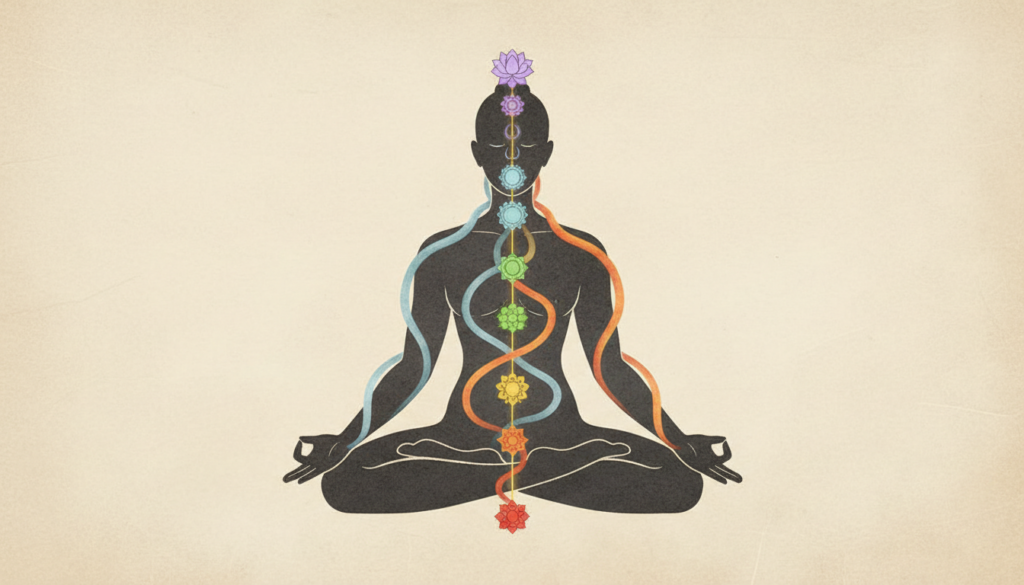
The Haṭha Yoga Pradīpikā discusses the relationship between breath, mind, nāḍī purification and the movement of prāṇa towards Suṣumṇā. The Śiva Saṃhitā and other yoga texts also describe the subtle channels. These works belong to particular contemplative and practice traditions; their language should be understood in that context rather than translated uncritically into modern anatomy.
Piṅgalā and the Intensity of Accumulated Experience
Piṅgalā is traditionally associated with the solar current and qualities of activity, heat and dynamism. This article takes that traditional association as a starting point for a further experiential inquiry: what relationship might there be between the intensity of a practitioner’s accumulated experiences and the intensity encountered during meditation?
A human life is not an empty vessel at the beginning of meditation. It carries years of impressions: effort, struggle, joy, fear, ambition, loss, discipline, desire and countless moments of heightened attention. These experiences may leave deep impressions on the practitioner’s inner life. In the interpretive model explored here, the solar intensity associated with Piṅgalā becomes a way of thinking about how accumulated energies and experiences may be brought into sharper relief during sustained inward attention.
This is an experiential interpretation, not a claim that classical texts define Piṅgalā as a literal storehouse of memories or that modern physiology has identified such a channel. The traditional texts establish the nāḍī framework and its symbolic associations; the relationship between accumulated personal experience and heightened intensity is a further proposition for reflection and enquiry.
The important point for learners is that intensity cannot be judged by a simple external measure. A practitioner may encounter powerful sensations or images; another may experience quietness; a third may encounter difficulty or no unusual event. The absence of dramatic experience does not establish failure, and the presence of intensity does not by itself establish spiritual attainment.
For another exploration of Iḍā, Piṅgalā and inner light in a traditional festival context, continue with Deepawali: The Great Churning of Samudra, the Emergence of Maa Mahalakshmi and the Awakening of Inner Light →.
Why Darkness May Intensify Inner Experience
When external stimulation is reduced, attention may become more aware of sensations, memories, images and emotions that ordinarily remain in the background. In contemplative language, darkness can therefore be understood as an amplifier of inner reality. The expression that darkness magnifies experience “a millionfold” is used here as a metaphor for perceived intensity, not as a measurable scientific quantity.
In the model proposed in this essay, the subtle channels are not simple switches that can be operated with a small input to produce a predictable result. The energies and impressions involved are understood as immense and complex. A practitioner may repeat a discipline for years in the hope of reproducing a particular experience, yet the inner response may remain variable. This is one reason that intensity must never be confused with control.
Darkness, in this sense, is not automatically beneficial and should not be treated as a technique to intensify without limits. It can reveal, unsettle, confuse or overwhelm. The task is not to chase extraordinary experiences, but to understand the limits of personal effort and the need for proper guidance.
Light, Inner Vision and the Limits of Experience
Reports of inner light appear in different contemplative traditions. Some yoga texts discuss forms of meditation associated with light or inner radiance. The Gheraṇḍa Saṃhitā, for example, presents different modes of meditation, including jyotir-dhyāna, meditation on light. Such descriptions belong to a specific textual and practice setting; they should not be reduced to a promise that every practitioner will see the same light.
Modern research has also documented unusual visual and perceptual experiences associated with meditation. Such reports can help describe what some practitioners experience, but they do not settle the philosophical meaning of those experiences. A light phenomenon, however vivid, need not be the final reality of meditation. It may be one event within a much larger process of surrender, attention, interpretation and transformation.
The distinction is essential: an experience may be powerful without being ultimate. The practitioner should not become attached to visions, nor assume that the appearance or disappearance of light proves spiritual success or failure.
The Void: An Immense Field Beyond Familiar Reference

What might remain when familiar sensory references, inner images and the pursuit of particular experiences fall away? The word void can suggest emptiness, but it can also point towards an immense openness that cannot be described through ordinary categories. In the experiential model explored here, the void is not a small blank space. It is imagined as a vast field of possibility and energy, beyond the familiar structures through which the practitioner has understood experience.
Cosmology offers images that may help readers imagine scale and mystery. Dark energy is a term used in modern cosmology for the phenomenon associated with the accelerating expansion of the universe; a black hole is an astrophysical region whose gravity is so strong that nothing, including light, can escape from within its event horizon. These are not scientific explanations of meditation, nor evidence that a meditative void is physically equivalent to dark energy or a black hole. They are analogies for vastness, hiddenness and the limits of ordinary observation.
Why use such an analogy? Because familiar language can make the unknown sound small. The image of an immense field invites a different question: when a familiar inner pattern reaches its culmination and falls silent, what orientation will the practitioner bring to the openness that follows? The next movement may involve clarity, compassion, understanding, disciplined enquiry or a renewed sense of purpose. Yet the nature of such a state cannot be prescribed in advance, and no one should try to force it to appear.
The void, then, is best approached here as a question for deeper enquiry—not as a destination that can be reached by following a do-it-yourself formula, and not as a promise of extraordinary powers.
Three Dimensions of the Enquiry
01 · Darkness
Ignorance, the unseen and the impressions that become more noticeable when familiar external reference points recede.
02 · Light
Sensory visibility, inner illumination and the interpretations through which a practitioner experiences reality.
03 · The Void
An immense metaphorical openness that invites humility, careful enquiry and a direction not decided beforehand.
The Guru: Guidance Is Essential
One vital principle must remain clear: the deeper dimensions discussed in this article cannot be safely understood or channelled through intellectual reading alone. In traditions that work with prāṇa, nāḍīs, breath, concentration and intensified meditative states, the guidance of a competent and experienced Guru is central. A Guru can assess readiness, explain the discipline within its lineage, recognise signs of imbalance and guide the practitioner with appropriate restraint.
This article is an invitation to enquire, not a set of instructions for practice. It does not teach breath retention, forceful breathing, prolonged sensory deprivation, or methods for deliberately intensifying inner experiences. Do not experiment with such methods on your own, and do not increase the duration or intensity of a practice without the direct guidance of a qualified Guru who knows your circumstances.
Important Safety Caution
Intensive or unsupervised meditation practices may sometimes cause serious psychological or physical destabilisation. Possible warning signs include overwhelming anxiety, disorientation, persistent sleep disturbance, distressing unusual perceptions, or symptoms resembling psychosis.
Do not attempt advanced or forceful practices, prolonged sensory deprivation, or deliberate intensification of inner experiences without the direct guidance of a qualified and experienced Guru. If serious distress or unusual symptoms arise, stop the intensive practice and seek prompt assessment from a qualified healthcare professional. Spiritual guidance does not replace medical care. Distress or loss of mental stability must never be interpreted as proof of spiritual progress.
Authentic Sources for Further Study
Primary Texts and Traditional Frameworks
- Pātañjala Yoga Sūtra 2.1: Kriyā Yoga as tapas, svādhyāya and īśvara-praṇidhāna; 2.3–2.5 on the kleśas and avidyā; 2.43 on tapas and its transformative role.
- Haṭha Yoga Pradīpikā, Chapter 2: breath, mind, nāḍī purification and prāṇa; verse numbering varies by edition.
- Śiva Saṃhitā, Chapter 2: traditional descriptions of Iḍā, Piṅgalā and Suṣumṇā.
- Gheraṇḍa Saṃhitā, Chapter 6: forms of meditation, including sthūla, jyotir and sūkṣma dhyāna.
- Muṇḍaka Upaniṣad 2.2.10: the light by which all else is illumined, beyond dependence on sun, moon, stars or fire.
Modern Research and Living Traditions
Modern studies of meditation-related perceptual experiences can help document the range of experiences reported by practitioners. They should be read alongside traditional texts, lineage-based instruction and careful first-person accounts. Neither laboratory measurement alone nor an isolated personal experience can settle every philosophical question raised by meditation.
Textual descriptions also differ across periods, schools and translations. Readers are encouraged to consult reliable editions and teachers within the relevant traditions rather than treating a single diagram or quotation as the final word.
References & Suggested Reading
The following sources allow readers to examine the traditional foundations and modern discussions separately. Verse numbering and translations may differ between editions; the links below are provided as study resources, not as a claim that every interpretation in this article is stated verbatim in those texts.
Primary Texts and Traditional Sources
- Pātañjala Yoga Sūtra 2.1, 2.3–2.5 and 2.43. For Kriyā Yoga, avidyā and tapas: GRETIL Sanskrit text of the Yogasūtra; see also The Matheson Trust: translations and study editions.
- Haṭha Yoga Pradīpikā, especially Chapter 2. For prāṇāyāma, nāḍī purification and the relation of breath and mind: Haṭhapradīpikā Online — critical edition and translation, University of Oxford and University of Marburg.
- Śiva Saṃhitā, Chapter 2. For a traditional account of the nāḍīs and subtle-body framework. Consult a reliable Sanskrit edition and a translation with commentary; descriptions vary across yoga texts and lineages.
- Gheraṇḍa Saṃhitā, Chapter 6. For the threefold account of meditation—sthūla, jyotis and sūkṣma: Gheraṇḍa Saṃhitā, Chapter 6 — Sanskrit and translation; see also the Sanskrit text at Sanskrit Documents.
- Muṇḍaka Upaniṣad 2.2.10. For the Upaniṣadic image of a light beyond dependence on the sun, moon and stars: Muṇḍaka Upaniṣad 2.2.10 — Sanskrit and translation.
Modern Research and Scholarly Context
- Lindahl, J. R., Kaplan, C. T., Winget, E. M. and Britton, W. B. (2014). “A phenomenology of meditation-induced light experiences: traditional Buddhist and neurobiological perspectives.” Frontiers in Psychology, 4:973. Read the research article. This paper examines reported light experiences; it should not be read as establishing that such experiences are the final or ultimate outcome of meditation.
- Light on Haṭha Yoga. A scholarly project on the history and textual transmission of haṭhayoga, including a critical digital edition of the Haṭhapradīpikā: University of Oxford project website.
Explore More on Tatsat Cosmos
Follow the questions raised in this article into other reflections and reading paths across Tatsat Cosmos:
Related articles
- Deepawali: The Great Churning of Samudra, the Emergence of Maa Mahalakshmi and the Awakening of Inner Light →
Continue exploring inner light, Iḍā and Piṅgalā through the symbolism of Samudra Manthan. - What Makes a Journey a Pilgrimage? →
Take the enquiry from meditation to the deeper meaning of an inward journey.
Browse by theme
Philosophy → Explore questions of consciousness, reality and meaning.
Yoga → Continue into practice, discipline and contemplative traditions.
Tatsat Cosmos Blog → Discover more reflections and essays from across the site.
Further Enquiry and Guidance
For further enquiry and detailed understanding of the ideas discussed here, contact Tatsat Cosmos on WhatsApp: +91-8400955079. Please approach any practice only under the direct guidance of a qualified Guru.
Continue reading and exploring at www.tatsatcosmos.com.
This article opens a field of enquiry. It does not replace personal instruction, a living tradition, or professional healthcare where needed.



Insightful