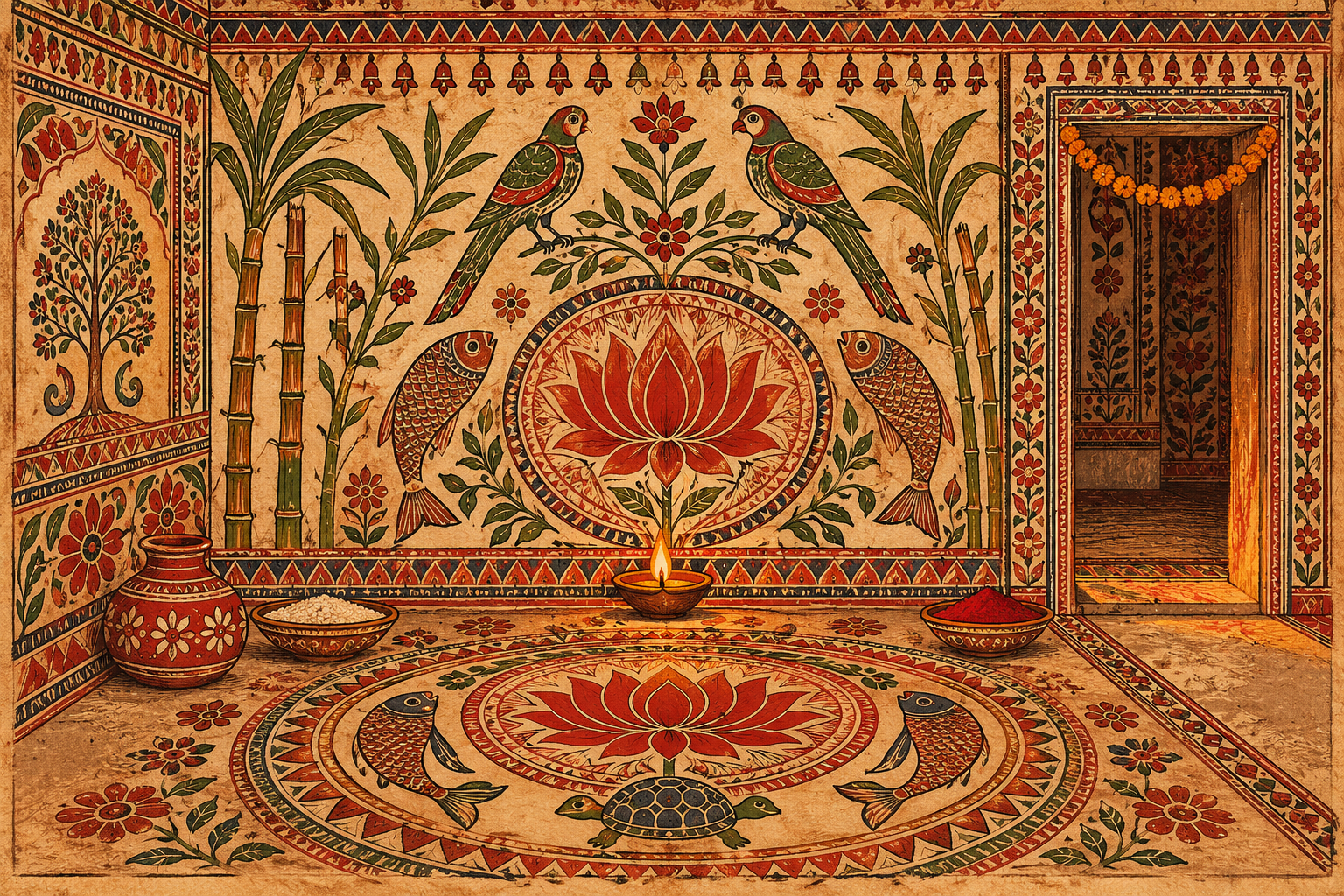
Kohbar Tantra: The Hidden Architecture of Marriage
An exploratory research article on the Kohbar space, the symbolic preparation of the bride, intimacy, domestic authority and the Tantric dimensions of married life in Mithila
Editorial note
This second draft takes your account of the Kohbar sequence as its central ethnographic proposition. It goes further than the first draft in examining the sexual, intimate and psychological dimensions of the transition into married life, while keeping the language suitable for a public research article.
One distinction is essential to its authenticity: your description is evidence of a particular interpretation and account of practice; it is not yet proof that every Mithila community follows the same sequence, or that the practices belong to a historically documented Tantric lineage. The article therefore distinguishes the practice as you describe it, the possible Tantric structure underlying it, and what still needs independent documentation.
The central argument is that Kohbar may be understood not merely as a decorated marriage chamber, but as a deliberately prepared ritual environment in which the bride’s new social, intimate and domestic identity is anticipated, represented and gradually brought into being.
Abstract
Marriage is commonly described as a ceremony through which two individuals enter a socially recognised relationship. Yet in many traditional settings, the visible wedding ceremony represents only the beginning of a much longer process. The bride’s arrival at the bridegroom’s household initiates a second transition: the negotiation of a new identity, a new domestic order, new expectations of intimacy, and a new relationship with the people who already inhabit that household.
This article examines the Kohbar through that less visible dimension of marriage. It proposes that, in the practice under consideration, the Kohbar is not simply a space decorated with auspicious images. It is a ritual environment prepared by the women of the bridegroom’s household, in which the bride’s anticipated identity is symbolically represented even before her physical arrival. The symbolic figure is treated as though it can be fed, addressed and prepared for married life. When the bride eventually enters, the encounter may be understood as a transition between her previous identity and the identity already prepared for her within the new household.
The article explores this sequence through the concepts of mandala, ritual embodiment, sound, food, sexual identity, domestic authority and the gradual formation of intimacy. It asks whether the Kohbar can be read as a Tantric arrangement in which the visible ritual is only one layer of a deeper process involving the body, desire, restraint and social belonging.
The term Kohbar Tantra is used here as an interpretive research proposition. Its historical and textual status requires further investigation. The article does not assume that every Kohbar custom is formally Tantric, nor that a bride’s entry into a household constitutes consent to every expectation subsequently placed upon her.
1. Marriage has a second beginning
The public understanding of marriage tends to concentrate on the wedding ceremony: the vows, sacred fire, family gatherings, exchange of gifts and formal union of the couple. But the ceremony does not immediately create familiarity, trust or shared intimacy.
For the bride, the arrival at the bridegroom’s house may initiate a much more complicated transition. She encounters a household whose relationships, customs, expectations and internal hierarchy have already been established. The people around her know one another. They understand the household’s habits and rules. She must gradually learn them.
This transition is not exclusively domestic. It is also emotional, psychological and intimate. The bride is expected to become a member of a new family while simultaneously entering a new relationship with her husband. Her position within the household and her position within the marriage are connected, but they are not identical.
The question raised by the Kohbar is whether this transition is anticipated and ritually organised before the bride arrives.
If the space is prepared in advance, if an image representing the anticipated bride is created and engaged with, and if the later encounter is arranged within that prepared environment, then the Kohbar may be understood as more than a place in which a newly married couple meets. It becomes a setting in which the household has already begun to construct the meaning of the bride’s arrival.
2. The women of the bridegroom’s household: custodians of the ritual space
In the account examined here, the Kohbar is prepared by the women of the bridegroom’s household.
This detail is significant. The ritual environment is not necessarily designed by the bride, nor is it simply an impersonal arrangement inherited from a written ritual manual. It is prepared by women who already understand the bridegroom, the household and its expectations.
The women who prepare the space possess knowledge of the household’s internal order. They know the bridegroom’s temperament, the family’s customs and the forms of conduct expected of a new bride. Their selection and placement of symbols may therefore express more than aesthetic preference.
According to the account, the symbols are arranged to favour the bridegroom and to place the incoming bride in a comparatively weaker position within the new household.
This interpretation introduces an important question of power. A ritual space can welcome a person while also communicating the conditions under which that person is expected to belong. It can promise auspiciousness and marital prosperity while simultaneously establishing a hierarchy.
The women preparing the Kohbar occupy an especially complex position. They may themselves have undergone a comparable transition when they entered their marital households. They can therefore be both transmitters of inherited domestic expectations and active interpreters of those expectations.
This should not be reduced to a simple opposition between women and women. The more important question is how authority is transmitted through the household, how women participate in that transmission, and whether the ritual gives the incoming bride room to negotiate the identity being prepared for her.
3. The bride before her arrival: the symbolic preparation
The most distinctive element of the account is the preparation of a symbolic image of the girl before the actual bride enters the bridegroom’s household.
This image is not described as a passive decoration. It is reportedly fed, addressed and prepared for married life. The symbolic figure therefore receives a kind of ritual attention before the physical arrival of the woman herself.
This detail deserves particular attention because it changes the interpretation of the Kohbar.
A painting or image may ordinarily represent an auspicious ideal: fertility, prosperity, protection, sexual union or the continuity of family life. But an image that is fed, spoken to and repeatedly engaged with occupies a different ritual position. It is treated as a participant in a sequence of actions, rather than merely as an illustration of an idea.
The image can be interpreted as a ritual anticipation of the bride. It gives the household a symbolic presence with which to establish expectations before the actual woman arrives.
Three layers may be distinguished:
- Representation: the symbolic figure stands for the bride who is expected to enter the household.
- Preparation: the figure is engaged with through feeding, speech and other prescribed interactions.
- Transition: the physical bride enters the prepared space and encounters an identity that has already been ritually anticipated.
The third layer is the most important. It raises the possibility that the ritual does not simply celebrate a marriage that has already taken place. It attempts to shape the conditions under which the bride will inhabit that marriage.
This is a substantial proposition. It should not be presented as an established fact about all Kohbar traditions without field documentation. But as an account of the particular practice being investigated, it offers a strong foundation for the second draft.
4. The Kohbar as a mandala: entering an already organised world
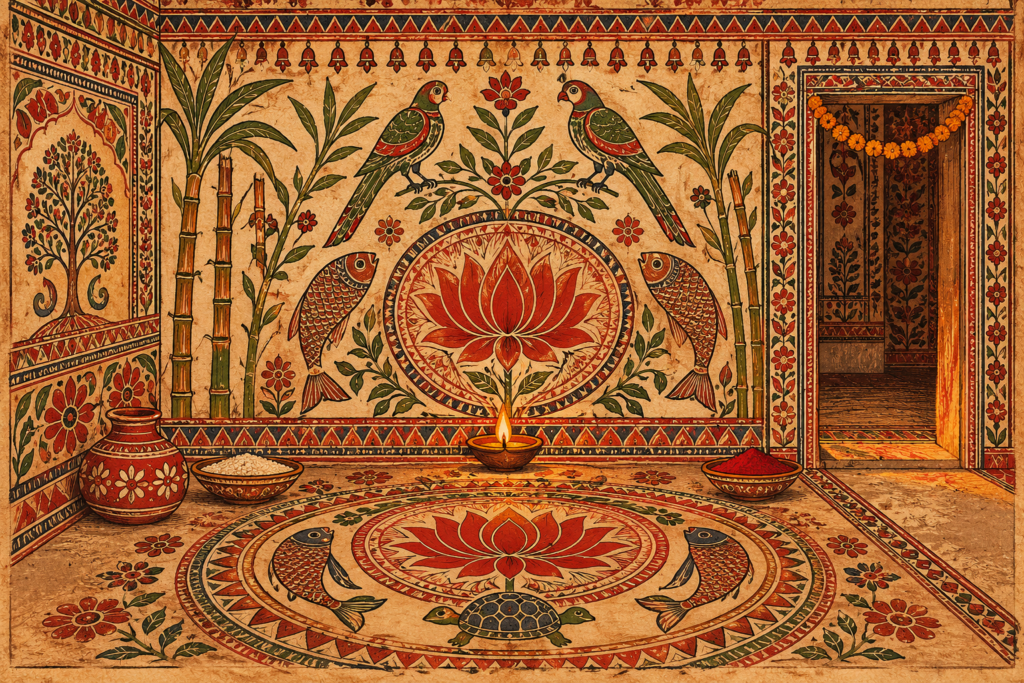
Your description places the sequence inside a maṇḍala. This is a more substantial claim than saying that the room contains auspicious decorations.
A maṇḍala is not simply a circular design. In several Tantric traditions, it is an ordered ritual field: a structured arrangement of space, direction, symbolic presence and prescribed action. Entry into such a field may involve preparation, orientation, invocation and participation.
If the Kohbar sequence is organised in this way, its symbols are not independent ornaments. Their placement, relationship and ritual use form a system. The space becomes meaningful through the interaction of its elements.
The bride’s entry would then have at least two dimensions:
- Physical entry: she crosses the threshold into the room and the bridegroom’s household.
- Ritual entry: she enters an environment whose symbols and expectations have been arranged before her arrival.
The second dimension is central to the proposed interpretation. The bride is not entering an empty space in which the couple will freely create every meaning for themselves. She is entering a prepared order.
The idea that her entry amounts to an agreement to accept the new household’s norms requires careful treatment. Ritual participation may express acceptance of a marriage and willingness to begin a shared life. It cannot, however, establish unlimited or irrevocable consent to every domestic, sexual or intimate expectation. The distinction matters both ethically and analytically.
The question for research is therefore not merely whether the bride enters the maṇḍala, but what she is told about it, what she understands, what she is expected to accept, and what scope she has to interpret or resist its demands.
5. The meeting: from the prepared image to the embodied woman
The account describes a symbolic sequence before the bride’s physical arrival, followed by a meeting in which auspicious interactions take place and the deeper process begins.
This can be interpreted as a movement from representation to embodiment.
Before the bride arrives, the symbolic figure gives the household a way to anticipate her. After she arrives, the actual woman occupies the place that the figure has symbolically prepared. The encounter can thus be understood as a passage between two states:
- the anticipated bride, represented through ritual;
- the embodied bride, who must now negotiate the lived realities of marriage.
The symbolic figure and the actual woman should not be treated as identical. The figure is created by those who prepare the space; the woman has her own memories, desires, fears, expectations and agency.
That distinction is especially important when examining intimacy. A ritual may symbolically prepare a woman for married life, but the lived relationship between two adults develops through communication, trust and consent. A symbolic act cannot substitute for those things.
The Kohbar may therefore be read as a setting where the household’s expectations of the bride and the bridegroom’s expectations of marital intimacy meet the actual person who has entered the room.
6. Sexuality and intimacy: the deeper layer
The sexual dimension is not an incidental addition to the Kohbar. It is central to understanding why the nuptial space carries such a strong ritual significance.
Marriage brings together two people who may have had little or no previous private familiarity. The social institution recognises them as a couple, but their intimate relationship still has to develop. The transition from strangers, or near-strangers, to intimate partners is not instantaneous.
The Bihar Museum’s interpretation of a Kohbar painting explicitly connects the meeting of the newly married couple with the awakening of sexual emotions. Its description notes that the bride and groom may be strangers and that their union is shaped by law, religion and social norms. It also identifies the use of red as carrying associations with passion and sexual energy. This gives a credible cultural basis for discussing sexuality as part of Kohbar symbolism, without needing to claim that every motif encodes a secret Tantric instruction.
The deeper question raised by your account is whether the ritual sequence goes beyond representing fertility or auspicious union. Does it also organise how the bride is expected to understand and inhabit her new sexual identity?
That question can be examined through several possible dimensions:
The body as a site of transition. The bride’s body is no longer understood only through her previous family and social identity. Marriage places it within a new framework of intimacy, reproduction, family continuity and social expectation.
The regulation of intimacy. Sexual life may be surrounded by periods of waiting, restraint, ritual timing and prescribed conduct. These practices can give intimacy a ceremonial structure, but they may also regulate the bride’s access to bodily autonomy.
The formation of a marital identity. The bride is expected to become a wife, but that identity is not simply bestowed by the wedding ceremony. It is negotiated through daily interaction, mutual recognition and the development of a private relationship.
The difference between ritual symbolism and actual consent. A ritual may represent union, readiness or auspiciousness. It cannot establish that a woman has consented to a particular sexual act, or to every expectation imposed upon her.
This article deliberately discusses these matters in restrained language. The restraint is not intended to deny the sexual dimension. It is intended to distinguish a serious examination of intimacy from sensational claims about hidden practices.
7. Symbolic feeding, speech and repeated interaction
One of the most unusual details in your account is that the symbolic image is fed and spoken to before the bride arrives.
These actions deserve to be treated as a sequence rather than as isolated customs.
Feeding can be understood as an act of incorporation: the symbolic figure is treated as someone who is being received, sustained and prepared. Speech can establish a relationship with the figure, address it and assign it a place within the household’s ritual imagination. Repetition can give the process continuity.
In a wider ritual analysis, these actions invite comparison with three dimensions:
- Āhāra — food and nourishment;
- Vāk — speech, utterance and the spoken word;
- Ācāra — conduct, custom and repeated practice.
These Sanskrit terms are useful analytical categories. They should not be presented as the names of specific Kohbar rites unless the actual ritual vocabulary supports that identification.
The important point is that the symbolic figure is reportedly treated as a presence with which the household interacts. The bride’s eventual arrival therefore takes place after a period of symbolic preparation.
This raises a research question: are the acts of feeding and speaking understood by the women who perform them as auspicious gestures, as preparation for the bride, as a form of ritual instruction, or as something else? The answer must come from the practitioners themselves.
8. The period of restraint: a year-long process?
You describe the process as involving an almost year-long period of bandhan or restraint.
This is potentially one of the most important elements of the proposed article, but it needs greater precision before it can be stated as a documented feature of Kohbar practice.
The word bandhan can carry several meanings: binding, attachment, obligation, limitation or a relationship that holds someone within a particular order. In the context of marriage, it may refer to a long period during which the bride gradually adjusts to the household’s expectations and learns the boundaries of her new position.
There are at least three possible dimensions to investigate:
- Social restraint: limits on movement, speech, interaction with particular family members or participation in household decisions.
- Ritual restraint: prescribed periods, observances, abstentions or repeated actions associated with the transition into married life.
- Intimate restraint: expectations concerning sexual conduct, timing, privacy, bodily expression and the gradual establishment of conjugal familiarity.
These dimensions should not be collapsed into one another. A period of ritual observance does not automatically establish a year-long restriction on sexual activity. Nor does a period of domestic adjustment necessarily constitute a formal Tantric discipline.
The article should therefore describe the year-long period as a claim within the particular account under study, not as a universal Mithila custom. The next stage of research must establish what the period begins with, what ends it, who prescribes it, what is restricted, and whether the bride herself recognises it as a ritual period.
If substantiated, this could become a major part of the article: the Kohbar would then be understood not as a single-night event, but as the opening of a longer process of domestic and intimate formation.
9. Is this genuinely Tantric?
The term Tantra must be used with intellectual care.
Tantric traditions in India are diverse. They include systems involving mantra, maṇḍala, yantra, deity visualisation, ritual initiation, the body, subtle physiology and the transformation of ordinary experience. Some traditions include sexual symbolism or ritualised approaches to sexuality; many do not make sexual rites central to their practice.
The presence of fertility symbols, sexual imagery or a sacred marriage chamber is not sufficient by itself to establish that a practice belongs to a Tantric lineage.
Carolyn Henning Brown’s important 1996 study, Contested Meanings: Tantra and the Poetics of Mithila Art, directly warns against interpreting Mithila art as Tantric merely because an observer recognises apparently Tantric motifs. Brown argues for attention to women’s own explanations, the ritual context and the power relations involved in interpreting the art.
That warning is particularly relevant here. If the Kohbar is to be studied as a Tantric system, the argument must rest on the actual sequence of practices, the ritual vocabulary used by practitioners, the arrangement of the space, the role of speech and repeated action, and any identifiable textual or lineage connection.
A useful working framework would examine five dimensions:
| Dimension | Research question |
|---|---|
| Maṇḍala | Is the space ritually ordered, and how is entry understood? |
| Mantra and vāk | Are particular words, songs, invocations or instructions prescribed? |
| Yantra and image | Are the symbols arranged according to a recognised ritual pattern? |
| Śakti and embodiment | How are femininity, sexuality, fertility and bodily identity understood? |
| Dīkṣā and transformation | Is there a recognised initiation, transmission or formal change of ritual status? |
These are questions for investigation, not findings already established.
The strongest formulation at this stage is that the Kohbar sequence described here may contain a Tantric interpretive structure: a prepared ritual field, symbolic representation, embodied participation, regulation of intimacy and a process of transformation. Whether this structure is historically connected to a specific Tantric tradition remains to be demonstrated.
That distinction does not weaken the research. It makes the argument more credible.
10. Sanskrit foundations: the bride entering the new household
The Vedic marriage hymn in the Ṛgveda provides an important textual foundation for understanding the bride’s arrival. It does not describe the Kohbar sequence as given in this account, but it shows that the transition into the bridegroom’s household was already treated as a significant ritual and social passage.
10.1 The bride enters as gṛhapatnī
Ṛgveda 10.85.26
पूषा त्वेतो नयतु हस्तगृह्याश्विना त्वा प्र वहतां रथेन ।
Pūṣā tveto nayatu hastagṛhyāśvinā tvā pra vahatāṃ rathena |
गृहान्गच्छ गृहपत्नी यथासो वशिनी त्वं विदथमा वदासि ॥
Gṛhān gaccha gṛhapatnī yathāso vaśinī tvaṃ vidathamā vadāsi ||
The verse invokes Pūṣan to lead the bride by the hand and the Aśvins to carry her in their chariot. She is addressed as gṛhapatnī — the woman of the household, its mistress or household partner.
The expression is significant. The bride is not described merely as a person being transferred into a new family’s possession. She is addressed through a status within the household.
The verse can therefore serve as a textual counterpoint to any interpretation in which the incoming bride is understood only as someone who must submit to an already established domestic order.
10.2 The new household and the responsibility of married life
Ṛgveda 10.85.27
इह प्रियं प्रजया ते समृद्ध्यतामस्मिन् गृहे गार्हपत्याय जागृहि ।
एना पत्या तन्वं सं सृजस्वाधा जिव्री विदथमा वदाथः ॥
The verse wishes prosperity in the new household and calls upon the bride to become attentive to domestic life. It also invokes the joining of the bride’s person with her husband.
For this research, the important issue is the relationship between household responsibility and personal intimacy. The Vedic verse presents marriage as a joining that takes place within a domestic order. It does not, however, establish that a particular later Kohbar practice is Tantric.
10.3 The bride as samrājñī
Ṛgveda 10.85.46
सम्राज्ञी श्वशुरे भव सम्राज्ञी श्वश्र्वां भव ।
Samrājñī śvaśure bhava, samrājñī śvaśrvāṃ bhava |
ननान्दरि सम्राज्ञी भव सम्राज्ञी अधि देवृषु ॥
Nanāndari samrājñī bhava, samrājñī adhi devṛṣu ||
The bride is addressed as samrājñī — sovereign or queen — in relation to her father-in-law, mother-in-law, husband’s sister and brothers.
This verse deserves a prominent place in the article. If the Kohbar is interpreted as a ritual through which the incoming bride is placed under the authority of the new household, the Vedic expression offers a contrasting ideal: the bride is also imagined as possessing dignity and authority within that household.
This contrast raises an important question: how did the ideal of the bride as samrājñī coexist with the actual distribution of domestic power in later social practice?
10.4 The joining of hearts
Ṛgveda 10.85.47
समञ्जन्तु विश्वे देवाः समापो हृदयानि नौ ।
Sam añjantu viśve devāḥ sam āpo hṛdayāni nau |
सं मातरिश्वा सं धाता समु देष्ट्री दधातु नौ ॥
Saṃ Mātariśvā saṃ Dhātā sam u Deṣṭrī dadhātu nau ||
The verse invokes the gods and cosmic powers to bring the hearts of the couple together.
This is particularly relevant to the distinction between a socially recognised marriage and an intimate relationship that develops through mutual participation. The ritual ideal is not merely that two people occupy the same household, but that their hearts become joined.
10.5 The Gṛhyasūtra tradition
The Gṛhyasūtras also preserve descriptions of the bride’s arrival and entry into the new household. Jayanta Bhattacharya’s historical overview of Hindu rites of passage discusses gṛhapraveśa and the use of verses from Ṛgveda 10.85 in the reception of the bride. The Śāṅkhāyana and Kauśika traditions are among the texts discussed in connection with these rites.
These references establish a historical context for the ritual significance of the bride’s arrival. They do not describe the symbolic preparation of a bride-image or prove a hidden Kohbar initiation system. Those remain questions for separate documentation.
11. The power question: who prepares the bride’s new identity?
The most challenging aspect of the proposed interpretation is the distribution of power.
The women of the bridegroom’s household prepare the space. They select the symbols. They reportedly prepare a representation of the bride before her arrival. They then participate in a sequence through which the actual bride enters the new domestic environment.
This suggests that the Kohbar may be a site where the incoming bride’s identity is anticipated and interpreted by people who already possess authority within the household.
The process may have a double character.
On one side, it may be a form of welcome and preparation. The household creates a sacred environment, invokes auspiciousness and establishes the conditions for a new relationship.
On the other side, the same sequence may communicate expectations that the bride has not herself designed. The symbolic figure may represent not only the woman who is arriving, but also the kind of wife the household expects her to become.
The phrase “an upper hand over the bride” in your account is therefore important. It suggests that the ritual may not be understood only as a blessing. It may also be a mechanism through which domestic authority is communicated and normalised.
But this must be investigated rather than assumed. The women who prepare the Kohbar may understand their actions differently. The bride may experience the same actions as welcome, instruction, pressure, protection or a mixture of these.
A serious study must allow these different interpretations to coexist.
12. The Kohbar as a process rather than a room
The argument emerging from this account is that the Kohbar may need to be studied as a process with several stages:
- Preparation of the ritual environment
The women of the bridegroom’s household organise the space and decide the placement of symbols. - Symbolic anticipation
An image representing the bride is prepared before her arrival and receives ritual attention through feeding, speech and other interactions. - Entry into the prepared space
The bride enters an environment whose meanings have already been organised by the household. - Auspicious interaction
The couple and other participants undertake symbolic actions that mark the beginning of their new relationship. - Domestic and intimate adjustment
The bride gradually encounters the household’s expectations, including those concerning intimacy, conduct and family relationships. - Longer period of restraint or obligation
The account describes an extended period, approaching a year, during which the bride remains subject to particular forms of restraint. The precise rules and their local meaning require verification.
This sequence is the working model of the article. It should not yet be presented as a universally established ritual sequence across Mithila.
13. What makes the Kohbar interpretation distinctive?
The existing scholarship gives us a valuable foundation. The Kohbar is recognised as a nuptial space with fertility symbolism, religious imagery and ritual significance. The 2026 study by Shashi Singh, Fulena Rajak and Anjali Sharma examines the sacred space and ritual paintings in the context of Mithila marriage traditions.
The Bihar Museum’s documentation also recognises the connection between Kohbar imagery, sexuality, fertility, protection and the first meeting of the newly married couple.
But the account developed in this article proposes a further line of investigation:
- The ritual may begin before the physical arrival of the bride.
- The symbolic representation may be actively engaged with, rather than merely displayed.
- The women of the bridegroom’s household may act as organisers of the ritual environment.
- The bride’s entry may be understood as entry into a prepared system of domestic and intimate expectations.
- The process may extend beyond the nuptial encounter into a longer period of adjustment and restraint.
These propositions take the research beyond the conventional interpretation of Kohbar as fertility art or nuptial decoration.
The most important contribution would be to establish whether these elements form a coherent local ritual system, and whether practitioners themselves understand that system through Tantric concepts.
14. Research questions that must be answered before publication
The next stage should not be to add more speculative Tantric terminology. It should be to establish the actual practice in sufficient detail that the interpretation can withstand scholarly scrutiny.
| Area | Evidence required |
|---|---|
| The symbolic bride | What exactly is created? Is it a drawing, an arrangement, an effigy or another representation? |
| Feeding and speech | What food is offered? What words are spoken? Who performs these actions? |
| Maṇḍala | What is its physical form? Is the word maṇḍala used by practitioners, or is it an analytical interpretation? |
| Sexual and intimate preparation | What specific expectations are communicated, and through which ritual or domestic actions? |
| The year-long restraint | What is restricted, when does the period begin, and what event marks its conclusion? |
| Women’s authority | Which women direct the sequence, and how do they explain their role? |
| The bride’s participation | What is explained to her? What does she understand and what choices are available to her? |
| Tantric connection | Are there mantras, yantras, ritual manuals, initiatory lineages or recognised Tantric practitioners associated with the sequence? |
The most valuable primary evidence would be interviews with women who have prepared Kohbar spaces, women who entered such spaces as brides, and people who preserve the ritual knowledge. Their accounts should be recorded separately, with their consent, rather than combined into one supposedly uniform tradition.
It would also be important to establish the precise locality, community and historical period. A practice documented in one Maithil family or village should not automatically be attributed to all Mithila communities.
15. Conclusion: the hidden architecture of married life
The Kohbar may be understood as much more than a decorated chamber in which a newly married couple meets. In the account explored here, it is a prepared ritual environment in which the bride’s anticipated identity is represented before her arrival, engaged with through symbolic actions, and then brought into relation with the woman who physically enters the household.
Its deeper significance may lie in the way it connects space, image, food, speech, sexuality, domestic authority and the formation of intimacy.
The proposed Tantric interpretation asks whether these elements function as parts of an organised ritual process rather than as disconnected symbols. It also asks whether the bride’s entry marks the beginning of a longer period in which her new domestic and intimate identity is shaped.
Yet the central tension cannot be ignored. The ritual may be presented as auspicious preparation for marriage, while also communicating a structure of authority that the incoming bride did not create. The same process may contain welcome and control, protection and restriction, intimacy and hierarchy.
The bride must therefore remain at the centre of the inquiry—not merely as a symbol in a ritual arrangement, but as a person whose own understanding and experience are indispensable to interpreting it.
The deepest question is not simply what the Kohbar symbols mean. It is what happens to the woman who enters the space, what identity has already been prepared for her, and how much of that identity she is able to make her own.
The term Kohbar Tantra can serve as the name of this research inquiry. Its historical status should remain open until the ritual sequence, local terminology and possible Tantric connections have been independently established.
Selected references
- Singh, Shashi, Fulena Rajak and Anjali Sharma. “The Kohbar Ghar: A Study of Sacred Space and Ritualistic Paintings in Mithila Marriage Traditions.” Indian Journal of Traditional Knowledge 25, no. 2 (2026): 190–201. https://doi.org/10.56042/ijtk.v25i2.22384.
- Brown, Carolyn Henning. “Contested Meanings: Tantra and the Poetics of Mithila Art.” American Ethnologist 23, no. 4 (1996): 717–737. https://doi.org/10.1525/ae.1996.23.4.02a00030.
- Bhattacharya, Jayanta. Hindu Rites of Passage: A Historical Overview. 2015. Sections on marriage and gṛhapraveśa. The relevant Gṛhyasūtra references should be checked against critical editions before final publication.
- Bihar Museum. “Kohbar.” Museum collection interpretation of Kohbar imagery and its relationship to Mithila marriage, fertility and sexuality. Bihar Museum.
- Ṛgveda, Maṇḍala 10, Sūkta 85, especially verses 26, 27, 46 and 47.
- Śāṅkhāyana Gṛhyasūtra, marriage and gṛhapraveśa sections.
- Āśvalāyana Gṛhyasūtra, marriage and household-entry sections.