India’s Unfinished Encounter with Tantra: Passive Reverence, Misunderstanding and the Crisis of Cultural Understanding
An independent research reflection by Tatsat Cosmos | Rooted in India. Open to the World.
Editorial note: This is a critical, exploratory essay rather than the report of a completed nationwide survey. It argues that shallow, passive and uncritical engagement with Tantra contributes to cultural misunderstanding. It does not claim that Tantra is one uniform system, that every Indian community misunderstands it, or that a passive approach to Tantra alone causes India’s social or cultural problems.
Introduction: A tradition known by name, but rarely understood in depth
India speaks frequently of its ancient knowledge traditions. Their names appear in public conversations, festivals, popular media, spiritual markets and political arguments. Yet familiarity with a name is not the same as understanding the intellectual world behind it. Tantra is a striking example. It is invoked with confidence, feared with equal confidence, marketed as a technique, dismissed as superstition, or reduced to sensational stories. Much less often is it approached through patient study of its texts, histories, ritual settings, philosophical arguments, lineages and ethical responsibilities.
This gap raises a difficult question: can a civilisation meaningfully preserve a tradition when it remembers its symbols but neglects the disciplines required to understand them? The concern is not that every person must become a Tantric practitioner or scholar. It is that a society which repeatedly speaks about a tradition without developing the ability to examine it carefully becomes vulnerable to distortion—whether that distortion comes from commercial exploitation, inherited prejudice, careless romanticism or uncritical reverence.
The argument of this essay is that India’s engagement with Tantra is often too passive. By “passive” we mean an approach that receives claims without examination, repeats ritual forms without understanding their context, treats secrecy as a substitute for knowledge, or leaves interpretation entirely to self-appointed authorities. This is not a measured claim about every Indian or every community. It is a diagnosis of recurring patterns that deserve closer research.
1. Tantra is not one book, one ritual or one uniform doctrine
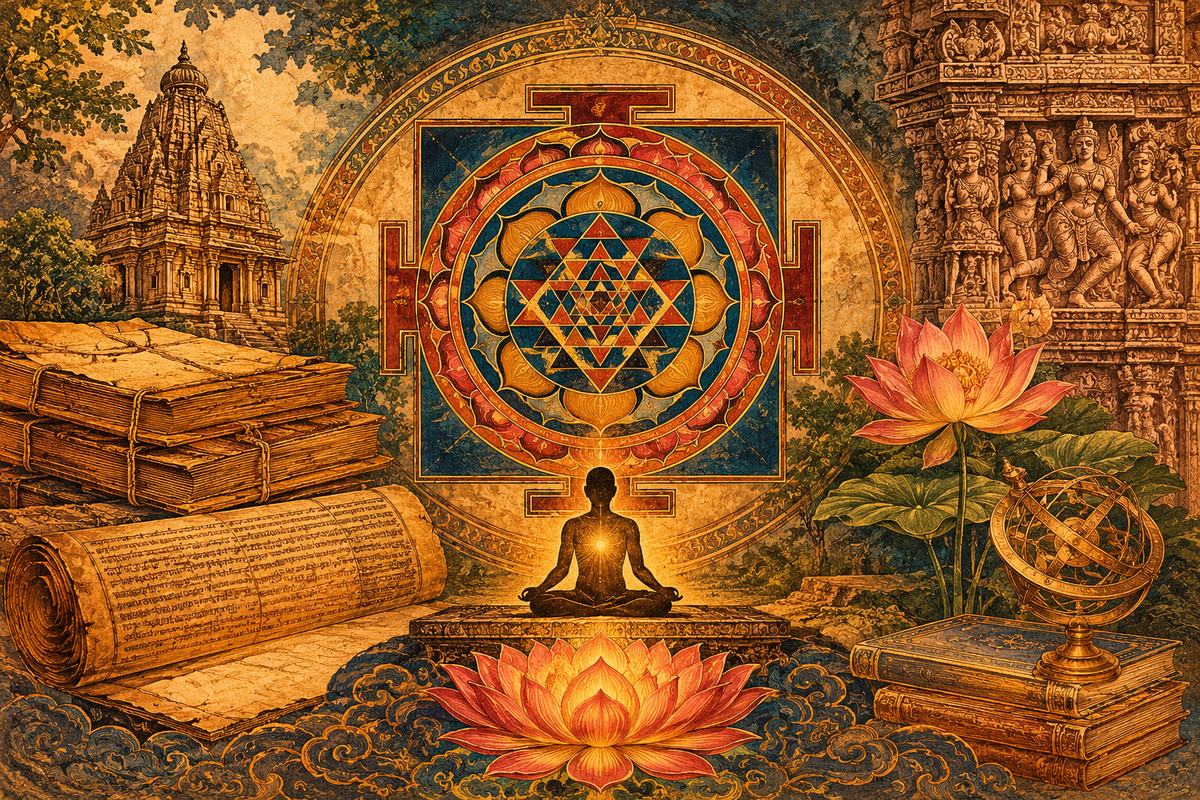
The first responsibility of serious discussion is to avoid treating Tantra as a single, timeless system. The term covers diverse South Asian traditions, texts, ritual technologies, philosophical schools and communities. Hindu and Buddhist Tantric traditions developed in historically identifiable forms across different periods and regions. Their relationships with other religious and intellectual traditions were complex. Their aims and practices were not identical.
Scholar David B. Gray stresses the diversity of Hindu and Buddhist Tantric traditions and the difficulty of defining them with a single formula. Hugh B. Urban describes Tantra as both historically important and persistently misunderstood, caught between hostile portrayals as black magic or moral degeneration and modern popular portrayals centred on sexual liberation. André Padoux’s work likewise shows that Tantra cannot be reduced to its most sensational elements: its histories include ritual, mantra, the body, sacred geography, iconography, mysticism and philosophical reflection.
Therefore, statements such as “Tantra teaches only desire,” “all Tantra is black magic,” “every ancient Indian ritual was Tantric,” or “all Tantric systems teach the same path” are intellectually inadequate. A responsible account must ask: which tradition, which text, which historical period, which region, which community, and which interpretation are being discussed?
2. The damage caused by misunderstanding: rejection at one end, spectacle at the other
Tantra has often been placed between two distortions. One is rejection: it is treated as inherently dangerous, irrational, immoral or marginal, without serious engagement with its texts and histories. The other is spectacle: it is presented as a shortcut to power, secret success, sexual excitement, supernatural control or instant transformation. These positions appear opposite, but both avoid disciplined understanding.
Hugh Urban’s historical analysis shows how modern images of Tantra have been shaped through encounters among Indian traditions, colonial-era interpretations, scholarly representations and contemporary popular culture. Sthaneshwar Timalsina has also examined how Tantra can be appropriated and commodified when its meanings are detached from the communities and contexts in which they developed. These studies do not establish that every contemporary representation is false. They show why representations must be examined rather than accepted at face value.
Commercial exploitation becomes especially troubling when a person is promised guaranteed powers, control over another person, cure of serious illness, wealth through secret rites, or spiritual status in exchange for money and obedience. Such promises should invite scrutiny. No claim of spiritual authority should place a teacher beyond questions about evidence, conduct, accountability and the safety of students.
3. What is meant here by a passive approach?
Passivity does not mean devotion, reverence or participation in ritual. These may be meaningful dimensions of religious life. The problem begins when reverence is used to avoid understanding, when repetition replaces reflection, or when a person is discouraged from asking reasonable questions.
Several patterns deserve attention:
- Ritual without context: symbols, mantras, diagrams and ceremonies are repeated without asking what a particular tradition says they mean, how the practice developed, or what its boundaries are.
- Authority without accountability: a teacher’s claims are treated as unquestionable, even when conduct is exploitative or instructions create risks for students.
- Secrecy without discernment: the fact that some teachings are restricted or transmitted through initiation is misused to make every unsupported claim impossible to question.
- Consumption without study: complex traditions are reduced to purchasable experiences, online formulas, dramatic stories or promises of immediate results.
- Identity without knowledge: Tantra is invoked as proof of cultural greatness or dismissed as a cultural embarrassment, while the actual sources remain unread.
- Fragmentation without dialogue: practitioners, scholars, artists, historians and local communities speak past one another instead of comparing evidence and acknowledging the limits of their knowledge.
These patterns are not unique to Tantra. They can affect any living tradition when inherited forms are preserved without the intellectual and ethical work that gives them meaning.
4. Why passivity matters for cultural identity
Cultural identity is not sustained by slogans alone. It depends on the ability to remember, interpret, question, transmit and renew inherited knowledge. A tradition becomes fragile when its symbols survive but the skills needed to understand them disappear. It can then be defined by outsiders, simplified by markets, weaponised in public arguments, or distorted by people who claim exclusive authority over it.
In this sense, India’s cultural identity faces a serious challenge—not because the country can be declared to be on the verge of collapse on the basis of one subject, but because shallow engagement with its many knowledge traditions can weaken cultural literacy. The claim that Tantra’s neglect has caused “thousands of problems” would require evidence that this essay does not possess. It would also be misleading to suggest that Tantra alone can explain India’s social, educational, political or cultural difficulties.
A more defensible concern is that when a society cannot distinguish historical evidence from legend, philosophical argument from marketing, ritual symbolism from literal instruction, or genuine lineage from invented authority, it becomes easier to manipulate. The loss is not only religious. It is educational and cultural: people lose the capacity to evaluate claims about their own inheritance.
5. The essence of Tantra cannot be reduced to a slogan
It would be a mistake to replace one oversimplification with another by announcing a single universal “essence” of Tantra. Different Tantric traditions articulate different understandings of reality, the body, consciousness, divine power, liberation, ritual, initiation and the relationship between the individual and the cosmos. Some traditions are strongly devotional; others place particular emphasis on ritual technologies, philosophical inquiry, yogic disciplines or forms of contemplative practice. Some are public, while others preserve restricted forms of transmission.
Nevertheless, one can identify a recurring demand that serious study must take seriously: the practitioner is not simply a consumer of extraordinary experiences. In many traditions, practice is embedded in a disciplined framework of preparation, instruction, ritual competence, ethical obligations and a larger account of spiritual purpose. The exact form of that framework varies. It must be established from the relevant sources rather than assumed to be identical everywhere.
Tantra should therefore be approached neither as a magical service nor as a collection of exotic secrets. It calls for historical literacy, linguistic care, philosophical attention, awareness of ritual context and ethical discernment. Where a tradition requires initiation or guidance, that requirement should be understood within its own historical and communal setting—not used as a licence for coercion, financial exploitation or the suppression of legitimate questions.
6. What a more active and responsible engagement could look like
If passive engagement is part of the problem, the answer is not aggressive revivalism or the indiscriminate performance of rituals. The answer is active understanding. A serious cultural programme could begin with a few practical commitments:
- Read sources in context. Study specific Tantric texts, commentaries, inscriptions, art, ritual manuals and oral histories with attention to date, region, language and transmission.
- Distinguish traditions. Do not merge Śaiva, Śākta, Vaiṣṇava, Buddhist, Jain and regional practices into one undifferentiated category.
- Strengthen language and textual skills. Sanskrit, relevant regional languages, manuscript studies and careful translation are essential to responsible interpretation.
- Listen to living communities. Practitioners, hereditary custodians, women, artists and local knowledge-holders should not be treated merely as objects of study. Their accounts should be documented with consent and appropriate attribution.
- Build ethical safeguards. No teacher or researcher should claim a right to another person’s body, money, identity or obedience. Consent, adult agency and protection from exploitation are non-negotiable.
- Separate evidence from interpretation. A textual reference, a community’s oral account, a researcher’s hypothesis and a personal spiritual experience are different kinds of evidence. Each should be labelled honestly.
- Make scholarship accessible. Publish careful translations, annotated bibliographies, public lectures, critical essays and educational material without turning uncertainty into sensational certainty.
7. A research agenda for India
India needs neither blind glorification nor blanket dismissal of Tantra. It needs better questions and better methods. Research should examine how Tantric traditions developed in particular regions; how texts and practices travelled; how temples, sacred landscapes, art and domestic rituals interacted with Tantric ideas; how knowledge was transmitted; and how contemporary communities understand their own practices.
It should also investigate the modern conditions that shape public understanding: school and university curricula, translation practices, publishing, tourism, online spiritual markets, popular entertainment and the influence of colonial-era categories. Such research must be comparative and open to correction. It should not begin with the assumption that every local custom is Tantric, nor with the assumption that Tantric traditions are merely marginal superstition.
For Tatsat Cosmos, this is a call to develop a research culture that is independent, transparent and critical. We should be willing to question our own interpretations, identify gaps in our sources and invite knowledgeable readers to correct us. Cultural confidence without intellectual honesty becomes another form of passivity.
Conclusion: A civilisation must do more than remember
India’s relationship with Tantra reveals a wider challenge in the preservation of knowledge. A tradition can be praised without being studied, feared without being understood, commercialised without being respected, or repeated without being meaningfully transmitted. None of these responses is enough.
The concern, therefore, is not that India will collapse because it has failed to practise Tantra. That would be an unsupported and misleading conclusion. The deeper concern is that a society which becomes passive towards its own intellectual inheritance risks losing the ability to interpret it on its own terms. When knowledge is replaced by slogans, cultural identity becomes vulnerable to both manipulation and forgetfulness.
The way forward is neither blind acceptance nor automatic rejection. It is disciplined inquiry, ethical practice, serious scholarship and open dialogue. Tantra deserves to be studied with the depth its traditions demand—and with the critical freedom that genuine understanding requires.
Selected references and further reading
- Gray, David B. “Tantra and the Tantric Traditions of Hinduism and Buddhism.” Oxford Research Encyclopedia of Religion (2016). https://doi.org/10.1093/acrefore/9780199340378.013.59
- Urban, Hugh B. “Tantra in South Asia.” Oxford Research Encyclopedia of Asian History (2023). https://doi.org/10.1093/acrefore/9780190277727.013.726
- Urban, Hugh B. Tantra: Sex, Secrecy, Politics, and Power in the Study of Religion. University of California Press, 2003. https://doi.org/10.1525/california/9780520230620.001.0001
- Padoux, André. The Hindu Tantric World: An Overview. University of Chicago Press, 2017. https://doi.org/10.7208/chicago/9780226424125.001.0001
- Timalsina, Sthaneshwar. “Encountering the Other: Tantra in the Cross-cultural Context.” Journal of Hindu Studies 4, no. 3 (2011): 274–289. https://doi.org/10.1093/jhs/hir033
- Payne, Richard K., and Glen A. Hayes, eds. The Oxford Handbook of Tantric Studies. Oxford University Press, 2022. https://doi.org/10.1093/oxfordhb/9780197549889.001.0001
Research note: This essay is a critical conceptual discussion based on the selected scholarship above. It is not an empirical survey of public attitudes across India, and it does not claim to establish a direct causal relationship between public misunderstanding of Tantra and specific national crises. Further work should include primary-text study, regional case studies, interviews and specialist review.
Tatsat Cosmos — Rooted in India. Open to the World.