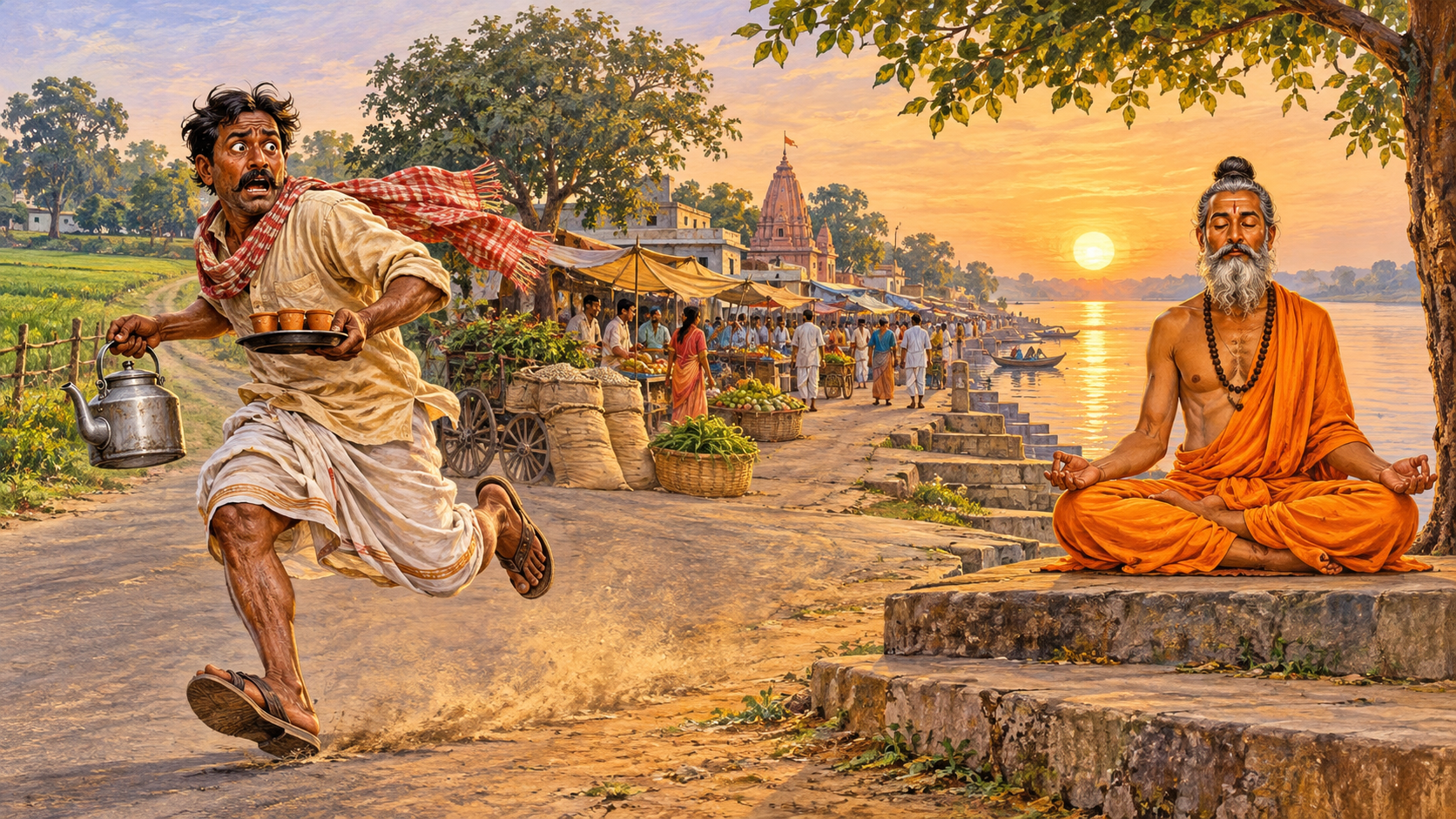
Kab Tak GHAR SE BHAGOGE, CHAIWALE AATE JAATE RAHENGE
Can Chhath Turn Bihar’s Returning Migrants into the Foundation of a New Home Market?
A market-first proposal for bringing purchasing power home, building demand before production, and turning Bihar into a trading gateway for its region.
Every year, Chhath brings home people who live and work across India and beyond. They return to their families, their villages, their ghats and their memories. Then, after the rituals, many board trains and buses and return to the places where their livelihoods are located. The familiar cycle continues: departure, return, celebration, departure again.
What if Bihar began to see this annual return not only as a movement of people, but as an economic opportunity? What if a portion of the purchasing power earned outside Bihar could be attracted into Bihar’s markets—and what if that seasonal market could become the starting point of a much larger economic transformation?
The opportunity is bigger than agriculture
Bihar’s economy should not be described as agriculture alone. The Government of Bihar’s statistical dashboard puts the 2024–25 quick estimate of GSDP at current prices at about ₹9.92 lakh crore. It reports the sectoral shares of gross state value added as approximately 22.37% agriculture, 23.57% industry and 54.07% services. The state therefore already has a substantial services economy, alongside a large agricultural and rural base. The challenge is to deepen production, trade, enterprise and value retention within Bihar.
Migration is part of this economic picture. People who work outside Bihar earn in other labour markets. Their income supports families at home, but much of their everyday consumption naturally takes place near their workplace. During Chhath and other family occasions, a large number return. That creates a recurring window in which Bihar can compete for a greater share of their spending.
The scale of festive mobility is visible in railway operations. Indian Railways reported 12,383 special train trips across its network for the 2025 Chhath period, from 1 October to 30 November. These are train trips—not a count of unique Bihari migrants or Chhath visitors—and they cover a national network. They nevertheless show how substantial and recurring the festive travel demand is.
Phase One: create the market before creating all the supply
The first phase of this proposal is deliberately market-first. Bihar should not wait until every product can be manufactured locally or until local production costs have fallen. It should begin by creating a compelling market for returning families and local consumers.
For a defined introductory period, participating businesses could offer selected goods and services at exceptionally attractive prices—even where that means accepting lower margins or a planned initial loss. This would be a commercial investment in customer acquisition, market expansion and the creation of a new buyer base. Products in this first phase need not all be made in Bihar. They should be sourced reliably, sold transparently and offered at prices that make buying in Bihar attractive.
The purpose is not to ask migrants to make a donation to their home state, nor to impose a compulsory spending rule. It is to give them a practical reason to reserve a portion of their festive purchasing budget for Bihar: better prices, dependable quality, wider choice, convenient markets and the ability to place orders for delivery after they return to their work cities.
Introductory losses must be voluntary, time-bound and financially planned by participating businesses. A pilot should disclose the promotional period, measure the actual cost of discounts, and test whether new customers return. Permanent losses without a route to sustainable business would not be development; they would simply transfer the risk to sellers.
Chhath as the first market pilot
Chhath offers an unusually strong starting point because the festival already brings together families, local markets, agricultural produce, artisans, transport and services. The pilot could begin in selected districts and focus on a planned Chhath Home Market.
- Organised shopping: temporary market zones and a digital catalogue of participating sellers, with clear prices and product information.
- Wide product choice: household goods, clothing, footwear, utensils, gifts, food products, local crafts and essential services—not only ritual items.
- Convenient ordering: advance orders, digital payments, home delivery and shipping to the cities where returning families work.
- Business participation: local retailers, wholesalers, logistics companies, manufacturers and outside brands can participate under transparent terms.
- Customer evidence: record what people buy, what they compare, what they find unavailable, and what they would purchase again.
The first objective is to create buyers, transactions and confidence. It is not to pretend that Bihar can immediately manufacture everything it sells. The market itself should reveal where demand is strong enough to justify new investment.
Phase Two: let demand pull production into Bihar
Once the market has a larger and more predictable base of buyers, the next phase can expand production inside Bihar. Businesses will have real transaction data: which products sell, in what quantities, at what price points, in which districts, and across which seasons. That evidence can make investment in local manufacturing, food processing, packaging, storage and distribution less speculative.
This is where Bihar’s agricultural strengths become an added advantage. Makhana, maize, litchi, dairy, fisheries, fruits, vegetables, grains and traditional foods can support processing and branded products. Bamboo crafts, textiles, household products and other local skills can also enter organised supply chains. Government support can focus on shared infrastructure, quality testing, cold storage, credit access, training, market spaces and logistics—not on trying to become the sole seller.
The direction is from top-down market creation to bottom-up enterprise development. First, organised demand creates a reason to invest. Then local entrepreneurs, producers and workers build the supply capacity to serve that demand. Over time, Bihar-made goods can become more competitive because production, processing and distribution are closer to the market and supported by scale.
Bihar as an agricultural trading gateway
The next opportunity is to look beyond Bihar’s own production. Border districts and strategically located transport corridors could be developed as agricultural collection, wholesale, processing and redistribution hubs for the wider region. Produce from Bihar and neighbouring states could enter these hubs, be aggregated, graded, stored, packaged or processed in Bihar, and then move to markets elsewhere—including, where commercially and legally feasible, cross-border markets in Nepal.
This is not merely a farmers’ market. It is a regional trade-hub strategy. Bihar could attract buyers from neighbouring states and Nepal, while also bringing produce from adjoining regions into its own trading and processing ecosystem. Even when a crop is grown outside Bihar, its aggregation, warehousing, processing, transport, finance and wholesale trade can create economic activity within Bihar.
The ambition should be to make selected border locations among India’s most competitive agricultural trading gateways—not to force farmers to accept the lowest price. Lower costs should come from efficient logistics, reduced wastage, direct links between producers and bulk buyers, transparent price discovery, storage and processing close to supply. Farmers need fair returns; buyers need reliable and competitive prices; local businesses need room to earn sustainable margins.
Such hubs would need careful site selection. Road and rail access, production catchments, existing trade routes, storage, electricity, land, water, market demand and customs or other regulatory requirements for cross-border trade must all be assessed. The pilot should compare locations and commodities before large infrastructure commitments are made.
The money-leakage question: examine it, do not assume it
Bihar should also examine how much economic activity and public revenue it loses when residents purchase goods or services outside the state, and how much value leaves because raw produce is sold without local processing. The state’s prohibition policy belongs in this discussion, but it must be assessed honestly and with evidence.
Bihar’s prohibition began in April 2016. A NITI Aayog and NCAER fiscal brief, drawing on the state’s fiscal analysis and PRS material, records that state excise revenue was ₹3,142 crore in 2015–16 and fell to ₹30 crore in 2016–17, becoming negligible thereafter. This is a documented fiscal change. It does not, by itself, measure how much household purchasing power moved to neighbouring states, how much was redirected to other household needs, or how much entered illegal markets.
Those are separate questions requiring evidence: household expenditure surveys near state borders, enforcement and seizure data, retail price comparisons, transport patterns and interviews with businesses and families. Any assessment must also consider the stated public-health and social objectives of prohibition, alongside enforcement costs and fiscal effects. Economic analysis should not erase those social questions, nor should social objectives make fiscal and market consequences impossible to examine.
A medium-term plan, not a one-season promise
Chhath should be the entry point, not the finish line. The first season can test the market in selected districts. The next two or three years can expand seller participation, repeat purchases, digital ordering and delivery beyond Bihar. The following years can use proven demand to attract local processing, manufacturing, storage and logistics investment. A five-to-ten-year horizon is a planning ambition, not a guaranteed forecast.
The programme should publish a small set of measurable results: total sales to returning visitors; how much value is retained by Bihar-based businesses and producers; the number of local enterprises and workers participating; the share of repeat purchases; the number of products later made or processed in Bihar; and the volume of agricultural trade handled through the selected hubs. It should also report discount costs and business survival, so that promotional losses do not get mistaken for lasting prosperity.
The real question is not whether everyone comes back
Bihar cannot expect every person who has migrated for work to return permanently simply because the state asks them to remember their roots. Nor should a person have to abandon a livelihood elsewhere to participate in Bihar’s future. The first step can be more practical: make Bihar a market worth buying from, a place worth investing in, and a trading gateway worth doing business through.
A returning worker can become a customer. A customer can become a repeat buyer. A trader can become an investor. A farmer can gain access to a larger market. A small business can grow because demand is no longer uncertain. And a person living outside Bihar can remain economically connected to the state without being forced to move back.
The Chhath homecoming gives Bihar an annual meeting between its people and their purchasing power. The task is to turn that meeting into a market—and then let the market create the conditions for production, enterprise and employment.
First create the market. Then expand production in Bihar. And build the trading routes that allow Bihar to serve the region.
Sources and further reading
- Government of Bihar — e-Statistics dashboard (2024–25 quick estimates and sectoral composition).
- NITI Aayog / NCAER — Macro and Fiscal Landscape of Bihar (March 2025; includes historical excise revenue figures and fiscal context).
- Press Information Bureau, Ministry of Railways — Special train trips for Chhath 2025 (26 December 2025).
- Business Standard — Counting the cost of Bihar’s liquor prohibition on state revenue (14 October 2024; analysis of fiscal and social dimensions).

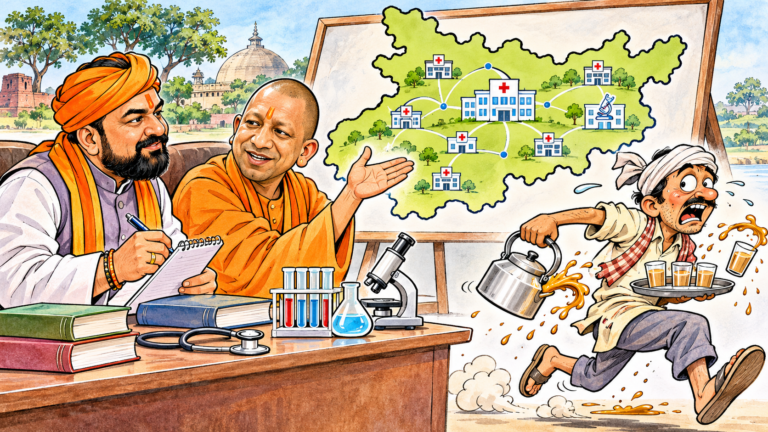



The first step is what creates the path ahead. Your article offers some very valuable suggestions for strengthening Bihar’s economic prospects. However, sometimes it feels as though the government seems more comfortable addressing problems than implementing solutions—perhaps because keeping the demands alive also keeps people’s hopes alive. Meaningful change, however, begins when the first step is taken.