The Great Human Displacement: When Technology Takes Away Not Just Jobs, But the Value of Human Time
An era in which knowledge is no longer enough, experience is no longer a guarantee, and the educated individual must find a new economic identity.

The arrival of an unfamiliar reality
Automation has taken shape at a speed far beyond what most people anticipated. The routine, repetitive and intermediary tasks that once provided livelihoods to millions are increasingly being absorbed by machines, algorithms and artificial intelligence.
For the first time in modern economic history, technological advancement appears to be moving faster than the average individual’s ability to understand, learn and adapt to it.
Earlier technological revolutions offered some breathing space. The arrival of computers, the internet, mobile communication and digital platforms brought disruption, but people had time to familiarise themselves with these changes and develop new occupations around them.
The present AI revolution is different in one critical respect: the technology is not merely providing tools to human beings. It is increasingly performing the very intellectual and administrative tasks for which people were previously employed.
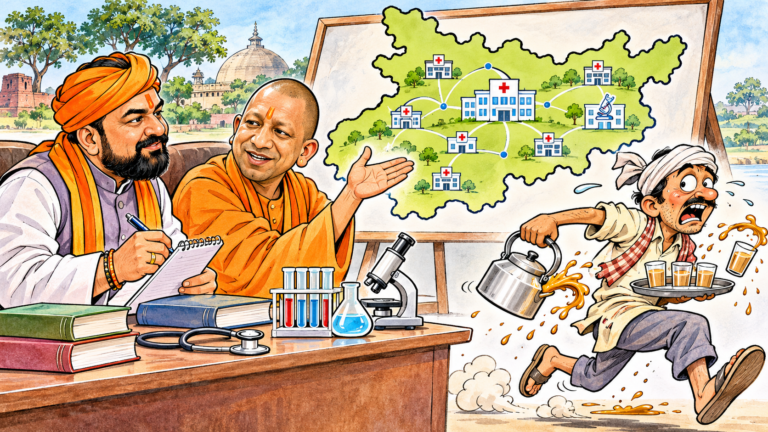
The chai wala was visiting a neighbouring country to prepare an unusually special masala chai when all this happened.
The disappearance of the intermediary
Consider the everyday economic activities around us.
Google Maps has transformed navigation and reduced dependence on traditional information intermediaries. Online grocery platforms have changed product discovery and purchasing. Digital marketing and recommendation algorithms have taken over much of the work previously performed by people who influenced consumer preferences and connected products with buyers.
Now, artificial intelligence is advancing into offices.
Research, documentation, communication, data analysis, reporting, customer support, coordination, preliminary financial assessment and even decision support are increasingly being handled by AI systems.
The people most exposed to this transition are not necessarily those performing physical labour. They also include individuals who spent years developing familiarity with business processes, coordinating teams, managing information and acting as a bridge between physical operations and technical inputs.
Their experience has not necessarily become worthless. But the market’s willingness to pay for that experience is changing.
This is a serious economic challenge for the educated and experienced middle class.
The numbers behind the concern
The scale of this transition is no longer merely a matter of speculation. Research published by the International Monetary Fund in 2025 estimated that around 26% of India’s workforce is in occupations highly exposed to AI, with a smaller share facing greater potential displacement risk. Exposure does not mean that every such job will disappear.
EY India’s 2025 research estimated that 24% of tasks across industries had potential for full automation, while another 42% could require substantially less time through generative AI.
The World Economic Forum’s Future of Jobs Report 2025 projected that 92 million jobs could be displaced globally by 2030, even as 170 million new jobs emerge. These are projections based on employer expectations, not a count of jobs already lost.
These numbers reveal something important: the problem is not simply the disappearance of employment. It is the redistribution of economic value between human labour, technology and capital.
A person who previously required eight working hours to complete a task may now find that a machine completes it in minutes. The question is not only what happens to the task, but also what happens to the remaining hours of that person’s working day and economic life.
The biggest casualty: the value of individual time
Here lies the most important dimension of this transformation.
An individual still technically owns 24 hours a day. AI has not taken away the physical clock, nor has it removed the individual’s right to decide how to spend personal time.
But the economic value of that time is increasingly being influenced by systems that operate at a speed and scale beyond individual competition.
The human being may have more free time, but not necessarily more income, bargaining power or economic independence.
This creates a strange contradiction: technology promises to save human time, while the economic system may simultaneously make that time less valuable in the employment market.
The fastest beneficiaries of this transition are likely to be those who own, control or effectively deploy technology, distribution networks, data and capital.
For the individual who sells knowledge, familiarity, coordination or working hours, the challenge is becoming increasingly difficult.
From communication dependence to algorithmic dependence
The communication revolution connected people. Social media and digital platforms changed how they discovered information, products and services.
AI takes this relationship a step further.
People are now approaching AI for financial planning, income ideas, personal routines, family organisation, education, professional decisions and even the evaluation of their own preferences.
The machine is no longer simply answering questions. It is increasingly influencing the questions people ask, the choices they consider and the decisions they make.
The concern is not that AI has become an independent final decision-maker in every aspect of human life. Rather, people and institutions are increasingly allowing algorithmic recommendations to shape decisions that were once made through personal experience, professional judgement and human interaction.
The convenience is extraordinary. So is the responsibility to remain conscious of who controls these systems, whose interests they serve and how much independent judgement we are willing to surrender.
India cannot stop the revolution
Countries like India cannot realistically stop this technological advancement. Nor should the objective be to stop progress.
India has a large educated population, an expanding digital economy and millions of people whose livelihoods depend on services, administration, information processing and technical assistance.
This makes the transition particularly significant.
The challenge is that the creation of new AI-related opportunities does not automatically guarantee that people displaced from conventional occupations will be able to access them.
A person with 15 years of administrative or operational experience cannot simply become an AI engineer overnight.
Reskilling is important, but reskilling alone may not solve the problem if the number of economically rewarding opportunities does not grow at the same pace as the number of people seeking them.
The future of the educated Indian workforce will therefore depend not only on learning new technology but also on discovering new ways to create economic value.
Entrepreneurship: the opening that remains visible
There is, however, one significant possibility.
If conventional employment becomes increasingly competitive and the value of routine technical assistance declines, individuals may need to move from being participants in established business systems to becoming creators of new business opportunities.
Entrepreneurship could become a major avenue for this transition.
But entrepreneurship in the AI age cannot be understood through the traditional idea of opening a shop, hiring employees and waiting for customers.
It must be built around new forms of discovery, collaboration, trust, distribution and economic participation.
This is where initiatives such as Vyapars.com, an initiative of Tatsat Cosmos, become relevant to the discussion.
The opportunity lies in creating digital spaces where individuals can present ideas, discover business possibilities, connect with other participants and develop economic relationships.
The objective should be to help people become creators of value rather than remain dependent on the limited number of conventional employment opportunities.
However, there is another challenge that cannot be ignored.
Even entrepreneurship is increasingly dependent on digital visibility. A website may provide an opportunity, but it does not automatically guarantee that real people will discover it.
Search engines, recommendation systems, social platforms and AI-driven algorithms increasingly influence what reaches the public and what remains invisible.
Therefore, the next generation of entrepreneurial platforms must solve two problems simultaneously: enabling people to create economic opportunities and helping those opportunities reach genuine human audiences.
The question that every educated individual must now ask
We have entered an age in which qualifications, experience and professional familiarity may no longer guarantee economic security.
The old understanding was simple: acquire education, develop expertise, secure employment, gain experience and gradually improve your financial position.
That understanding is now under pressure.
The new challenge is to develop the ability to create something that has economic value beyond the performance of a task that a machine can replicate.
It may be a business, a community, a product, a service, a trusted network or a platform that connects people and opportunities.
AI may become the most powerful tool ever created for human productivity. But its benefits will not automatically be distributed equally.
The real dividing line may eventually be between those who own or control productive systems and those who merely depend on them.
Welcome to the age of intelligent machines, accelerated capitalism and the search for a new human economic identity.
The question is no longer whether AI will change our working lives.
The question is whether individuals will find a way to participate in the new economy before the old economy stops offering them a meaningful place.
Perhaps the next great opportunity will not belong to those who know the most, but to those who learn how to create, connect and build in a world where knowledge itself is becoming increasingly accessible to machines.
Tatsat Cosmos | GOSSIP
An observation on technology, society, business and the changing realities of human life.